A Snapshot of Modern Life: Léger’s ‘Breakfast’
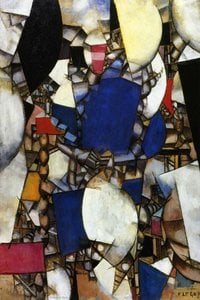
Fernand Léger's “The Breakfast,” painted in 1921, isn’t merely a depiction of a simple meal; it’s a bold declaration of Cubist principles and an ambitious attempt to translate the burgeoning dynamism of industrial society onto canvas. Created during a period marked by rapid technological advancement – the rise of automobiles, factories, and urban sprawl – Léger sought to capture this transformative era not through idealized landscapes or portraits, but through fractured geometric forms that mirrored the fragmented experience of modern existence. The painting’s stark black and white palette amplifies its impact, stripping away superfluous detail to focus on essential shapes and textures.
Cubist Innovation: Deconstructing Reality
Léger's stylistic approach firmly establishes him within the influential Cubist movement spearheaded by Pablo Picasso and Georges Braque. Unlike Impressionists who prioritized capturing fleeting moments of light and color, Cubists rejected illusionistic representation altogether. Instead, they dissected objects into multiple perspectives simultaneously, presenting them as interlocking planes that challenge conventional notions of space and form. In “The Breakfast,” this is evident in the elongated head of the figure—a deliberate distortion designed to convey movement and instability—and the fragmented arrangement of the table’s elements. These geometric shapes aren't simply decorative; they embody the underlying structure of reality itself, as perceived through the lens of industrial progress.
Technique and Texture: Pointillism Revisited
While primarily categorized as Cubist, Léger subtly incorporates techniques reminiscent of Neo-Impressionism—specifically Pointillism—to achieve a remarkable textural effect. Rather than blending pigments to create smooth gradations, Léger meticulously applied tiny dots of color – predominantly white and ochre – onto the canvas. This method maximizes luminosity and creates an illusion of shimmering surface texture that mimics the light reflecting off metal surfaces prevalent in the period. The artist’s painstaking attention to detail underscores his commitment to conveying both visual accuracy and emotional resonance.
Symbolism Beyond Representation
Beyond its formal innovations, “The Breakfast” carries symbolic weight. The table itself represents stability amidst chaos—a grounding element against which the fragmented figure asserts its presence. The bottle symbolizes nourishment and vitality, mirroring Léger’s fascination with the human body as a machine capable of adapting to new environments. Furthermore, the vase adds an element of organic beauty – a counterpoint to the dominant geometric forms – suggesting that even in the industrialized world, there remains space for contemplation and appreciation of nature.
Emotional Resonance: Capturing the Spirit of an Age
Ultimately, Léger’s “Breakfast” succeeds in conveying the emotional core of its time—a sense of optimism tempered by apprehension about the future. The painting isn't sentimental; it doesn’t strive to evoke nostalgia for a bygone era. Instead, it confronts viewers with a deliberately unsettling image that compels them to consider how humanity navigates change and embraces new possibilities. It remains a powerful testament to Léger’s artistic vision and his enduring legacy as one of the pioneers of modern art.
问答详情
在 1921 年创作“Breakfast”时,费尔南·莱热 的年龄是多少?
当"Breakfast"于1921创作时,出生于1881的费尔南·莱热正值40岁。
"Breakfast" 的艺术家是谁?
《Breakfast》被归为费尔南·莱热的作品。
是否有关于 费尔南·莱热 的《Breakfast》 的指南?
针对 费尔南·莱热 的《Breakfast》,我们提供了一个 指南 页面:这是一份可打印的艺术品资料页,专为学生及课堂教学使用而设计。
费尔南·莱热 的《Breakfast》 是在何时创作的?
费尔南·莱热 的《Breakfast》创作于1921年。
如何发现与 费尔南·莱热 的《Breakfast》 风格相近的艺术品?
与 费尔南·莱热 的《Breakfast》 相似的作品已汇集在作品的 相似作品 页面中。
费尔南·莱热 的作品《Breakfast》知名度如何?
费尔南·莱热 的《Breakfast》 的记录热度为 Recognized。
哪里可以买到费尔南·莱热 的《Breakfast》的手绘复制品?
费尔南·莱热 的《Breakfast》 的手绘复制品可在 本网站 购买:亚麻画布手工绘制油画复制品,请通过 本页 进行订购。