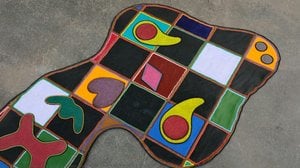
购买高分辨率增强版数字图像,其品质远超在线预览。
每一份文件都由我们的内部专家使用先进工具与专业的后期润色技术精心打造。我们确保每一张图像都具备卓越的清晰度、精准的色彩还原度以及细腻的细节表现。
最终文件将在 72 小时内通过电子邮件交付,并针对专业、编辑及印刷用途进行了优化。其品质与顶级设计工作室、出版社和画廊所信赖的标准完全一致。
下载高分辨率文件,用于个人展示、打印及创意项目。 ( 切换至版画销售渠道 订购此收藏品的纯手工复刻画作)
选择 WahooArt.com,您获得的不仅仅是一张图像——您收到的是经过专业级增强、精雕细琢的数字艺术作品,并享有满意保证。以下是您的订单中自动包含的所有内容:

您的高分辨率数字图像文件将在下单后 72 小时内通过电子邮件发送给您 —— 即可立即使用。

您的艺术品经过专业优化,结合先进的 AI 技术与人工修饰,确保呈现极致的细节、清晰度与色彩准确度。

不小心删除了文件或找不到了?没关系——我们将随时为您免费重发。

即刻拥有您的艺术作品,无需支付任何关税、税费或运费——数字下载始终免税。

我们通过专业工具与色彩管理技术,确保您的数字图像尽可能真实地还原原作色彩。

如果您对所购数字图像不满意,我们将在100天内为您进行修改或提供100%的全额退款——无需任何理由。

不满意?在收到数字文件后的100天内,您可以申请全额退款——无需任何理由。

购买 3 张享 10% 折扣 - 购买 5 张享 15% 折扣 - 购买 10 张以上享 20% 折扣。非常适合创意项目、画廊及机构使用。
Elyn Zimmerman, born in Philadelphia, Pennsylvania, on December 16, 1945, embarked on a journey that would establish her as a pivotal figure in the landscape of American sculpture. Her formative years unfolded against the backdrop of Los Angeles, a city undergoing a radical artistic transformation during the 1960s. This environment proved crucial to Zimmerman’s development, fostering an openness to experimentation and a fascination with perceptual phenomena. She pursued a B.A. in psychology at UCLA, a choice that would subtly yet profoundly inform her later work—a deep understanding of how viewers experience space and form. While immersed in the fine arts program, she began working alongside pioneering artists like Jim Turrell and Robert Irwin on their groundbreaking Art & Technology exhibition at LACMA in 1967.
Zimmerman’s academic pursuits continued with an MFA in painting and photography at UCLA, where she benefited from the mentorship of influential figures such as Richard Diebenkorn and Robert Heineken. This period was marked by a burgeoning interest in Light and Space Art—a movement characterized by its exploration of sensory experience through materials like glass, fluorescent light, and cast acrylic. The ethos of this movement resonated deeply with Zimmerman, shaping her commitment to creating art that engaged directly with the viewer’s perception.
Following graduation in 1972, Zimmerman began teaching at California State University, Humboldt, and later Mills College in Oakland. These positions provided a platform for experimentation, allowing her to refine principles that would become hallmarks of her artistic practice: an emphasis on form, space, and the integration of natural elements. The mid-1970s witnessed the creation of temporary installations—works designed specifically for museum and gallery contexts—at institutions like the Berkeley Art Museum, the Museum of Modern Art PS1, and the Chicago Museum of Contemporary Art. These early projects were crucial in establishing Zimmerman’s reputation and honing her skills.
A pivotal moment arrived in 1976 with a National Endowment for the Arts Fellowship that enabled Zimmerman to travel to India. This journey proved transformative, igniting a profound fascination with sacred and historic sites—particularly those at Ellora and Ajanta. Inspired by these archeological wonders, she resolved to create meaningful public spaces through a synthesis of sculpture, architecture, and landscape design. This marked a shift towards large-scale, site-specific installations that would define her career.
The 1980s saw Zimmerman’s artistic vision fully coalesce with the creation of permanent sculpture works ranging from intimate studio pieces to monumental public commissions. A defining characteristic of these projects is their masterful use of stone—particularly granite—coupled with the ethereal qualities of water and landscape elements. She developed a long-standing relationship with a quarry in Cold Spring, Minnesota, allowing her to work directly with the material and explore its inherent possibilities.
Her first major commission, *MARABAR* (1984) for the National Geographic headquarters in Washington, D.C., stands as a testament to this evolving aesthetic. Named after the fictional caves in E.M. Forster’s *A Passage to India*, the sculpture consists of a rectangular reflecting pool surrounded by granite boulders—three polished to mirror their surroundings and two left in their natural state. The work evokes a sense of timelessness, seamlessly blending the tangible with the illusionary.
Throughout her career, Zimmerman has completed over forty major site-specific installations worldwide, each imbued with her principle of creating “places, not things.” Her projects—which include memorials, sculpture gardens, and urban oases—are deeply experiential, connecting the present to the archaic past. Notable commissions include a fountain commemorating the 1993 World Trade Center bombing in New York City, and designs for the Birmingham Museum of Art in Alabama and AT&T headquarters in New Jersey.
Zimmerman’s contributions have been widely recognized within the art world. In 2016, she received the prestigious Isamu Noguchi Award—an honor shared with Tadao Ando—acknowledging her profound impact on contemporary sculpture and environmental art. Her work continues to inspire artists and designers alike, demonstrating the enduring power of site-specific interventions that engage with both the physical landscape and the human psyche.

1945 - , United States of America


 实景预览
实景预览
 发送
发送 分享
分享
 详情
详情 指南
指南

 下载图片
下载图片
 相似作品
相似作品 X射线
X射线 幻灯片播放
幻灯片播放 统计数据
统计数据

 阅读全文
阅读全文