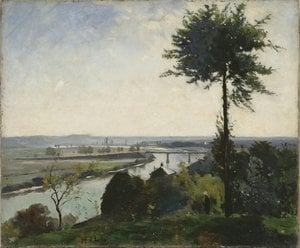
博物馆级艺术微喷或帆布版画,制作高效,并提供多种饰面选择。 ( 购买手绘画作 切换至数字图像销售渠道)





























从与原作比例一致的预设尺寸中进行选择。

您可以输入自定义尺寸,以适配特定的画框或空间。如果您选择的尺寸与原图比例不符,我们将对作品进行裁剪,或通过镜像填充/纯色填充边缘的方式来扩展图像。在开始制作之前,我们会向您发送一份数字效果图供您确认。
请注意,屏幕上的预览并不能反映实际的裁剪或扩展效果。只有效果图才能准确展示最终的构图。
虽然我们提供定制尺寸,但为了保持原图比例,我们建议您从预设列表中选择尺寸。

Landscape
复制品尺寸
In this evocative landscape from 1932, the viewer is invited into a moment of profound stillness, where the rhythmic flow of a river meets the quiet contemplation of human presence. The painting captures a scene of pastoral grace, centered around a tranquil waterway dotted with boats that seem to drift effortlessly through the composition. A solitary figure stands near the water's edge, acting as a silent witness to the beauty of the natural world. This man, perhaps lost in thought or simply absorbing the gentle movement of the current, serves as an emotional anchor for the piece, inviting us to share in his meditative state. The presence of other figures and a loyal dog wandering nearby adds a layer of lived-in warmth to the scene, suggesting that while nature is vast and enduring, it is also a place of shared peace and companionship.
The brushwork and technique reflect the masterful hand of Eliseu Meifrèn i Roig, a titan of Spanish Impressionism. The artist employs a delicate touch to capture the interplay of light and water, using soft, blended strokes that evoke the shimmering surface of the river. There is a palpable sense of atmosphere here; the air feels heavy with the quietude of a summer afternoon. Through his command of color, Meifr'n creates a harmonious palette that blends the earthy tones of the riverbank with the luminous reflections of the sky upon the water. This Impressionistic approach does not merely document a location but rather captures the sensory experience of being present in that specific moment, making the landscape feel alive and breathing.
To understand this work is to understand the spirit of late Spanish Impressionism. Meifrèn i Roig, born in Barcelona, was a painter who breathed the air of Paris and the salt spray of the Mediterranean. His ability to translate the light of Italy, the Canary Islands, and Mallorca onto canvas allowed him to create landscapes that feel both geographically specific and universally timeless. This particular piece, dating from 1932, showcases his mature style—a period where his academic foundations merged seamlessly with a liberated, emotive use of light. The painting stands as a testament to an era when artists sought to find the sublime within the everyday, turning a simple riverbank into a stage for spiritual reflection.
For the discerning collector or interior designer, this reproduction offers more than just visual beauty; it provides a focal point of tranquility. The composition’s balance between the expansive sky and the grounded elements of the shore makes it an ideal addition to spaces designed for relaxation and thought. Whether placed in a sunlit study or a sophisticated living area, the painting brings a sense of historical depth and organic calm. It is a piece that does not demand attention through loud colors, but rather earns it through a subtle, enduring elegance that complements both classical and contemporary decor.

In the golden twilight of the nineteenth century, a transformative energy swept through the European art world, breaking the rigid shackles of academic tradition to embrace the fleeting beauty of light and atmosphere. At the heart of this movement in Catalonia stood Eliseu Meifrèn i Roig, an artist whose brush captured the very soul of the Mediterranean landscape. Born in Barcelona in 1857, Meifrèn’s journey was one of profound metamorphosis. Though he initially pursued a path in medicine, following the footsteps of his father, the irresistible call of the canvas led him to abandon science for the vibrant possibilities of art. This early decision would eventually allow him to become a titan of Spanish Impressionism, a painter capable of translating the salt spray of the sea and the warmth of the sun into enduring visual poetry.
Meifrèn’s artistic foundation was laid at the Escola de la Llotja in Barcelona, where he studied under the esteemed masters Antoni Cabà and Ramón Martí Alsina. This academic grounding provided him with a rigorous understanding of anatomy, perspective, and color, yet his spirit yearned for something more ephemeral. In 1879, the allure of Paris drew him to the heart of the burgeoning Impressionist movement. During these formative Parisian years, he lived the life of a dedicated bohemian, supporting his studies by selling small canvases and sketches of urban cityscapes. This immersion in the vibrant French art scene profoundly reshaped his sensibilities, teaching him to observe the subtle shifts in light and the rhythmic pulse of modern life.
The evolution of Meifrèn’s style was further catalyzed by his travels, most notably a brief but transformative excursion to Italy. This sojourn introduced him to new palettes and compositional approaches that would become hallmarks of his mature work. Upon returning to Spain, he began to refine his ability to capture fleeting moments of beauty—the shimmering surface of a river, the hazy horizon of a coastal vista, or the soft glow of twilight over a harbor. His debut exhibition at Sala Parés in Barcelona in 1890 was a landmark achievement, showcasing seventy oil paintings that garnered immense acclaim and caught the attention of influential figures like Santiago Rusiñol.
His repertoire became a celebrated collection of Mediterranean wonders, characterized by a deep emotional connection to his subjects. Meifrèn’s work often focused on:
What distinguishes a Meifrèn masterpiece is his masterful command of Impressionistic technique. He employed a delicate touch to capture the interplay of light and water, using soft, blended strokes that evoke the luminous reflections of the sky upon a moving current. There is a palpable sense of atmosphere in his paintings; the air often feels heavy with the quietude of a summer afternoon or the salt-laden breeze of a Mediterranean evening. Through a harmonious palette of earthy tones and brilliant highlights, he did not merely document a location but rather captured the sensory experience of being present within it.
As a pivotal figure in Catalan art, Meifrèn i Roig bridged the gap between traditional academicism and the revolutionary spirit of modernism. His ability to infuse landscapes with both documentary value and poetic emotion ensured his place in the canon of Spanish Impressionism. Even as he moved through different stages of his life—from the student of medicine to the celebrated painter of the Mediterranean—his dedication to capturing the ephemeral beauty of the natural world remained constant, leaving behind a radiant legacy that continues to inspire awe in all who behold it.

1857 - 1940 , Spain

Explore the rich history of rivers in painting! Discover masterpieces from ancient times to Impressionism & beyond. Learn about symbolism, artists like Monet & Daubigny, and find your perfect serene artwork at WahooArt.

Explore the rich history of landscape art with WahooArt. Discover renowned artists, movements like Impressionism & Romanticism, and expert guidance for collecting timeless pieces. Find your perfect serene escape today!

Explore the rich history of landscape art with WahooArt. Discover renowned artists, movements like Impressionism & tonalism, and expert guidance for collecting timeless pieces. Find your perfect serene escape today!
Explore the history of serene landscape art & discover artists who evoke tranquility. Find the perfect calming artwork for your home with expert guidance from WahooArt.

探索康斯塔布尔的25幅传世杰作!沉浸于英国田园风光,感受浪漫主义绘画大师的光影与色彩。高清油画复制、艺术品购买尽在WahooArt.com,为您的家居增添经典之美。立即在线探索完整系列!


 效果预览
效果预览
 分享
分享 分享
分享
 详情
详情

 下载
下载
 相似作品
相似作品 X射线
X射线 幻灯片播放
幻灯片播放 统计数据
统计数据


 展开详情
展开详情









 玻璃选项仅适用于110厘米以下的尺寸。


![Spanish Landscape, Toledo [paisaije Español, Toledo] — 迭戈·里维拉, Cubism](/media/artworks/images-thumb/67/22/67223cfb67a3e879b8599832c8849094.jpg)