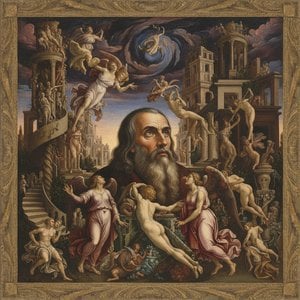
A Vision of Faith Illuminated: Exploring El Greco’s High Altar
The painting “High Altar,” completed in 1577 by Domenikos Theotokópoulos, known universally as El Greco, stands as a testament to the artist's singular ability to fuse Byzantine tradition with Renaissance fervor. More than just a depiction of religious iconography—it’s an immersive experience designed to evoke contemplation and reverence within its viewer. Located in Toledo Cathedral, Spain, this monumental artwork embodies the spiritual anxieties and artistic breakthroughs characteristic of the late Mannerist period.
- Subject Matter & Composition: At its core lies a dramatic portrayal of Christ crucified, dominating the central panel with an arresting gaze that commands attention. Surrounding him are depictions of saints—Saint Mary Magdalene and Saint John the Evangelist—each rendered in meticulous detail, reflecting El Greco’s unwavering commitment to portraying biblical figures with palpable emotion. The overall composition is deliberately unsettling; figures are elongated, distorted, and positioned off-center, mirroring a stylistic trend that prioritized psychological intensity over realistic representation.
- Style & Technique: El Greco's distinctive style—often termed Mannerism—is instantly recognizable. He eschewed the smooth surfaces and idealized forms favored by earlier Renaissance artists, opting instead for thick impasto brushstrokes that create a textured surface brimming with luminosity. This technique lends an ethereal quality to the painting, enhancing the dramatic impact of the scene. The artist’s use of color is equally striking—deep reds, blues, and golds dominate the palette, conveying both solemnity and grandeur.
Historical Context: Toledo Cathedral and the Renaissance Spirit
Toledo Cathedral represents a pivotal moment in European art history. Constructed over centuries, it exemplifies the ambition of the Spanish Habsburg monarchy to assert religious dominance following the Reconquista—the Christian reconquest of Iberia from Muslim rule. El Greco’s commission coincided with this period of fervent piety and artistic experimentation. The cathedral's architectural grandeur served as inspiration for artists like El Greco, who sought to convey spiritual truths through emotionally charged imagery. Furthermore, the painting reflects broader humanist concerns about mortality and divine grace—themes prevalent in Renaissance thought.
- Symbolism: Each element within “High Altar” carries significant symbolic weight. The crucifix itself represents Christ’s sacrifice for humanity's salvation, while the saints embody virtues such as compassion and faith. The candles flanking the altar symbolize divine illumination and prayer—a visual reminder of the spiritual quest at the heart of Christian belief. The statue of Jesus atop the dome reinforces the cathedral’s central role as a symbol of Christendom.
Emotional Impact & Legacy
“High Altar” transcends mere representation; it aspires to elicit an emotional response from the viewer. El Greco's masterful manipulation of perspective and color creates a palpable sense of drama, drawing the eye inward toward the crucified Christ. The painting’s unsettling distortions serve not merely as stylistic devices but also as conduits for conveying profound psychological states—fear, sorrow, and acceptance. Its enduring influence can be seen in subsequent artistic movements, foreshadowing Expressionism's preoccupation with emotional authenticity and informing explorations of distorted forms. Today, reproductions of “High Altar” continue to captivate audiences worldwide, offering a glimpse into the visionary spirit of El Greco and the transformative power of art.
问答详情
“High Altar”是如何融入 埃尔·格列柯 的主题与风格之中的?
在埃尔·格列柯的作品集中,"High Altar" 呈现出Spanish Mannerism风格,并贯穿着byzantine tradition, venetian style, catholic faith, toledo patronage, spiritual expression的主题。
埃尔·格列柯 的《High Altar》 使用的是强烈的对比,还是柔和的和谐?
埃尔·格列柯 的《High Altar》 的色彩构成将 Bold 的对比与 Balanced Harmony 的和谐融为一体。
埃尔·格列柯 的《High Altar》 的版权情况是如何界定的?
埃尔·格列柯 的《High Altar》 已进入 属于公有领域 —— 其版权已过期。版权保护期自艺术家逝世之日起计算,该艺术家于 1614 年逝世。