博物馆级艺术微喷或帆布版画,制作高效,并提供多种饰面选择。 ( 订购纯手工绘制画作 切换至数字图像销售渠道)
您可以从与原作比例一致的预设尺寸中进行选择。

请输入您所需的宽度和高度,以适配您的画框或墙面。由于印刷品只能进行裁剪,无法超出原图尺寸,因此若比例不一致,画面的一部分将会被裁切。在正式印刷之前,我们会为您发送一份数字效果图供您确认。本页面显示的图片并非最终裁剪后的效果——只有效果图才能展示真实的裁剪情况。
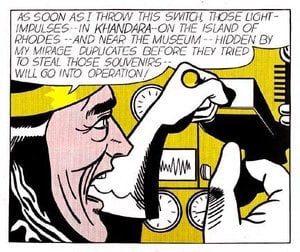
Mad scientist
复刻品尺寸
Edward Ruscha, a pivotal figure in the Pop Art movement, presents "Mad Scientist," a vibrant and intriguing work that encapsulates his signature style. Born in Omaha, Nebraska, Ruscha's artistic journey led him to Los Angeles where he honed his skills at the Chouinard Art Institute (now California Institute of the Arts). His exploration of American landscapes, typography, and vernacular language has cemented his place as an influential artist.
"Mad Scientist" depicts a man seemingly immersed in scientific experimentation. The central figure, clad in a lab coat, playfully sports a beaker atop his head – a whimsical touch that immediately establishes the painting's quirky and unconventional nature. He is surrounded by an array of scientific paraphernalia: microscopes, test tubes, hinting at a chaotic yet fascinating laboratory setting. Ruscha’s composition isn’t about meticulous realism; instead, it prioritizes visual impact and a sense of playful absurdity.
The painting firmly aligns with Pop Art principles. Ruscha employs bold colors—predominantly orange, blue, green, and yellow—to create a visually striking composition. The background features a colorful gradient that enhances the overall vibrancy and contributes to the piece's energetic atmosphere. Ruscha’s technique is characterized by its flatness and lack of traditional perspective, further emphasizing the Pop Art aesthetic which rejected academic artistic conventions in favor of imagery drawn from popular culture.
Emerging in the 1960s, Pop Art challenged the dominance of Abstract Expressionism. Artists like Ruscha sought to incorporate everyday objects and commercial imagery into their work, reflecting a shift towards consumerism and mass media. "Mad Scientist" can be interpreted as a commentary on the burgeoning scientific advancements of the era, perhaps with a touch of satirical humor regarding the perceived eccentricities often associated with scientists. The “mad” descriptor suggests a departure from conventional norms, embracing experimentation and unconventional thinking.
"Mad Scientist" evokes a sense of playful chaos and quirky fascination. The vibrant colors and unusual imagery create an engaging visual experience that is both humorous and thought-provoking. The painting’s appeal lies in its ability to blend the familiar (the lab coat, scientific equipment) with the unexpected (the beaker as a hat), resulting in a work that is instantly memorable and endlessly intriguing. It's a piece that sparks curiosity and invites viewers to embrace the unconventional.
"Mad scientist" 的描绘主题为 mad scientist, pop art, laboratory, science, chaos, colorful, ruscha, equipment。
鲁斯查 (Lǔsīchā) 的《Mad scientist》 的 相似作品 页面展示了相关艺术作品。
您可以在 高分辨率数字图像 页面直接购买 “Mad scientist” 的 高分辨率数字图像下载。

1937年12月16日出生于内布拉斯加州奥马哈市的爱德华·约瑟夫·鲁沙四世,在一个罗马天主教家庭中长大。他从小就对艺术表现出浓厚的兴趣,尤其擅长漫画创作,这得益于母亲的支持和鼓励。1956年,鲁沙搬到洛杉矶,并在1956年至1960年在Chouinard艺术学院(现加州艺术学院)学习,师从罗伯特·欧文和爱默生·沃尔弗。在Chouinard期间,他与罗伯特·欧文合作编辑了《Orb》杂志,这可以看作是另类报纸的前身。
鲁沙的艺术之旅始于20世纪60年代初,使他与洛杉矶Ferus画廊团体结盟。他的创作受到众多艺术家影响,包括贾斯珀·约翰斯、约翰·麦克劳林、H.C.韦斯特曼、亚瑟·多夫、阿尔文·拉斯蒂格和马塞尔·杜尚。爱德华·霍珀的作品,特别是他的画作《加油站》(1940),也与鲁沙不断发展的风格产生了共鸣。他早期的作品探索了商业主义的视觉语言和日常美国生活的风貌。
鲁沙以其将文字和短语融入绘画而闻名,通常以一种平淡、冷静的美学呈现。他经常描绘普通的题材,如加油站、汽车旅馆和南加州的风景。他的摄影书籍,例如《日落大道上的每一栋建筑》(1966),是他概念性艺术方法的标志性例子。鲁沙作品的关键主题是探索口语语言和洛杉矶的视觉文化。
鲁沙被认为是波普艺术运动中的关键人物,尽管他的风格常常超越简单的分类。他对当代艺术家产生了影响,这些艺术家们致力于使用语言、摄影和概念艺术进行创作。他帮助确立了洛杉矶在20世纪60年代作为重要的艺术创新中心地位。鲁沙继续生活和工作在加利福尼亚州卡尔弗城,仍然是艺术界一个活跃而有影响力的人物。

1937 - , 美国

探索抽象表现主义的十幅经典杰作!波洛克、罗斯科等大师作品,揭秘艺术史上的重要瞬间。WahooArt.com为您呈现高品质艺术品复制和精选家居装饰方案,感受现代艺术的力量与魅力。立即浏览全系列!

探索几何抽象艺术的十大杰作!康定斯基、蒙德里安等大师作品,色彩构成与非具象之美。WahooArt.com提供博物馆级艺术复制品,为您的家居带来现代艺术灵感。立即在线探索完整系列!

Journey through Wassily Kandinsky's 25 most iconic abstract paintings. Explore his revolutionary use of color, form & spiritual expressionism. Find museum-quality Kandinsky reproductions and elevate your home decor with WahooArt.com. Discover all masterpieces on WahooArt.com!
Master the high-impact world of contemporary abstraction. Discover how bold colors, textures, and modern movements like Abstract Expressionism can transform your space with premium, high-energy art curated for the design-conscious professional.

探索爱德华·霍珀25幅经典作品,感受美国现实主义的光影魅力与寂静之美。深入了解每件画作背后的故事、艺术技巧及文化意义。WahooArt.com提供高清油画复制和精选家居装饰灵感。立即探索完整系列!


 实景预览
实景预览
 分享
分享 分享
分享
 详情
详情 指南
指南

 下载作品
下载作品
 相似作品
相似作品 X射线
X射线 幻灯片播放
幻灯片播放 Q&A
Q&A 统计数据
统计数据
 展开全文
展开全文






































 玻璃选项仅适用于110厘米以下的尺寸。