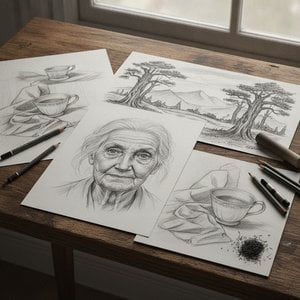
A Portrait of Melancholy: Unveiling Edvard Munch’s Untitled Sketch
Edvard Munch's "Untitled (4115)" isn’t merely a charcoal sketch; it’s a distilled essence of the anxieties and profound emotionality that defined his artistic legacy. Born in 1863 amidst a landscape scarred by illness and loss, Munch channeled his personal demons into a body of work that continues to resonate with viewers over a century later. This particular piece, executed likely around the turn of the 20th century, offers an intimate glimpse into this turbulent inner world – a study in quiet contemplation punctuated by the unspoken weight of sorrow. The sketch’s raw immediacy, achieved through loose, gestural lines and a deliberate avoidance of meticulous detail, speaks volumes about Munch's commitment to capturing not just likeness but the very *feeling* of his subject.
The Language of Monochrome: Technique and Composition
The artwork’s monochrome palette – a carefully orchestrated dance between deep blacks, stark whites, and countless shades of gray – immediately establishes an atmosphere of somber introspection. Munch masterfully employs line to define form; thick, confident strokes delineate the contours of the woman's face and clothing, while thinner, more delicate lines suggest the texture of her garments and the subtle play of light and shadow. Notice how the artist uses varying line density—a heavier hand for the jawline, a lighter touch around the eyes—to create a sense of volume and depth within the two-dimensional space. The composition itself is deceptively simple: a bust-length portrait centered within the frame, slightly off-center to lend a naturalistic quality. This deliberate restraint focuses all attention on the subject’s face, inviting the viewer into an almost unsettlingly close encounter.
Echoes of Trauma and Symbolism
Munch's life was profoundly shaped by early tragedy – the deaths of his mother and sister from tuberculosis, coupled with his father’s struggles with mental illness. These experiences weren’t simply biographical details; they became the bedrock of his artistic vision, fueling a relentless exploration of mortality, sickness, and the fragility of human existence. “Untitled (4115)” embodies this preoccupation. The woman's gaze is direct, almost challenging, yet simultaneously imbued with a profound sadness. It’s not a portrait of outward beauty but rather an invitation to contemplate the hidden depths of the soul. The monochrome palette itself serves as a potent symbol – often associated with mourning, introspection, and the absence of joy. The sketch's overall mood evokes a sense of melancholy, mirroring Munch’s own lifelong struggle with despair and anxiety.
A Window into an Expressionist Soul
This work is undeniably rooted in the burgeoning movement of Expressionism, though it predates its formal articulation. Munch wasn't interested in replicating reality; he sought to externalize his inner emotional state. The loose brushwork, the distorted forms (subtly present even within a sketch), and the emphasis on subjective experience are all hallmarks of this approach. As documented in extensive research – including detailed accounts from the Munch Museum in Oslo – Munch’s artistic process was intensely personal and driven by a desire to capture not just what he *saw*, but what he *felt*. The subtle lighting, seemingly emanating from the left side of the frame, further enhances the sense of intimacy and vulnerability. Consider this sketch as more than just a portrait; it's a raw, unfiltered expression of an artist grappling with the fundamental questions of life, death, and the human condition – a testament to Munch’s enduring power to connect with our deepest emotions.
For a high-quality reproduction that captures the essence of this evocative sketch, explore the stunning hand-painted reproductions available at WahooArt.com.



 效果预览
效果预览
 购买印刷品
购买印刷品 分享
分享 分享
分享
 详情
详情

 下载
下载
 相似作品
相似作品 X射线
X射线 幻灯片播放
幻灯片播放

 展开详情
展开详情






































 玻璃选项仅适用于110厘米以下的尺寸。