A Descent into Emotion: Edvard Munch’s “Stanislaw Przybyszewski”
Edvard Munch, a titan of modern art whose legacy continues to resonate profoundly within the artistic landscape, achieved unparalleled fame through his seminal 1893 painting "The Scream," an image instantly recognizable as embodying the anxieties and psychological complexities of the fin de siècle. Yet, beyond its iconic status lies a deeper exploration of human experience—a quest for truth expressed not merely visually but emotionally, intellectually, and spiritually. Munch’s artistic journey began amidst considerable personal hardship; his childhood was scarred by devastating illness – the premature deaths of his mother and sister from tuberculosis – fostering an enduring preoccupation with mortality and shaping the very core of his creative output. This formative trauma fueled a relentless investigation into the darker recesses of consciousness, propelling him toward Expressionism as a stylistic vanguard.
At the Royal School of Art and Design in Kristiania (now Oslo), Munch’s mentor Christian Krohg championed a revolutionary approach: painting from feeling rather than observation. Krohg encouraged Munch to abandon academic conventions and embrace subjective experience, recognizing that genuine artistic expression resided within the realm of emotion—a conviction that would irrevocably alter Munch's artistic trajectory. This influence solidified his commitment to portraying inner turmoil with unflinching honesty, mirroring the pervasive sense of unease characterizing the era. His own struggles with mental illness – a familial inheritance – served as an inescapable catalyst for artistic introspection and fueled the symbolic language of his canvases.
The Expressionist Vision: Technique and Style
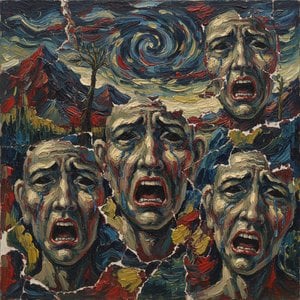
“Stanislaw Przybyszewski” exemplifies Munch’s distinctive Expressionist style, characterized by distorted forms, jarring colors, and agitated brushstrokes designed to convey psychological states rather than literal representations. The painting utilizes oil paint on canvas—a medium favored by Munch for its ability to capture nuanced tonal variations and textural depth—resulting in a surface imbued with palpable energy. Munch eschewed meticulous detail, prioritizing instead the conveyance of emotion through simplified shapes and bold hues. Notice particularly the dominant use of crimson red – a color frequently associated with passion, fear, and impending doom – which dominates the sky and reverberates throughout the composition. The artist’s deliberate manipulation of perspective contributes to an unsettling sense of disorientation, mirroring the protagonist's internal turmoil.
Historical Context: Fin de Siècle Anxiety
“Stanislaw Przybyszewski” emerged during the “fin de siècle,” a period marked by profound social and intellectual upheaval in Europe—a time of burgeoning anxieties concerning scientific advancements, societal shifts, and the looming shadow of impending war. Munch’s artistic endeavors were inextricably linked to this cultural milieu; he absorbed the philosophical currents of Nietzsche and Kierkegaard, grappling with existential questions about faith, morality, and the human condition. The painting reflects the pervasive sense of dread prevalent during this era—a preoccupation with death, illness, and psychological vulnerability that finds expression in Munch’s masterful depiction of human emotion.
Symbolism: Fear and Isolation
The central figure—a man gazing intently off-camera—represents not merely an individual but embodies a universal experience of fear and isolation. His posture conveys vulnerability and despair, mirroring the protagonist's internal struggle against overwhelming anxiety. The surrounding landscape—characterized by swirling crimson hues—amplifies this emotional impact, symbolizing the turbulent forces shaping human consciousness. Munch’s deliberate use of color serves as a conduit for psychological symbolism—communicating unspoken anxieties and conveying the profound sense of unease inherent in confronting existential truths.
Emotional Resonance: A Window into the Soul
Ultimately, “Stanislaw Przybyszewski” transcends mere visual representation; it offers an immersive journey into the depths of human emotion. Munch’s artistic genius lies in his ability to translate psychological experience onto canvas—creating a work that compels viewers to confront their own vulnerabilities and grapple with fundamental questions about existence. The painting's enduring power resides in its capacity to evoke empathy and provoke contemplation—a testament to Munch’s unwavering commitment to portraying the complexities of human consciousness with unflinching honesty and artistic brilliance.
问答详情
"Stanislaw Przybyszewski" 属于 爱德华·蒙克 艺术生涯中的哪个时期?
“Stanislaw Przybyszewski”属于爱德华·蒙克艺术生涯中的Mature Period时期。这一分类将该作品与艺术家的创作发展历程联系在一起。
“Stanislaw Przybyszewski”中的色彩呈现出多少光泽感?
"Stanislaw Przybyszewski" 的色彩呈现出 Gentle Luminance 的亮度。
爱德华·蒙克 还以哪些名称为人所知?
爱德华·蒙克 也以 艾德華·蒙克, 埃德瓦尔·蒙克, 爱德华·克里斯蒂安·蒙克 等其他名称为人所知。

 订购此收藏品的纯手工复刻画作







 实景预览
实景预览
 发送
发送 分享
分享
 详情
详情 指南
指南

 下载图片
下载图片
 相似作品
相似作品 X射线
X射线 幻灯片播放
幻灯片播放 统计数据
统计数据

 阅读全文
阅读全文






































 玻璃选项仅适用于110厘米以下的尺寸。


