
x


从与原作比例一致的预设尺寸中进行选择。

您可以输入自定义尺寸,以适配特定的画框或空间。如果所选尺寸与原图比例不符,我们将通过裁剪作品或添加手绘元素来扩展画面。数字样稿将在制作开始前发送给您确认。
请注意,屏幕预览无法准确反映实际的裁剪或扩展效果,只有样稿才能真实呈现最终的构图。
虽然我们提供定制尺寸服务,但为了保留原作比例,建议您从预设列表中选择尺寸。

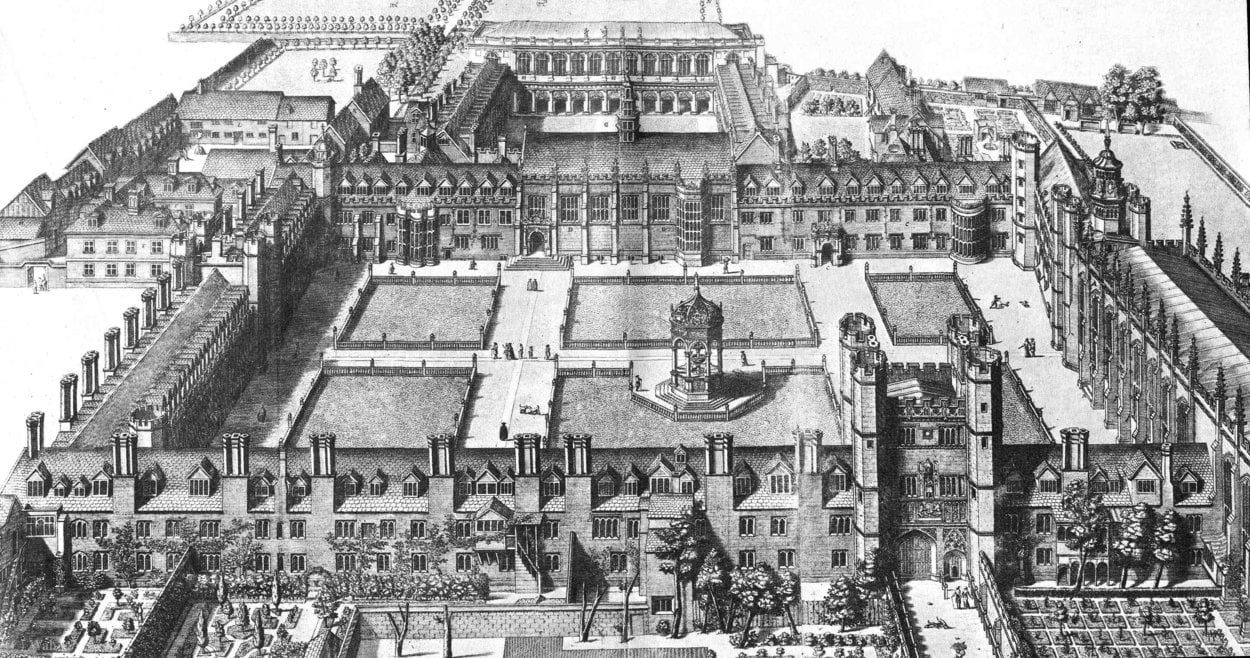
Trinity college cambridge
复制品尺寸

In the grand tapestry of seventeenth-century English art, few names evoke the meticulous precision and architectural splendor of David Loggan. A master of the Baroque era, Loggan possessed a rare ability to translate the heavy, stone-bound majesty of academic institutions into the delicate, flowing lines of engraving. His journey began far from the spires of Oxford, in the vibrant, maritime atmosphere of Danzig. Born in 1634, his early years were shaped by the rich artistic currents of Northern Europe. Under the guidance of masters such as Willem Hondius in Amsterdam and Crispin van de Passe II, Loggan developed a technical virtuosity that would later allow him to capture the very soul of English architecture through the medium of print.
Loggan’s migration to London in the late 1650s marked a transformative chapter in his career. Navigating a city often gripped by the shadows of plague and political upheaval, he established himself not merely as an engraver, but as a vital figure within the artistic and social fabric of the capital. His talent for miniature portraits—specifically his exquisite plumbago drawings—endeared him to the aristocratic circles of Leicester Fields. By acting as both an artist and an agent for wealthy patrons in their acquisition of fine works, Loggan positioned himself at the intersection of commerce and high culture, a role that required both aesthetic sensitivity and shrewd social navigation.
The true zenith of Loggan’s contribution to art history lies in his monumental topographical achievements. His appointment as the "Public Sculptor" to the University of Oxford provided him with the ultimate canvas: the storied colleges of the realm. This period of intense scholarly and artistic devotion culminated in the publication of Oxonia Illustrata in 1675. This breathtaking folio, produced with the assistance of Robert White, offered the world unparalleled bird’s-eye views of Oxford’s collegiate landscape. Through his engraver's burin, Loggan did more than map buildings; he captured the atmosphere of intellectual sanctuary, rendering Gothic grandeur and urban life with a clarity that remains historically indispensable.
His ambition did not rest solely with the spires of Oxford. Loggan turned his gaze toward Cambridge, embarking on an equally rigorous undertaking. The resulting Cantabrigia Illustrata, published in 1690, stands as a companion piece to his earlier masterpiece, documenting the colleges and even Eton College with the same unwavering commitment to accuracy and artistic subtlety. His work serves as a visual bridge between the medieval past and the burgeoning scientific precision of the late seventeenth century, ensuring that the architectural heritage of these great universities was preserved for posterity in a form that was both beautiful and scientifically rigorous.
To study the works of David Loggan is to witness the marriage of draughtsmanship and topography. His technique allowed him to navigate the complexities of light and shadow, giving depth to stone facades and life to the bustling streets beneath them. His legacy is defined by several key pillars of achievement:
Ultimately, David Loggan was much more than a mere chronicler of buildings; he was an artist who understood that architecture is the stage upon which history unfolds. Through his engravings, the stone walls of King’s College Chapel or Emmanuel College became living entities, frozen in a moment of eternal grace. His work remains a cornerstone of British printmaking, inviting every generation to rediscover the enduring majesty of the academic world through his incomparable vision.

1634 - 1692 , United Kingdom


第一时间获取最新的艺术新闻、独家优惠及装饰灵感。
向我们介绍您的项目需求,我们的艺术专家将为您提供 3 个个性化的艺术品推荐。
由我们的专家为您精选 3 款心仪之作 —— 完全免费!

 效果预览
效果预览
 购买印刷品
购买印刷品 分享
分享 分享
分享
 详情
详情

 下载
下载
 相似作品
相似作品 X射线
X射线 幻灯片播放
幻灯片播放 展开详情
展开详情






































 玻璃选项仅适用于110厘米以下的尺寸。


