
x


从与原作比例一致的预设尺寸中进行选择。

您可以输入自定义尺寸,以适配特定的画框或空间。如果所选尺寸与原图比例不符,我们将通过裁剪作品或添加手绘元素来扩展画面。数字样稿将在制作开始前发送给您确认。
请注意,屏幕预览无法准确反映实际的裁剪或扩展效果,只有样稿才能真实呈现最终的构图。
虽然我们提供定制尺寸服务,但为了保留原作比例,建议您从预设列表中选择尺寸。

Landscape With Stream And Haymakers
复制品尺寸

In the heart of the Victorian era, a period defined by both industrial expansion and a profound longing for the untouched natural world, David Hall McKewan emerged as a master of atmospheric watercolor. Born in London on February 16, 1816, to David McKewan and Matilda, his early life was steeped in the burgeoning artistic energy of the British capital. As a student under the legendary David Cox the Elder, McKewan did not merely learn a technique; he inherited a philosophy of light and movement. This lineage placed him at the very center of the Cox School of Art, a movement that prioritized the emotional resonance of a landscape over the cold, clinical precision of topographical mapping.
McKewan’s brushwork became a bridge between reality and romanticism. He possessed a rare ability to capture the ephemeral qualities of the English countryside—the way mist clings to a valley or how sunlight pierces through a heavy canopy. His early explorations were deeply rooted in the Kentish landscape, where he produced evocative views of Pembury Castle and Chartwell House. Through these works, he demonstrated a profound mastery of the "brown wash" technique, using layered tones to create an ethereal, almost dreamlike depth that invited the viewer to step into his tranquil, often melancholic, vistas.
While many of his contemporaries focused solely on wide-reaching horizons, McKewan found equal inspiration in the rugged textures of the earth and the silent dignity of historical architecture. He gained significant acclaim for his ability to render rocky scenes, where the interplay of shadow and stone felt tactile and permanent. Yet, this fascination with the physical world extended inward; he was equally adept at capturing the somber, majestic atmosphere of old mansion interiors. His depictions of legendary estates such as Knole and Haddon Hall showcased a unique talent for portraying the weight of history through light filtering into grand, silent halls.
His artistic journey was not confined to the borders of England. Driven by a desire to document the diverse character of the British Isles, his travels took him through the rugged terrains of Wales, the sweeping highlands of Scotland, and the lush landscapes of Ireland. Each region offered a new palette for his watercolor studies, allowing him to expand his repertoire from tranquil woodlands to dramatic mountain ranges. This breadth of subject matter ensured that his work remained dynamic, reflecting a deep psychological connection to the varying moods of the natural world.
Beyond his contributions to the Royal Academy and his election as a full member of the Royal Institute of Painters in Water-colours in 1850, McKewan left an enduring mark on the art community through his dedication to teaching. He was not content to keep his mastery a secret; rather, he sought to elevate the standards of watercolor painting for future generations. In 1869, he published Lessons on Trees in Water Colours, a seminal manual that provided aspiring artists with essential guidance on color theory and compositional structure. This publication solidified his reputation as a pedagogue who understood the delicate balance between technical skill and artistic expression.
The life of David Hall McKewan concluded in August 1873, but his influence persists in the works that continue to evoke the spirit of the Romantic movement. His ability to blend the sublime with the serene remains a hallmark of his oeuvre. Today, when we look upon his notable works, such as Ambleside Mill or Landscape With Stream And Haymakers, we see more than just scenery; we witness a profound meditation on the beauty and fragility of the natural world, captured through the delicate, enduring medium of watercolor.

1816 - 1873

探索浪漫主义风景画的巅峰!本文精选十部经典名作,带您领略莫奈、库尔贝等大师的艺术魅力。感受色彩与光影的诗意,重温自然风光的震撼。WahooArt.com为您提供博物馆级别的艺术复制品和个性化家居装饰方案。尽在WahooArt.com!

Journey through 10 legendary watercolor masterpieces by Sargent, Turner & Homer! Explore iconic landscapes, portraits & floral art that redefined history. Find museum-quality reproductions and curated decor ideas at WahooArt.com.

Explore the captivating world of watercolor painting! Discover its rich history, essential techniques, influential artists & collecting tips. A comprehensive guide for art enthusiasts from WahooArt.
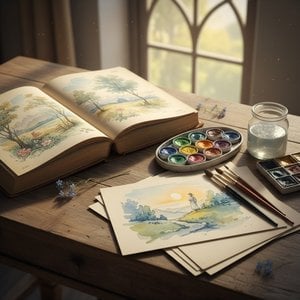
探索水彩艺术的流光溢彩!深入了解其历史渊源、大师技法与现代实践。提供专业的艺术咨询、定制油画服务,助您收藏和鉴赏优秀作品。WahooArt.com – 您的艺术之选。

Explore the captivating world of watercolor painting! Discover its rich history, essential techniques, influential artists & collecting tips from art experts. A comprehensive guide for enthusiasts.


第一时间获取最新的艺术新闻、独家优惠及装饰灵感。
向我们介绍您的项目需求,我们的艺术专家将为您提供 3 个个性化的艺术品推荐。
由我们的专家为您精选 3 款心仪之作 —— 完全免费!


 效果预览
效果预览
 购买印刷品
购买印刷品 分享
分享 分享
分享
 详情
详情

 下载
下载
 相似作品
相似作品 X射线
X射线 幻灯片播放
幻灯片播放
 展开详情
展开详情






































 玻璃选项仅适用于110厘米以下的尺寸。


