

博物馆级艺术微喷或帆布版画,制作高效,并提供多种饰面选择。 ( 订购纯手工绘制画作 切换至数字图像销售渠道)
您可以从与原作比例一致的预设尺寸中进行选择。

请输入您所需的宽度和高度,以适配您的画框或墙面。由于印刷品只能进行裁剪,无法超出原图尺寸,因此若比例不一致,画面的一部分将会被裁切。在正式印刷之前,我们会为您发送一份数字效果图供您确认。本页面显示的图片并非最终裁剪后的效果——只有效果图才能展示真实的裁剪情况。
W.E.B. Du Bois
复刻品尺寸

In the soft, luminous grain of a platinum print, one finds more than just a likeness; one finds a profound reclamation of identity. Cornelius Marion Battey, a master of the Pictorialist style, did not merely capture faces; he sculpted dignity from light and shadow. Born in Augusta, Georgia, in 1873, Battey’s journey through the American landscape—from the industrial pulse of Cleveland to the vibrant artistic corridors of Manhattan—prepared him to become one of the most significant visual chroniclers of the African American experience during the early twentieth century. His work emerged at a time when the prevailing visual narrative often sought to diminish Black humanity, and in response, Battey utilized the camera as a tool of grace, elevating his subjects to a plane of timeless elegance.
Battey’s technical mastery was forged in the prestigious studios of New York City, where he honed his craft under the rigorous standards of commercial excellence. His tenure at the Bradley Photographic Studio on Fifth Avenue and his leadership within the retouching department at Underwood & Underwood provided him with a sophisticated understanding of light manipulation. Embracing the Pictorialist movement, Battey moved away from the stark, clinical realism of traditional documentary photography. Instead, he adopted a technique reminiscent of a painter’s brushstroke, utilizing soft focus and meticulous retouching to create an ethereal glow around his sitters. This stylistic choice was deeply intentional; by softening edges and emphasizing luminosity, he imbued his portraits with an idealized, almost mythic quality that celebrated the intellectual and social stature of his subjects.
The true historical weight of Battey’s oeuvre lies in its profound social impact. Through his Battey and Warren Studio, he established a visual language for Black excellence that challenged the pervasive racial stereotypes of the Jim Crow era. His collaboration with the legendary W. E. B. Du Bois was particularly transformative. As a regular contributor to The Crisis, the official magazine of the NAACP, Battey’s portraits provided a counter-narrative to the caricatures found in mainstream media. He placed the faces of Black intellectuals, writers, and statesmen—figures such as Paul Laurence Dunbar and Frederick Douglass—into the public consciousness with an unmistakable aura of authority and poise.
Beyond the printed page, Battey’s influence extended into the very institutions shaping the future of Black education and leadership. His appointment to head the photography department at the Tuskegee Institute allowed him to mentor a new generation of photographers and document the burgeoning progress of the era. His lens captured not only the leaders of the day, such as Booker T. Washington, but also the quiet strength of a community in transition. Today, the rediscovered archives of his work serve as a vital bridge to the past, reminding us that through the careful manipulation of light and shadow, an artist can illuminate the enduring truth of human dignity.
Key Contributions and Historical Milestones:

1873 - 1927 , Georgia

Explore the captivating world of Charles Marion Russell, 'the cowboy artist.' Discover his life, iconic paintings, advocacy for Native Americans, and investment potential. A guide for discerning art collectors.
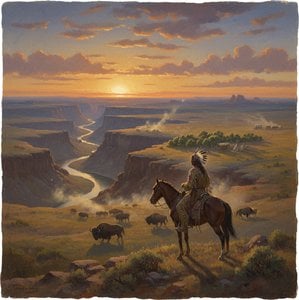
Explore the evocative paintings of Henry Farny, renowned for his romantic realism & depictions of Native American life in the 19th-century West. Discover his legacy and key artworks at WahooArt.

 实景预览
实景预览
 分享
分享 分享
分享
 详情
详情 指南
指南

 下载作品
下载作品
 相似作品
相似作品 X射线
X射线 幻灯片播放
幻灯片播放 问答
问答
 统计数据
统计数据

 展开全文
展开全文






































 玻璃选项仅适用于110厘米以下的尺寸。


