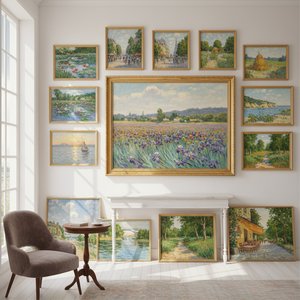
A Moment Captured: The Essence of Impressionism
Claude Monet’s “Oat Field,” a seemingly simple depiction of a golden expanse punctuated by wildflowers, is anything but. It's a profound meditation on light, color, and the fleeting beauty of the natural world – hallmarks of the Impressionist movement that revolutionized painting in the late 19th century. Painted around 1890-1891, during a period of intense experimentation for Monet, this work embodies his dedication to capturing not just what he *saw*, but how he *felt* observing the landscape. The scene unfolds within the artist’s beloved garden at Giverny, a place that served as both studio and sanctuary, constantly evolving under his watchful eye.
Monet wasn't interested in meticulously recreating reality; instead, he sought to convey the ephemeral qualities of light and atmosphere. He achieved this through a technique known as *plein air* painting – working directly outdoors, allowing him to observe and translate the shifting conditions onto canvas with unprecedented immediacy. The brushstrokes are loose and visible, creating an almost shimmering effect, particularly in the field itself. Notice how Monet doesn’t define the individual blades of grass or flowers; rather, he blends them together into a vibrant tapestry of color and texture, suggesting movement and life.
The Language of Color: A Study in Light
Color is undeniably the dominant force within “Oat Field.” Monet masterfully employed complementary colors – blues and oranges, greens and reds – to create visual excitement and depth. The intense yellows and golds of the wheat fields are juxtaposed against the cooler hues of the sky and distant trees, generating a dynamic interplay that draws the eye across the canvas. He used broken color, applying small dabs and strokes of pure pigment rather than mixing them on the palette, allowing the colors to mingle optically when viewed from a distance. This technique intensified the sense of luminosity and vibrancy, mirroring the way sunlight would actually interact with the landscape.
The sky itself is rendered in a series of hazy blues and whites, suggesting an atmospheric perspective – a subtle indication of depth achieved through variations in color and tone. Monet wasn’t aiming for photographic accuracy; he was striving to capture the *impression* of the sky as it appeared at that particular moment, influenced by the surrounding elements.
Symbolism and Emotional Resonance
Beyond its purely visual qualities, “Oat Field” carries a quiet emotional resonance. The vastness of the field evokes a sense of tranquility and solitude, inviting contemplation. The inclusion of wildflowers adds a touch of rustic charm and hints at the abundance of nature. Some art historians interpret the scene as a reflection on rural life and the connection between humanity and the land – themes that were increasingly important to Monet during this period.
Furthermore, “Oat Field” represents a pivotal moment in Monet’s artistic journey. It exemplifies his commitment to capturing fleeting moments of beauty and demonstrates his mastery of Impressionist techniques. It's a testament to the power of observation and the artist’s ability to transform a simple landscape into a profound work of art. Reproductions, like those offered by WahooArt.com, allow us to experience this captivating scene in exquisite detail, bringing Monet’s vision to life within our own spaces.
常见问题与解答
在哪里可以找到关于克劳德·莫奈 的《Oat Field》的数据统计?
"Oat Field" 拥有专属的 访问统计 页面。该页面通过国家和语言维度的细分,展示了该作品及艺术家其他作品的每月访问量趋势图。
如何下载 克劳德·莫奈 的《Oat Field》 的图片?
您可以在作品的下载数字图像页面下载克劳德·莫奈 的《Oat Field》的数字图像:高分辨率数字图像下载。
在哪里可以找到关于“Oat Field”的指南?
"Oat Field" 的指南请参阅作品的 指南 页面 —— 这是一份可打印的信息单,包含了该作品的说明、署名以及详细信息表(艺术家、日期、媒介、原尺寸、馆藏)。