
 PaintingVorticism
 1911Modern
 45.0 x 81.0 cm
 Ben Uri Gallery and Museum
由我们的艺术家按需定制,为您提供您所选尺寸及画框的布面手工油画。 ( 切换至版画销售渠道 切换至数字图像销售渠道)





























从与原作比例一致的预设尺寸中进行选择。

您可以输入自定义尺寸,以适配特定的画框或空间。如果所选尺寸与原图比例不符,我们将通过裁剪作品或添加手绘元素来扩展画面。数字样稿将在制作开始前发送给您确认。
请注意,屏幕预览无法准确反映实际的裁剪或扩展效果,只有样稿才能真实呈现最终的构图。
虽然我们提供定制尺寸服务,但为了保留原作比例,建议您从预设列表中选择尺寸。

Untitled (Vorticist Figures)
复制品尺寸
In the heart of the early twentieth century, as the world stood on the precipice of profound industrial and social transformation, Clara Birnberg captured a moment of raw, kinetic energy in her 1911 masterpiece, Untitled (Vorticist Figures). This painting is not merely a depiction of a street scene; it is a rhythmic exploration of movement and human connection within the modern cityscape. Through a bold, vibrant palette and a composition that defies traditional perspective, Birnberg invites the viewer into a bustling urban theater where every figure contributes to a larger, swirling dance of life. The work vibrates with the spirit of the Vorticist movement, utilizing flattened forms and sharp, geometric intersections to mirror the fragmented yet interconnected nature of modern existence.
The scene unfolds across a street teeming with activity, where at least thirteen distinct individuals navigate their shared environment. Some figures stand tall, observing the flow of the city, while others are captured in moments of repose, sitting or lying down amidst the architectural backdrop. There is a fascinating tension between the permanence of the buildings and the fleeting, transient nature of the people passing through them. Birnberg masterfully employs depth not through classical shading, but through the strategic layering of figures—placing some in the immediate foreground to create intimacy, while others recede into the distance, pulling the eye deeper into the urban labyrinth. This technique creates a sense of immersion, making the collector feel less like an observer and more like a participant in this lively metropolitan moment.
While some might describe the execution as crude or stripped-back, it is precisely this pared-down approach that lends the painting its enduring power. Birnberg utilizes a flattened pictorial plane to emphasize shape and color over anatomical precision. This stylistic choice aligns her with the avant-garde movements of her era, where the essence of a subject was found in its structural energy rather than its literal likeness. The colors are unapologetically bright, acting as emotional anchors that guide the viewer's gaze across the canvas. Each stroke serves to define the boundaries of the figures and the geometry of the architecture, creating a mosaic of human interaction that feels both chaotic and meticulously orchestrated.
For the discerning collector or interior designer, this piece offers a profound sense of movement and character. It is an ideal selection for spaces that require a focal point of high energy—a room where conversation and vitality are encouraged. The painting’s ability to bridge the gap between historical significance and modern aesthetic appeal makes it a timeless addition to any curated collection. As a hand-painted reproduction, every nuance of Birnberg's original vision is preserved, offering an opportunity to bring the electric atmosphere of 1911 London into a contemporary setting. To possess this work is to hold a fragment of history, a captured heartbeat of a world in motion.

Born in Romania in 1892, Clara Birnberg’s artistic journey took her from the heart of Eastern Europe to the vibrant and evolving art scene of early 20th-century England. Initially known as Clara Weinstein, she later adopted the surname Winsten upon marrying fellow artist Stephen Winsten – a union that profoundly shaped both their creative lives and their shared commitment to pacifism. Her story is one of resilience, artistic exploration, and a deep engagement with social and political currents of her time.
Clara’s early life was marked by displacement and the echoes of persecution. Her family’s emigration from Romania in 1902, fleeing anti-Semitic violence, instilled within her a sensitivity to themes of identity, belonging, and the human condition. This formative experience would later inform much of her work, particularly her poignant portraits and symbolic illustrations. The Slade School of Fine Art between 1910 and 1912 proved pivotal, providing her with technical skills alongside exposure to influential figures like Isaac Rosenberg and David Bomberg – artists who formed the nucleus of the ‘Whitechapel Boys,’ a collective known for its radical approach to art and its engagement with social issues.
This association with the Whitechapel Boys was particularly significant. As the only female member, Clara navigated a predominantly male artistic environment, forging her own distinctive voice within a group grappling with questions of modernity, identity, and the complexities of post-Impressionism. Her work during this period reflected both the influence of her peers and her burgeoning individual style – characterized by bold colors, dynamic compositions, and a willingness to explore challenging subject matter.
Clara Winsten’s artistic output spanned painting, sculpture, and illustration. Her paintings often featured portraits—not merely likenesses but explorations of character and emotion—as well as evocative landscapes and symbolic compositions. She was particularly known for her watercolor works, employing a loose, expressive style that captured both the beauty and the turmoil of the world around her. Her sculptures, frequently commissioned by prominent figures like George Bernard Shaw, demonstrated a growing technical skill and an ability to imbue inanimate materials with life and meaning.
Among her most celebrated achievements is the bronze sculpture of George Bernard Shaw, created in 1946. This piece, reflecting Shaw’s intellectual stature and humanist values, stands as a testament to Winsten's skill and her deep understanding of her subject. Other notable works include her illustrations for Shaw’s *Buoyant Billions*, a satirical comedy that showcased her ability to capture the wit and charm of the playwright’s prose, and several portraits of prominent figures from British society.
Her work during World War I reflected her pacifist beliefs. She created powerful symbolic images exploring themes of conflict and its devastating consequences. The ‘Attack,’ a dynamic watercolor depicting battle and divine intervention, exemplifies this period's artistic concerns – a potent blend of realism and spiritual contemplation.
Clara Winsten’s association with the 'Whitechapel Boys' was more than just an artistic affiliation; it represented a shared cultural heritage and a commitment to social justice. The group, comprised largely of Jewish artists and poets living in East London, provided a space for creative exchange and intellectual debate—a vital counterpoint to the prevailing conservative attitudes of the time. Her background as a member of the Jewish community profoundly influenced her artistic perspective, informing her engagement with themes of identity, displacement, and the complexities of belonging.
Her marriage to Stephen Winsten further solidified this connection, creating a collaborative partnership built on shared values and mutual respect. Together, they became active participants in Quaker humanistic circles, advocating for peace and social justice through their art and their lives. The couple’s commitment to pacifism was deeply intertwined with their artistic practice, shaping the themes and messages conveyed in their work.
Clara Birnberg (Winsten) left behind a significant body of work that continues to be studied and appreciated today. Her paintings and sculptures are held in various museums and collections across the United Kingdom, including the Stanley and Audrey Burton Art Gallery in Leeds and the Aurora Art Fund in Bucharest, Romania – reflecting her dual heritage and international artistic reach.
Her story serves as a reminder of the contributions made by women artists throughout history—often overlooked or marginalized—and highlights the enduring power of art to challenge conventions, express profound emotions, and promote social change. Clara Winsten’s legacy endures not only through her artistic creations but also through her unwavering commitment to humanism and her pioneering spirit as a female artist in a male-dominated field.

1892 - 1989 , Romania
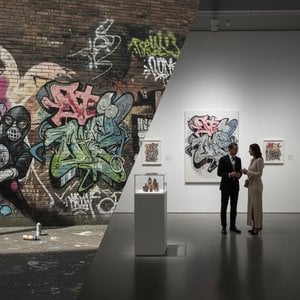
Explore the captivating journey of street art from urban walls to prestigious galleries. Discover how contemporary graffiti has evolved into a high-end collectible movement, redefining modern interior design and global art culture.

Explore the profound mystery of Banksy, from his subversive stencils to his impact on global pop culture. Dive into an art-historical analysis of street art's greatest icon and the power of social commentary in modern urban landscapes.


 效果预览
效果预览
 分享
分享 分享
分享
 详情
详情

 下载
下载
 相似作品
相似作品 X射线
X射线 幻灯片播放
幻灯片播放 统计数据
统计数据 展开详情
展开详情









 玻璃选项仅适用于110厘米以下的尺寸。


