x


从与原作比例一致的预设尺寸中进行选择。

您可以输入自定义尺寸,以适配特定的画框或空间。如果所选尺寸与原图比例不符,我们将通过裁剪作品或添加手绘元素来扩展画面。数字样稿将在制作开始前发送给您确认。
请注意,屏幕预览无法准确反映实际的裁剪或扩展效果,只有样稿才能真实呈现最终的构图。
虽然我们提供定制尺寸服务,但为了保留原作比例,建议您从预设列表中选择尺寸。

Ograph
复制品尺寸

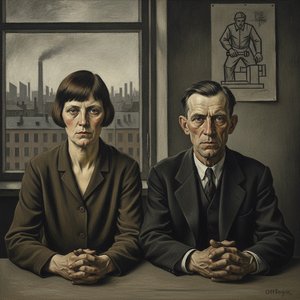
In the fractured landscape of post-World War I Europe, few artists captured the shimmering decadence and underlying psychological tension of the era as piercingly as Christian Schad. Born in 1894 in Miesbach, Bavaria, to a prosperous lawyer, Schad possessed a unique vantage point that allowed him to navigate the turbulent currents of the early twentieth century with both intimacy and detachment. His journey was one of profound stylistic evolution, moving from the raw emotionality of Expressionism toward the sharp, clinical precision of New Objectivity and the experimental frontiers of Dada. While his contemporaries often sought to scream against the chaos of a broken world, Schad’s work frequently whispered of its secrets, using a meticulous, almost surgical technique to expose the hollowed-out glamour of Vienna and Berlin.
The Great War served as a pivotal, albeit indirect, catalyst for his artistic trajectory. Avoiding military service through a self-inflicted heart defect, Schad found himself in Switzerland, a sanctuary where he encountered the radical energies of the Cabaret Voltaire. It was here, amidst the avant-garde ferment of Zurich, that he engaged with figures like Hans Arp and Hugo Ball. During this period, he pioneered his celebrated Schadographs—innovative photograms created by placing objects directly onto light-sensitive paper. These works, characterized by their ghostly, fragmented silhouettes, embodied the Dadaist rejection of traditional representation and captured the ephemeral, fractured essence of a world in flux.
As the 1920s dawned, Schad’s artistic gaze shifted southward. His time in Italy, particularly his immersion in the art academies of Naples and Rome, introduced a new layer of refinement to his practice. Influenced by the classical mastery he encountered there, his style began to transition toward Magic Realism. This period was marked by an increasing preoccupation with detail and a subtle, uncanny clarity that would become his hallmark. The warmth of Mediterranean light met a growing interest in psychological depth, creating a tension between the beautiful surface of his subjects and the profound isolation they seemed to inhabit.
By 1927, the relocation to Vienna and the subsequent return to Berlin placed Schad at the very heart of the New Objectivity movement. It was in these urban centers that he achieved his most enduring fame. His portraits became emblematic of the era's social climate—capturing the polished, often artificial elegance of the upper classes while simultaneously hinting at the moral and economic decay lurking beneath the surface. Through works like Amourette and St. Genois d’Anneaucourt, Schad utilized a smooth, almost porcelain-like finish to render skin and fabric, creating an aesthetic that was both alluring and unsettlingly sterile.
The trajectory of Schad’s career was irrevocly altered by the global economic collapse of 1929. The loss of his father's financial support forced a retreat from the intense painting production of his youth, and as the political climate in Germany darkened, his artistic output slowed significantly. Unlike many of his peers in the New Objectivity movement whose work was branded as "degenerate" by the Nazi regime, Schad’s art was paradoxically included in the Great German Art Exhibition in 1937, a complex historical fact that continues to invite scholarly scrutiny regarding his position within the era's political landscape.
Today, Christian Schad is remembered not merely as a chronicler of a lost era, but as a master of psychological portraiture. His ability to blend the experimental spirit of Dada with the hyper-realistic precision of Magic Realism allows his work to transcend its historical moment. To look upon a Schad portrait is to witness a profound dialogue between beauty and disillusionment, a testament to an artist who could find the haunting truth hidden within the most polished of surfaces.

1894 - 1982

Elevate your digital artistry with our expert guide to mastering collage. Learn professional techniques for layering textures, blending imagery, and creating profound visual narratives through advanced digital composition and modern creative workflows.


第一时间获取最新的艺术新闻、独家优惠及装饰灵感。
向我们介绍您的项目需求,我们的艺术专家将为您提供 3 个个性化的艺术品推荐。
由我们的专家为您精选 3 款心仪之作 —— 完全免费!


 效果预览
效果预览
 购买印刷品
购买印刷品 分享
分享 分享
分享
 详情
详情

 下载
下载
 相似作品
相似作品 X射线
X射线 幻灯片播放
幻灯片播放
 展开详情
展开详情






































 玻璃选项仅适用于110厘米以下的尺寸。