
 Chicano Art
 1987Contemporary
 25.0 x 20.0 cm
 USC Fisher Museum of Art
博物馆级艺术微喷或帆布版画,制作高效,并提供多种饰面选择。 ( 购买手绘画作 Switch to Digital Image)





























从与原作比例一致的预设尺寸中进行选择。

您可以输入自定义尺寸,以适配特定的画框或空间。如果您选择的尺寸与原图比例不符,我们将对作品进行裁剪,或通过镜像填充/纯色填充边缘的方式来扩展图像。在开始制作之前,我们会向您发送一份数字效果图供您确认。
请注意,屏幕上的预览并不能反映实际的裁剪或扩展效果。只有效果图才能准确展示最终的构图。
虽然我们提供定制尺寸,但为了保持原图比例,我们建议您从预设列表中选择尺寸。

The Wanderer
复制品尺寸
In the evocative painting "The Wanderer," created in 1987 by the visionary Chicano master Carlos Almaraz, we are invited into a fleeting, atmospheric moment of urban solitude. The canvas captures a poignant scene of a man navigating a rain-swept landscape, accompanied only by his loyal canine companion. Clad in a striking blue jacket, the figure holds an umbrella aloft, a small shield against the elements, as he moves through a world blurred by moisture and mist. This is not merely a depiction of a walk in the rain; it is a profound meditation on companionship and the quiet resilience required to traverse life's inevitable storms. The presence of other figures and a distant, parked truck grounds the scene in a tangible reality, suggesting a shared human experience of enduring the weather, yet the central subject remains isolated in his rhythmic, solitary journey.
The technique employed by Almaraz in this piece reflects his unique ability to blend vibrant energy with deep emotional resonance. While much of his work is celebrated for its explosive color and social commentary, "The Wanderer" showcases a more nuanced, atmospheric approach. The brushwork captures the very essence of a damp, post-rain atmosphere, where colors seem to bleed into one another under a heavy sky. The interplay of light and shadow creates a sense of depth that pulls the viewer into the street, making the cool tones of the rain feel almost palpable. For collectors and interior designers, this painting offers a sophisticated palette that can serve as a soulful focal point in any room, providing a sense of calm, contemplative movement.
To understand "The Wanderer," one must look toward the historical heartbeat of Carlos Almaraz’s career. As a pivotal figure in the Chicano art movement and a founder of the influential collective Los Four, Almaraz spent his life documenting the vibrant, often turbulent pulse of Los Angeles. His work frequently bridged the gap between the grit of urban street life and the refined elegance of fine art. In this particular work, we see a departure from the more overtly political themes of his earlier years, moving instead toward a universal symbolism. The act of wandering through the rain becomes a metaphor for the human condition—the search for direction, the comfort of companionship, and the quiet strength found in persistence.
For those seeking to adorn their spaces with art that tells a story, this reproduction offers more than just aesthetic beauty; it offers a connection to a legacy of cultural identity and artistic innovation. The painting’s ability to evoke both nostalgia and a sense of present-moment awareness makes it an ideal acquisition for those who appreciate art that breathes with life. Whether placed in a contemporary gallery setting or a cozy, private study, "The Wanderer" serves as a constant reminder of the beauty found in the quiet, overlooked moments of our daily lives, wrapped in the masterful hand of a true American visionary.
Carlos Almaraz (1941-1989) stands as a monumental figure in the Chicano art movement, forever etching himself into the cultural landscape of Los Angeles and beyond. Born in Mexico City to Rudolph Almaraz and Roe Miller, his early life was defined by a profound duality. His family relocated to Chicago shortly after his birth, exposing him to the industrial grit of Gary steel mills alongside the vibrant pulse of Mexican American communities. This stark contrast between urban decay and rich familial heritage became a recurring motif throughout his artistic oeuvre, creating a visual language that spoke to both the struggle and the splendor of the human condition.
Almaraz’s formative years instilled in him an acute awareness of social disparities and cultural identity, themes that would profoundly shape his artistic vision. After pursuing formal training at the Art Institute of Chicago, where he honed his skills in painting and printmaking, he established himself as a resident artist in East Los Angeles during the late 1960s and early 1970s. This period coincided with the burgeoning Chicano movement—a powerful assertion of Mexican American pride and activism. Almaraz quickly became a central figure in this cultural awakening, recognizing the immense potential for art to serve as a catalyst for social change and community dialogue.
The evolution of Almaraz’s style was deeply informed by his engagement with international art movements. Surrealism and Expressionism served as crucial touchstones for his development, providing him with the tools to translate internal emotions onto the canvas. The dreamlike imagery of Salvador Dalí and the emotionally charged, jagged compositions of Ernst Ludwig Kirchner allowed him to move beyond mere representation. He learned to weave together the fantastic and the real, creating works that felt both deeply personal and broadly political.
His commitment to community was perhaps most tangibly expressed through his collaborative efforts. Alongside fellow artists such as Ursula Celada, Judith Baca, and Willie Villalpando, Almaraz co-founded the Centro de Arte Público (CAP) in Highland Park, Los Angeles. This institution aimed to foster Chicano artistic expression and engage local communities in vital conversations about identity and social justice. Through these collective endeavors, he helped bridge the gap between street art and the fine art establishment, ensuring that the voices of East Los Angeles were heard within the broader canon of American art.
Perhaps Almaraz’s most celebrated body of work is his Echo Park series—a collection of paintings depicting the urban sprawl of East Los Angeles with a haunting, luminous beauty. These canvases capture more than just physical landscapes; they are psychological portraits of a city in flux. Through vibrant colors and sweeping, energetic brushstrokes, he depicted the movement of traffic, the glow of streetlights, and the complex layers of urban life, transforming the mundane into something mythic and profound.
The historical significance of Carlos Almaraz lies in his ability to navigate multiple identities simultaneously. As a founder of the influential group Los Four, he was instrumental in bringing Chicano aesthetics to the forefront of the contemporary art world. His work remains a testament to the power of resilience and the beauty found within the struggle for recognition. Even today, his legacy continues to inspire artists who seek to use their craft as a tool for cultural reclamation and social transformation, ensuring that his vibrant vision of Los Angeles will never fade.

1941 - 1989

Explore the rich history of the blue dress in Western art! Discover its symbolism, from Renaissance masterpieces to modern interpretations by artists like Martin & Schiele. Uncover cultural meanings and artistic techniques.

Explore the evolution of cityscape painting from historical maps to Impressionist masterpieces. Discover artists like Caillebotte, Utrillo & Matsumoto Shunsuke. Find museum-quality reproductions at WahooArt.

Immerse yourself in the captivating world of slate blue! Explore 10 iconic paintings by Monet, Van Gogh & Renoir. Discover their stories, techniques & find museum-quality art reproductions for your home at .
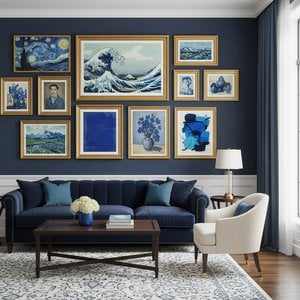
Dive into a world of captivating navy hues! Explore 10 iconic paintings – from Van Gogh's 'Starry Night' to Monet’s seascapes. Discover the stories behind these masterpieces & find museum-quality art reproductions for your home at .
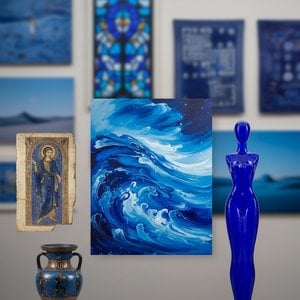
Explore the rich history of blue in art! Discover its symbolism, from ancient pigments to modern masterpieces by Kandinsky & Seurat. Uncover the psychological impact and cultural meanings behind this captivating hue.


 效果预览
效果预览
 分享
分享 分享
分享
 详情
详情

 下载
下载
 相似作品
相似作品 X射线
X射线 幻灯片播放
幻灯片播放 Stats
Stats 展开详情
展开详情









 玻璃选项仅适用于110厘米以下的尺寸。


