购买高分辨率增强版数字图像,其品质远超在线预览。
每一份文件都由我们的内部专家使用先进工具与专业的后期润色技术精心打造。我们确保每一张图像都具备卓越的清晰度、精准的色彩还原度以及细腻的细节表现。
最终文件将在 72 小时内通过电子邮件交付,并针对专业、编辑及印刷用途进行了优化。其品质与顶级设计工作室、出版社和画廊所信赖的标准完全一致。
选择 WahooArt.com,您获得的不仅仅是一张图像——您收到的是经过专业级增强、精雕细琢的数字艺术作品,并享有满意保证。以下是您的订单中自动包含的所有内容:

您的高分辨率数字图像文件将在下单后 72 小时内通过电子邮件发送给您 —— 即可立即使用。

您的艺术品经过专业优化,结合先进的 AI 技术与人工修饰,确保呈现极致的细节、清晰度与色彩准确度。

不小心删除了文件或找不到了?没关系——我们将随时为您免费重发。

即刻拥有您的艺术作品,无需支付任何关税、税费或运费——数字下载始终免税。

我们通过专业工具与色彩管理技术,确保您的数字图像尽可能真实地还原原作色彩。

如果您对所购数字图像不满意,我们将在100天内为您进行修改或提供100%的全额退款——无需任何理由。

不满意?在收到数字文件后的100天内,您可以申请全额退款——无需任何理由。

购买 3 张图片可享 10% 折扣 - 购买 5 张可享 15% 折扣 - 购买 10+ 张可享 20% 折扣。非常适合创意项目、画廊和机构使用。

In the vibrant, shifting landscape of the late Italian Renaissance, few artists captured the tension between classical order and Mannerist artifice as delicately as Carlo Urbino. Born in the Lombard town of Crema around 1525, Urbino emerged from a period of profound intellectual ferment, where the rigid structures of the High Renaissance were beginning to dissolve into the more expressive, elongated, and dramatic forms of Mannerism. His journey was one of both artistic refinement and scientific inquiry, a path that saw him move through the influential circles of Venice and Milan, leaving behind a trail of frescoes and drawings that bridge the gap between the grace of the 16 th century and the burgeoning energy of the Baroque.
Urbino’s early development was deeply rooted in the aesthetic currents of the Veneto. Training amidst the luminous traditions of Venice, he absorbed a mastery of light and color that would later define his approach to composition. However, it was his connection to the Campi family—specifically the masters Antonio, Bernardino, and Giulio Cambi—that provided the stylistic scaffolding for his career. This lineage instilled in him a penchant for complex, often crowded arrangements and a fascination with the human form in motion. His work does not merely depict a scene; it orchestrates a visual drama, utilizing sfumato and dynamic gestures to guide the viewer’s eye through intricate religious narratives.
What truly distinguishes Carlo Urbino from his contemporaries was his profound intellectual curiosity, which extended far beyond the boundaries of the canvas. He was a true Renaissance man, possessing a mind that sought to find the underlying geometry in all things. This passion for structure led to a remarkable collaboration with the mathematician and engineer Camillo Agrippa. Together, they worked on the Codex Huygens, a monumental endeavor that explored the intersection of art, proportion, and the science of armaments. Through this work, Urbino demonstrated that his interest in perspective was not merely a tool for illusion, but a way to understand the very mechanics of the physical world.
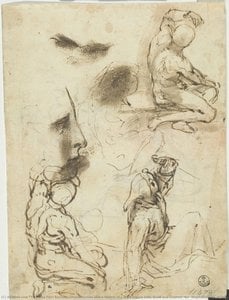
This scientific rigor is often visible in his preparatory drawings and sketches. Whether working with ink, sanguine, or pen, Urbino possessed an ability to distill complex anatomical truths into elegant lines. His studies for religious compositions were not merely blueprints but explorations of weight, balance, and tension. This duality—the ability to be both a dreamer of divine visions and a student of mathematical precision—allowed him to create works that felt both spiritually transcendent and physically grounded.
As his reputation grew, Urbino’s career found its most significant momentum in Milan, where he secured prestigious commissions from the era's most influential patrons. His work for Vespasiano Gonzaga and Alessandro Sforza placed him at the heart of Lombard political and religious life. In the sacred spaces of Milan, such as the Church of Santa Maria della Passione, his frescoes breathed life into the walls, showcasing a command of perspective that could transform a flat surface into an expansive, heavenly realm. His contributions to the St. Joseph’s Chapel remain a testament to his ability to handle large-scale religious iconography with both solemnity and grace.
The breadth of his artistic output can be seen in several key areas of his career:
By the time of his death in 1585, Carlo Urbino had helped establish a stylistic bridge that would support the weight of the coming Baroque era. He left behind an oeuvre that serves as a vital link in the history of Italian art—a legacy defined by the seamless integration of the eye's beauty and the mind's logic. His ability to navigate the transition from the balanced ideals of the Renaissance to the emotive complexity of Mannerism ensures his place as a pivotal figure in the evolution of European painting.

1525 - 1585 , Italy


 效果预览
效果预览
 切换至版画销售渠道
 分享
分享 分享
分享
 详情
详情

 下载
下载
 相似作品
相似作品 X射线
X射线 幻灯片播放
幻灯片播放 统计数据
统计数据
 展开详情
展开详情