
 Mixed MediaWallArtMongol Zurag
 2014Contemporary
 194.0 x 144.0 cm
 Queensland Art Gallery | Gallery of Modern Art
Get a print-ready file that goes far beyond the web preview. Every digital image we sell comes from a high-resolution master in our stock database — usually 5,000 to 15,000 pixels wide — so you can print large, crop tightly, or reproduce fine detail with confidence.
No file leaves our studio untouched. A digital expert checks the colors against the original painting and corrects them if needed, then improves clarity and detail with professional retouching tools — always staying faithful to the artist's brushwork and style. The result is an image that looks like the painting, not like a filtered scan.
You approve before you're done: our expert sends the image by e-mail within 72 hours for your review. Not satisfied? Ask for improvements or corrections, or request a refund if the quality falls short.
This is the quality relied on by publishers, design studios, galleries and print shops.
下载高分辨率文件,用于个人展示、打印及创意项目。 ( 切换至版画销售渠道 订购此收藏品的纯手工复刻画作)
选择 WahooArt.com,您获得的不仅仅是一张图像——您收到的是经过专业级增强、精雕细琢的数字艺术作品,并享有满意保证。以下是您的订单中自动包含的所有内容:
您的高分辨率数字图像文件将在下单后 72 小时内通过电子邮件发送给您 —— 即可立即使用。
您的艺术品经过专业优化,结合先进的 AI 技术与人工修饰,确保呈现极致的细节、清晰度与色彩准确度。
不小心删除了文件或找不到了?没关系——我们将随时为您免费重发。
即刻拥有您的艺术作品,无需支付任何关税、税费或运费——数字下载始终免税。
我们通过专业工具与色彩管理技术,确保您的数字图像尽可能真实地还原原作色彩。
如果您对所购数字图像不满意,我们将在100天内为您进行修改或提供100%的全额退款——无需任何理由。
不满意?在收到数字文件后的100天内,您可以申请全额退款——无需任何理由。
购买 3 张享 10% 折扣 - 购买 5 张享 15% 折扣 - 购买 10 张以上享 20% 折扣。非常适合创意项目、画廊及机构使用。
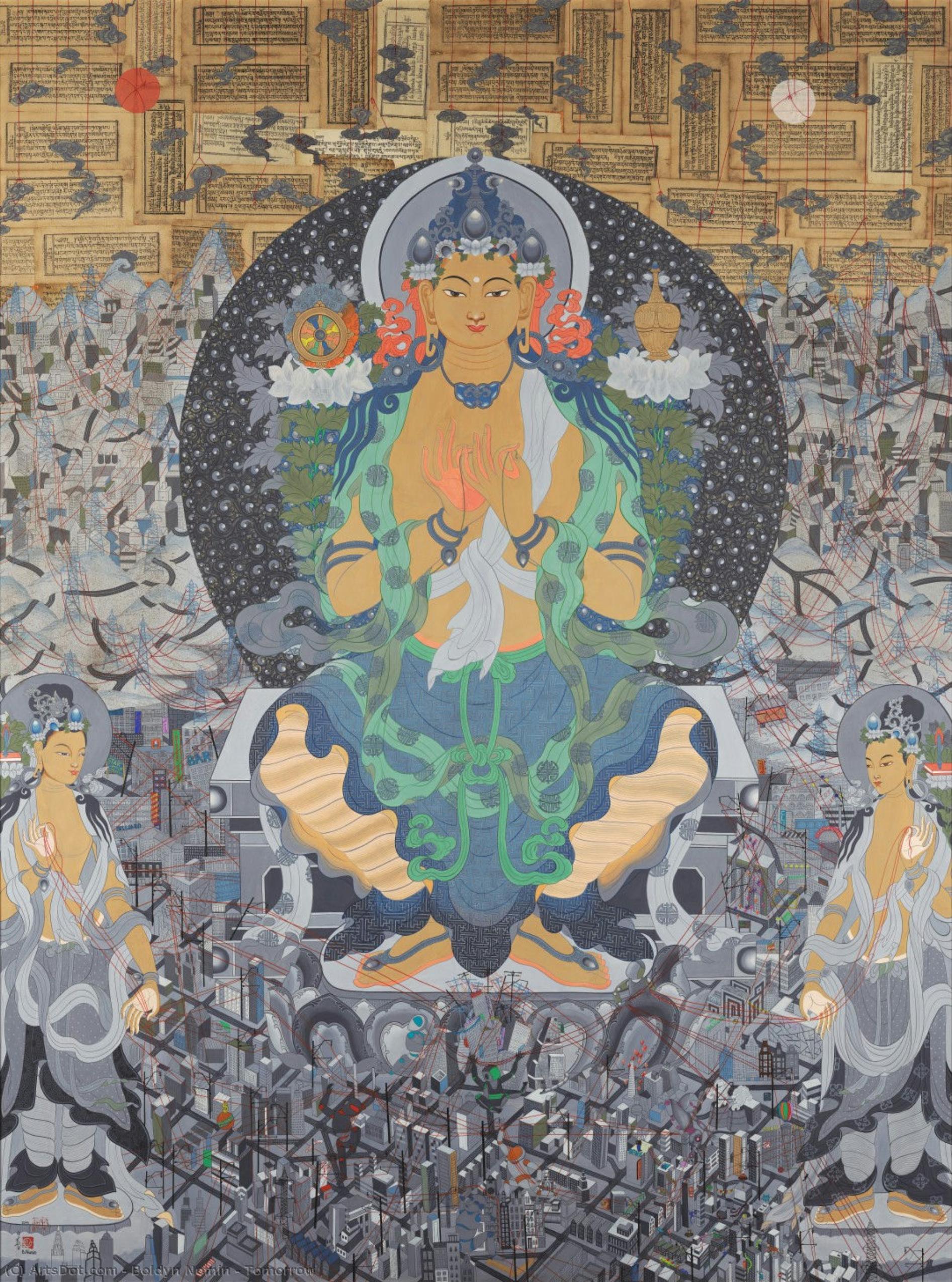
In the breathtaking masterpiece Tomorrow, the contemporary Mongolian artist Nomin Bold orchestrates a visual symphony that bridges the ancient spiritualities of the past with the electric, often jarring realities of the present. At first glance, the viewer is drawn into a celestial realm, where a large central deity sits in serene repose, flanked by two consubstantial consorts. Yet, as the eye wanders through this intricate landscape, the divine and the mundane begin to intertwine in a way that is both startling and profoundly moving. Bold utilizes the sacred geometry of Tibetan Buddhist tangka painting to structure her composition, creating a sense of eternal order that stands in stark contrast to the chaotic energy of the modern world creeping into the frame.
The brilliance of this work lies in its ability to find the divine within the urban. While the central figures command a space of spiritual stillness, the background reveals a receding tangle of city streets, rendered with a fascinating use of linear perspective. In a stroke of creative genius, Bold uses power lines—the very veins of modern infrastructure—to thread the gods through the scene, physically and metaphorically connecting the heavens to the earth. This juxtaposition serves as a poignant commentary on the contradictions of contemporary Mongolian life, where ancient traditions must navigate the rapid urbanization and technological shifts of the twenty-first century.
To appreciate Tomorrow is to understand the revival of Mongol Zurag, a painterly idiom that serves as a vessel for national identity. This style, which emerged during Mongolia's struggle for independence in the early twentieth century, is a sophisticated synthesis of Tibetan Buddhist tangka, Chinese guohua, and the equestrian artistry of the Liao dynasty. Bold’s execution of this technique is nothing short of extraordinary; her ultra-fine brushwork creates a level of detail that demands close, intimate inspection, while her use of bright, vibrant colors breathes life into every figure and element within the composition.
The artist’s technical prowess is further elevated by her experimental use of materials. By incorporating collaged pages from Mongolian scriptures and delicate gold-leafing, Bold adds a tactile, multidimensional quality to the canvas. These elements do more than just decorate; they imbue the painting with an inherent sanctity, reminding the viewer of the sacred texts that have shaped Mongolian thought for centuries. The interplay between the flat, stylized perspective characteristic of zurag and the shimmering gold accents creates a luminous effect that captures the light, making the artwork feel as though it is vibrating with its own internal energy.
For the discerning collector or interior designer, Tomorrow offers much more than mere aesthetic beauty; it provides a profound emotional resonance. The painting captures the tension of an era—the struggle between the weight of history and the uncertainty of what lies ahead. It is a work that speaks to the resilience of culture and the enduring power of spiritual symbols in a secularizing world. The presence of everyday objects, such as the apple or the subtle inclusion of birds, grounds the celestial drama in a relatable, earthly reality, making the divine feel accessible.
Owning a high-quality reproduction of this work allows one to bring a piece of Mongolia's cultural renaissance into their personal space. Whether placed in a quiet study for meditative reflection or as a bold focal point in a contemporary living area, Tomorrow serves as a conversation piece that invites inquiry and deep thought. It is an evocative testament to Nomin Bold’s ability to transform the historical struggles of her people into a universal narrative of hope, continuity, and the beautiful, complex dance between our ancestors and our future.
“Tomorrow”属于博尔德尼·诺明艺术生涯中的Mature Period时期。这一分类将该作品与艺术家的创作发展历程联系在一起。
博尔德尼·诺明 的创作主题常涉及 tibetan buddhist tangka influence, mongolian zurag revival, contemporary life contradictions, secular nationalism themes, spiritual and urban tension, mastery of fine brushwork;而《Tomorrow》则聚焦于 mongol zurag, tibetan buddhist, contemporary life, deity, gold leaf, spiritual, urbanization。


1982 - , 蒙古

 实景预览
实景预览
 发送
发送 分享
分享
 详情
详情 指南
指南

 下载图片
下载图片
 相似作品
相似作品 X射线
X射线 幻灯片播放
幻灯片播放 统计数据
统计数据 阅读全文
阅读全文


