艺术家简介
Robert Rauschenberg: A Revolutionary of the Mid-Century
Robert Rauschenberg, born Milton Ernest Rauschenberg in Port Arthur, Texas, on October 22, 1925, wasn’t simply a painter; he was a radical reimaginer of art itself. His career, spanning nearly six decades until his death in May 1986, witnessed an evolution from early explorations within the Abstract Expressionist movement to the development of his groundbreaking “Combine” paintings – works that irrevocably blurred the boundaries between painting, sculpture, and everyday objects. Rauschenberg’s life was marked by a restless curiosity and a profound engagement with the world around him, qualities that profoundly shaped his artistic vision. He initially studied at the University of Texas at Austin, but interrupted his education to serve in the Navy during World War II. This period instilled in him a deep appreciation for the unexpected juxtapositions and inherent contradictions within American culture – themes that would become central to his later work.
Early Influences and the Rise of Assemblage
Rauschenberg’s artistic journey began with an immersion in the vibrant, experimental art scene of post-war New York. He initially aligned himself with Abstract Expressionism, exhibiting a raw energy and gestural approach reminiscent of Jackson Pollock. However, he quickly grew dissatisfied with the perceived limitations of this style, seeking new ways to express his ideas. This dissatisfaction led him to explore “Assemblage,” a technique that began in 1954. These early assemblages – often constructed from found objects like tires, fabric scraps, and discarded materials – were not merely decorative; they were deliberate critiques of consumer culture and the commodification of art. Rauschenberg’s use of these everyday items challenged traditional notions of artistic value and invited viewers to reconsider their relationship with the objects that surrounded them. The influence of Marcel Duchamp's readymades was undeniably significant, but Rauschenberg pushed beyond mere appropriation, imbuing his assemblages with a palpable sense of process and materiality.
The “Combine” Paintings: A Synthesis of Disciplines
Rauschenberg’s most celebrated achievement is undoubtedly the “Combine” paintings, developed between 1954 and 1964. These works represent a radical departure from traditional painting techniques, integrating elements of both painting and sculpture into a single, unified object. He would often paint on a wooden board or canvas, then attach found objects – a shoe, a piece of fabric, a photograph, a toy – directly to the surface. The resulting paintings were complex, layered constructions that demanded close examination, inviting viewers to decipher their meaning through a process of visual and intellectual engagement. The “Canyon” (1959) is perhaps the most iconic example, a sprawling, chaotic composition incorporating a discarded tire, a photograph of a canyon landscape, and layers of paint. These works weren’t simply paintings with added objects; they were entirely new forms of artistic expression, demonstrating Rauschenberg's mastery of materials and his ability to create unexpected dialogues between disparate elements.
Expanding Horizons: Printmaking, Performance, and Beyond
Rauschenberg didn’t limit himself to painting and assemblage. He actively explored printmaking throughout his career, experimenting with various techniques including screenprinting and lithography. His prints often incorporated collage elements and reflected the same conceptual concerns as his paintings – a fascination with chance, process, and the relationship between image and object. In the 1960s, Rauschenberg began to incorporate performance art into his practice, creating elaborate, multi-media events that blurred the lines between artist and audience. These performances were often collaborative and involved elements of improvisation and chance, reflecting his broader interest in exploring the unpredictable nature of human interaction. He also developed a deep connection with photography, using it as both a subject and a tool for artistic expression.
Legacy and Historical Significance
Robert Rauschenberg’s impact on 20th-century art is immeasurable. His innovative approach to painting, his embrace of found objects, and his willingness to challenge conventional notions of artistic practice paved the way for subsequent generations of artists working in collage, assemblage, and mixed media. He was a key figure in the development of Pop Art, though he resisted easy categorization, preferring to describe his work as “object-painting.” Rauschenberg’s legacy extends beyond specific artworks; it lies in his spirit of experimentation, his commitment to process over product, and his profound engagement with the complexities of contemporary culture. He remains a vital influence on artists today, reminding us that art can be found in the most unexpected places – in discarded objects, chance encounters, and the ever-evolving relationship between artist and audience. His work continues to provoke thought and inspire creativity, solidifying his place as one of the most important and influential American artists of the 20th century.










 效果预览
效果预览
 购买手绘画作
 分享
分享 分享
分享
 详情
详情

 下载
下载
 相似作品
相似作品 X射线
X射线 幻灯片播放
幻灯片播放

 展开详情
展开详情






































 玻璃选项仅适用于110厘米以下的尺寸。


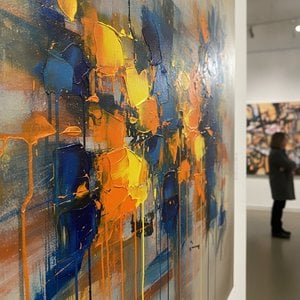
![Abstract Composition [triptych] — Vaclav Vytlacil, Abstract Expressionism](/media/artworks/images-thumb/08/3c/083c0675045645fd42d4e6c6d63f1ced.jpg)


