
x


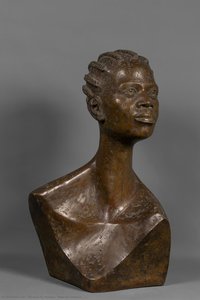
 1986
1986 94.0 x 20.0 cm
 Yemisi Shyllon Museum of Art
从与原作比例一致的预设尺寸中进行选择。

您可以输入自定义尺寸,以适配特定的画框或空间。如果所选尺寸与原图比例不符,我们将通过裁剪作品或添加手绘元素来扩展画面。数字样稿将在制作开始前发送给您确认。
请注意,屏幕预览无法准确反映实际的裁剪或扩展效果,只有样稿才能真实呈现最终的构图。
虽然我们提供定制尺寸服务,但为了保留原作比例,建议您从预设列表中选择尺寸。

Untitled
复制品尺寸
The story of Benson G. Osawe is one of profound continuity, a bridge spanning the ancient traditions of the Edo Kingdom and the bold frontiers of international modernism. Born in 1931 in Agbozoman, Delta State, Osawe’s destiny was etched into his very beginnings. He was the son of a master carver at the royal court of the Oba Eweka II, a lineage that provided him with an intimate, first-hand education in the sacred art of the Benin Palace. This early immersion in the rhythmic precision of traditional carving instilled in him a deep reverence for materiality and the symbolic weight of form. Long before he encountered the avant-garde movements of Europe, Osawe was already conversant in the language of wood and bronze, learning how a single stroke could evoke the dignity of an entire civilization.
His journey from the ancestral workshops of Nigeria to the cosmopolitan studios of London marked a transformative era in his artistic development. Moving to England in 1956, Osawe sought to expand his technical vocabulary, enrolling at the School of Graphic Art and later the prestigious Camberwell School of Art and Crafts between 1960 and 1965. It was within this crucible of European modernism that his style began to undergo a breathtaking metamorphosis. While he absorbed the principles of abstraction, geometric simplicity, and the interplay of light and shadow characteristic of mid-century Western art, he never abandoned the soul of his heritage. Instead, he achieved a rare synthesis: a way to use the sleek, polished surfaces of modern sculpture to breathe new life into ancient African motifs.
Osawe’s sculptural oeuvre is a masterclass in deliberate abstraction. He possessed a singular ability to strip away the superfluous, leaving behind only the essential truth of his subjects. Working primarily with wood, bronze, and even cement, he crafted figures that felt both grounded in the earth and ethereal in their grace. His fascination with the tension between solidity and emptiness allowed him to create works that were not merely static objects, but meditations on the human condition. In his hands, a smooth, polished curve of bronze could convey the profound resilience of a woman or the quiet strength of an ancestral spirit.
His thematic focus often centered on the celebration of African identity and the nuanced complexities of human nature. Many of his most celebrated works explore:
The historical significance of Benson G. Osawe cannot be overstated. He emerged during the post-independence era as a pioneer who refused to let African art be relegated to the past. By integrating the sophisticated techniques of the London art scene with the ancestral rhythms of the Benin Kingdom, he helped define a new, contemporary Nigerian aesthetic. His work was not a rejection of tradition, but an evolution of it—a way to ensure that the visual language of his ancestors could speak fluently to a modern, global audience.
Throughout his illustrious career, which saw him representing Nigeria at prestigious international venues such as the Commonwealth Festival in Glasgow, Osawe remained anchored to his roots. His return to Nigeria and his eventual practice as a freelance artist allowed him to remain a living link between generations of sculptors. Today, his legacy endures not just in the physical bronze and wood he left behind, but in the enduring spirit of Nigerian Modernism—a movement characterized by the same courage, resilience, and profound beauty that Osawe so masterfully captured in every piece he touched.
1931 - 2007 , Nigeria


第一时间获取最新的艺术新闻、独家优惠及装饰灵感。
向我们介绍您的项目需求,我们的艺术专家将为您提供 3 个个性化的艺术品推荐。
由我们的专家为您精选 3 款心仪之作 —— 完全免费!


 效果预览
效果预览
 购买印刷品
购买印刷品 分享
分享 分享
分享
 详情
详情

 下载
下载
 相似作品
相似作品 X射线
X射线 幻灯片播放
幻灯片播放 展开详情
展开详情






































 玻璃选项仅适用于110厘米以下的尺寸。


