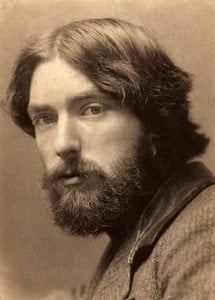
A Portrait of Resilience: The Soul of The Emir Feisal
In the quiet intensity of Augustus Edwin John’s 1919 masterpiece, The Emir Feisal, one encounters more than a mere historical likeness; one meets a profound study of human fortitude. As the world grappled with the seismic shifts following the Great War, John turned his gaze toward Sheikh Feisal bin Abdulaziz Al Saud, capturing a moment of stillness amidst global turbulence. The portrait does not simply present the face of a future monarch; it distills the very essence of dignity. Through a masterful command of light and shadow, the artist invites the viewer into a private space of contemplation, where the weight of leadership and the gravity of history converge in a single, piercing gaze.
The composition is a triumph of realist technique, characterized by John’s ability to breathe life into texture and form. The Sheikh is depicted in formal, traditional attire, with a dark robe draped elegantly over his shoulder, creating a rhythmic interplay of deep tones and soft highlights. John employs chiaroscuro—the dramatic tension between light and dark—to sculpt the subject's features, lending a sculptural three-dimensionality to the face and the intricate folds of the turban. Every brushstroke feels deliberate, yet possesses a fluid vitality that prevents the realism from feeling static. The subtle rendering of the decorative elements on his headwear, suggesting pearls or fine beads, showcases a meticulous attention to detail that rewards close, lingering inspection.
Symbolism and the Weight of Wisdom
Beyond the physical accuracy of the portrait lies a rich tapestry of symbolic meaning. Held firmly within the Sheikh’s hands is a book, an element that serves as a silent testament to intellectual engagement and the pursuit of knowledge. In this context, the book transcends its material form to represent the wisdom and cultural heritage central to the identity of the Arabian Peninsula during its formative years. This connection between the subject and his scholarly attribute imbues the painting with an aura of quiet authority, suggesting a leader whose power is rooted in deep-seated intellect and tradition.
The emotional impact of the work is anchored by the subject's direct gaze. By looking squarely at the viewer, Feisal establishes an immediate, respectful connection, demanding recognition while maintaining an air of impenetrable composure. This psychological depth makes the painting an extraordinary piece for any collection; it possesses a commanding presence that can anchor a room, offering a sense of stability and historical continuity. For the discerning collector or interior designer, The Emir Feisal offers a sophisticated focal point—a window into a transformative era of history, rendered with a poetic sensitivity that continues to resonate across generations.
常见问题与解答
针对 奥古斯都·埃德温·约翰 的《The Emir Feisal》 的版画,推荐的尺寸和方向是什么?
对于“The Emir Feisal”,建议的打印设置尺寸为 Medium,方向为 Portrait。
奥古斯都·埃德温·约翰 的《The Emir Feisal》 的主导色是什么?
在“The Emir Feisal”中,最引人注目的颜色是Driftwood (#88714a)。了解作品的主色调有助于将其与室内装饰进行搭配。
"The Emir Feisal" 的画幅比例是多少?
"The Emir Feisal" 的画幅格式为 Portrait。这对于规划复制品的摆放位置非常有用。