
x































从与原作比例一致的预设尺寸中进行选择。

您可以输入自定义尺寸,以适配特定的画框或空间。如果所选尺寸与原图比例不符,我们将通过裁剪作品或添加手绘元素来扩展画面。数字样稿将在制作开始前发送给您确认。
请注意,屏幕预览无法准确反映实际的裁剪或扩展效果,只有样稿才能真实呈现最终的构图。
虽然我们提供定制尺寸服务,但为了保留原作比例,建议您从预设列表中选择尺寸。

Self-Portrait
复制品尺寸
Anna Maria van Schurman’s “Self-Portrait,” created in 1640 at the age of thirty-three, is more than a simple likeness; it’s a carefully constructed statement about identity, intellect, and the constraints placed upon women during the Dutch Golden Age. This remarkable engraving, executed with a masterful blend of etching and engraving techniques, offers a rare glimpse into the mind of a truly exceptional individual – a scholar, poet, philosopher, and artist who defied societal expectations to pursue her intellectual passions.
The portrait itself is framed within an elegant oval, a formal device common in 17th-century portraiture. Van Schurman presents herself with quiet dignity, dressed in a richly embellished gown of deep blue, adorned with delicate lace detailing on the bodice and sleeves. Her attire speaks to her social standing and reflects the fashionable styles of the period, yet it’s subtly understated, avoiding ostentation and emphasizing her inner qualities rather than outward display. The artist has skillfully rendered the illusion of spatial depth through careful shading – a subtle recession around the oval frame draws the viewer's eye back into the picture plane, creating a sense of distance and suggesting that she is positioned slightly behind a ledge.
What truly distinguishes this portrait is Van Schurman’s innovative use of engraving and etching. The fine lines, meticulously etched into the metal plate, create a remarkably detailed surface texture – one can almost feel the delicate weave of her dress or the subtle contours of her face. Hatching and cross-hatching are employed extensively to model form and establish shadows, lending a remarkable sense of volume and realism to the image. The combination of these techniques allows for both precise detail and a nuanced understanding of light and shadow, elevating the portrait beyond a mere representation to a sophisticated artistic statement.
Interestingly, Van Schurman’s decision to combine engraving and etching was not merely technical; it reflected her intellectual approach – a willingness to synthesize different methods and disciplines. This fusion is mirrored in the portrait itself: the formal structure of the oval frame juxtaposed with the intimate portrayal of the artist's self-reflection.
The obscured hands, deliberately positioned within the folds of her gown, are perhaps the most compelling element of this portrait. Constantijn Huygens, a contemporary poet and statesman, famously chided Van Schurman for this choice, suggesting she was ashamed of her “ink-stained hands,” those tools of her craft. This seemingly minor detail carries significant symbolic weight. It speaks to the societal pressures placed upon women during the 17th century – expectations that they should prioritize domesticity over intellectual pursuits and that their hands should be reserved for household tasks, not artistic creation.
The inscription at the bottom of the frame, a plea addressed to her friends, further illuminates this theme: “See my likeness depicted in this portrait:/May your favor perfect the work where art has failed.” It’s a subtle assertion of her worth – a recognition that her artistic endeavors are not merely hobbies but genuine expressions of her intellect and spirit. The request for "favor" suggests a desire for acceptance and validation, reflecting the challenges she faced as a woman pursuing intellectual life in a male-dominated world.
Anna Maria van Schurman’s “Self-Portrait” is not simply a beautiful work of art; it's a poignant testament to her courage and intellect. It embodies the spirit of a Renaissance woman who defied convention, embraced knowledge, and left an indelible mark on both the artistic and intellectual landscape of her time. The portrait invites us to contemplate the complexities of identity, the constraints imposed by societal expectations, and the enduring power of self-expression – themes that resonate powerfully even today.
In the vibrant, intellectually charged atmosphere of the seventeenth-century Netherlands, few figures shone with as much multifaceted brilliance as Anna Maria van Schurman. Born in Cologne in 1607 to a wealthy and noble Protestant family, her life was a testament to the power of intellect over the restrictive boundaries of gender. While many women of her era were confined to the domestic sphere, Schurman’s early years were defined by an insatiable hunger for knowledge. Under the tutelage of her father, Frederik van Schurman, she mastered Latin and various other classical languages by the tender age of four, setting the stage for a life that would bridge the gap between the delicate arts and the rigorous world of philosophy.
As her family moved to Utrecht in 1623, Schurman became a central figure in the city's burgeoning intellectual scene. She was not merely a student but a polymath whose talents spanned the spectrum of human creativity. Her hands were as skilled at the delicate art of embroidery and intricate paper cuttings as they were capable of wielding the tools of more permanent media. This versatility allowed her to navigate both the social expectations of a lady of distinction and the demanding technical requirements of a professional artist, earning her an honorary membership in the prestigious Guild of Saint Luke in Utrecht in 1643—a rare and profound recognition for a woman of her time.
Schurman’s artistic development was deeply intertwined with her scholarly pursuits. While she maintained that much of her learning was self-directed, the influence of established masters provided a vital foundation for her technical mastery. In the 1630s, she sought instruction in drawing and engraving from Magdalena van de Passe, a pioneering female engraver whose work helped pave the way for women in the graphic arts. Through this training, Schurman developed a command over various mediums, producing small-scale portraits, self-portraits, and sculptures crafted from wax or boxwood. Her work often possessed a refined elegance, mirroring the precision found in her celebrated calligraphy.
Her artistry was never an isolated endeavor; it served as a visual extension of her profound linguistic and philosophical capabilities. To observe her calligraphy was to witness a symphony of script, as she could transcribe complex texts in over a dozen ancient and modern languages. This ability to marry the aesthetic beauty of the written word with deep intellectual content made her a sensation across Europe. She became known as the "Utrecht Minerva," a title that bestowed upon her the mantle of the goddess of wisdom, reflecting her status as a scholar who could navigate the complexities of science, literature, and theology with equal grace.
Beyond the physical beauty of her engravings and portraits lies a legacy of profound social significance. Schurman was a vocal advocate for the education of women, publishing dissertations and treatises that challenged the prevailing notion that women were unfit for the rigors of academic study. Her correspondence network was a who's who of the seventeenth-century intellectual elite, including luminaries such as René Descartes and Constantijn Huygens. Through these letters, she engaged in the most pressing debates of her day, asserting the right of the female mind to participate in the advancement of human knowledge.
However, her life also underwent a dramatic spiritual transformation. In her later years, her devotion to the Labadist community—a Protestant sectarian group—led her to retreat from the secular pursuits of science and classical literature. While this shift moved her away from the public intellectual stage, it did not diminish the impact of her earlier contributions. Anna Maria van Schurman remains a singular icon of the Dutch Golden Age: a woman who refused to be contained by a single frame, much like the very art she created, leaving behind a trail of inspiration for every artist and scholar who dares to transcend the limits of their era.

1607 - 1678 , Germany

探索伦勃朗25幅杰作,领略荷兰黄金时代光影大师的艺术传奇!从《夜巡》到自画像,深入了解巴洛克艺术、历史绘画与人物肖像背后的故事。WahooArt.com提供高清艺术复制品及家居装饰灵感。立即探索完整系列!

Explore the life & work of Adriaen van Ostade, a leading Dutch Golden Age painter. Discover his realistic genre scenes, social commentary, and lasting influence on art history. Learn more at WahooArt.

Discover Jan van Goyen, the master of Dutch landscape painting. Explore his subtle technique, atmospheric realism & lasting influence on art history. Learn about this 17th-century pioneer at WahooArt.
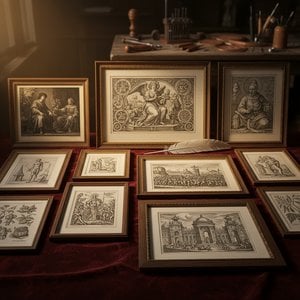
Journey through art history with our Top 10 Legendary Engravings! Explore masterpieces by Dürer, Rembrandt & Goya. Discover the stories behind these iconic prints and find museum-quality reproductions for your home at WahooArt.com.

Explore the captivating world of Dutch Golden Age still life with Abraham van Beyeren. Discover his innovative techniques, symbolic banquet scenes & lasting influence on art history. Learn about collecting these masterpieces.


第一时间获取最新的艺术新闻、独家优惠及装饰灵感。
向我们介绍您的项目需求,我们的艺术专家将为您提供 3 个个性化的艺术品推荐。
由我们的专家为您精选 3 款心仪之作 —— 完全免费!


 效果预览
效果预览
 购买印刷品
购买印刷品 分享
分享 分享
分享
 详情
详情

 下载
下载
 相似作品
相似作品 X射线
X射线 幻灯片播放
幻灯片播放

 展开详情
展开详情









 玻璃选项仅适用于110厘米以下的尺寸。


