
博物馆级艺术微喷或帆布版画,制作高效,并提供多种饰面选择。 ( 购买手绘画作 切换至数字图像销售渠道)





























从与原作比例一致的预设尺寸中进行选择。

您可以输入自定义尺寸,以适配特定的画框或空间。如果您选择的尺寸与原图比例不符,我们将对作品进行裁剪,或通过镜像填充/纯色填充边缘的方式来扩展图像。在开始制作之前,我们会向您发送一份数字效果图供您确认。
请注意,屏幕上的预览并不能反映实际的裁剪或扩展效果。只有效果图才能准确展示最终的构图。
虽然我们提供定制尺寸,但为了保持原图比例,我们建议您从预设列表中选择尺寸。

Virgin and Child
复制品尺寸
In the quiet intimacy of Andrea Mantegna’s 'Virgin and Child', painted around 1470, we encounter more than a mere religious icon; we step into a profound dialogue between the earthly and the divine. This masterpiece serves as a breathtaking embodiment of the humanist spirit that began to pulse through Renaissance Italy. Rather than presenting a flattened, symbolic arrangement common in earlier medieval art, Mantegna utilizes an unprecedented mastery of linear perspective to create a window of immense depth. The viewer is not merely observing a scene but is drawn into a sacred space where the architectural grandeur of Roman antiquity meets the tender vulnerability of maternal love. It is a work that commands attention through its structural brilliance and its ability to make the spiritual feel tangibly present.
The composition is a triumph of spatial illusion, reflecting Mantegna’s deep fascination with classical Roman principles. By meticulously calculating the recession of space, he mirrors the monumental feeling of ancient temples and theaters, elevating the figures of Mary and Jesus above the mundane. The Virgin Mary sits upon a throne that evokes the dignity of imperial iconography, her pose radiating an authority that is both regal and deeply compassionate. As she gazes down at the infant Christ, her expression carries a weight of contemplative melancholy, a subtle foreshadowing of the sacrifice to come. This emotional complexity is balanced by the peaceful slumber of the Child, whose innocence provides a serene counterpoint to the heavy historical significance surrounding him.
Mantegna’s technical prowess is most evident in his restrained yet luminous palette. Dominated by earthy, resonant hues such as ochre, umber, and terracotta, the painting possesses a somber beauty that feels grounded in the very soil of Italy. Through the meticulous layering of thin glazes over precise underdrawings, Mantegna achieved a surface of remarkable smoothness and light-catching luminosity. This technique allows for subtle gradations of color that breathe life into the fabric of Mary’s blue cloak—a hue traditionally used to symbolize purity and divinity—and the fine white cloth swaddling the Christ child. This white shroud, while representing innocence, also serves as a poignant symbolic link to the shroud of the crucifixion, adding a layer of theological depth to the visual narrative.
For the discerning collector or interior designer, this artwork offers an unparalleled sense of timelessness and gravitas. The soft, diffused lighting creates an atmosphere of quiet sanctuary, making it an ideal centerpiece for spaces designed for reflection, study, or sophisticated repose. The interplay between the dark, indistinct background and the highly detailed, realistic facial features ensures that the emotional core of the piece remains the focal point. To possess a reproduction of this work is to bring into one's environment a fragment of the Renaissance—a piece that celebrates the intersection of archaeological accuracy, technical innovation, and the enduring power of human emotion.

1431 - 1506 , 意大利
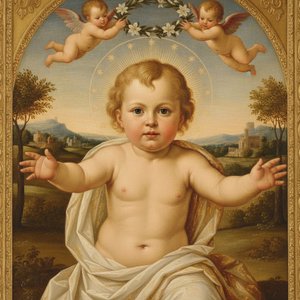
Explore the profound beauty of Baby Jesus in fine art history. From Raphael's Renaissance masterpieces to symbolic light, discover how classical painters captured divine innocence through masterful technique and sacred iconography.

Explore the profound beauty of Marian iconography through an art historian's lens. Discover iconic masterpieces by Raphael and Renaissance masters, celebrating the divine grace and timeless elegance of the Virgin Mary in classical fine art.

Embark on a profound journey through art history with our exploration of the most iconic depictions of the Virgin Mary. Discover the divine grace, symbolism, and masterful techniques found in Renaissance masterpieces and sacred iconography.


 效果预览
效果预览
 分享
分享 分享
分享
 详情
详情

 下载
下载
 相似作品
相似作品 X射线
X射线 幻灯片播放
幻灯片播放 统计数据
统计数据

 展开详情
展开详情









 玻璃选项仅适用于110厘米以下的尺寸。


