
由我们的艺术家按需定制,为您提供您所选尺寸及画框的布面手工油画。 ( 切换至版画销售渠道 切换至数字图像销售渠道)





























从与原作比例一致的预设尺寸中进行选择。

您可以输入自定义尺寸,以适配特定的画框或空间。如果所选尺寸与原图比例不符,我们将通过裁剪作品或添加手绘元素来扩展画面。数字样稿将在制作开始前发送给您确认。
请注意,屏幕预览无法准确反映实际的裁剪或扩展效果,只有样稿才能真实呈现最终的构图。
虽然我们提供定制尺寸服务,但为了保留原作比例,建议您从预设列表中选择尺寸。

untitled (1471)
复制品尺寸
Amedeo Modigliani’s “Untitled (1471),” a captivating portrait of a man and woman locked in an unspoken exchange, is more than just a depiction of two figures; it’s a profound meditation on connection, longing, and the inherent melancholy that permeated the artist's life. Painted around 1921, shortly before his untimely death at the age of 35, this work embodies the core tenets of Modigliani’s distinctive style – elongated forms, piercing eyes, and an atmosphere of quiet intensity. The painting immediately draws the viewer in with its carefully constructed composition: a man and woman stand side-by-side, their gazes directed towards something just beyond the frame, creating a sense of shared observation yet also individual introspection.
The man, rendered with Modigliani’s signature elongated neck and subtly almond-shaped eyes, exudes an air of contemplative seriousness. His posture is formal, accentuated by the tie he wears – a detail that hints at a societal expectation of decorum, perhaps contrasting with the emotional depth of his expression. Across from him, the woman possesses a captivating vulnerability. Her mouth is slightly open, as if caught mid-sentence or in a moment of profound thought, and her eyes hold a mixture of curiosity and gentle sadness. The interplay between these two figures – their averted gaze suggesting both intimacy and distance – forms the heart of the painting’s power.
Modigliani’s artistic language was deeply rooted in his personal experiences and a rejection of academic conventions. He drew inspiration from African sculpture, Byzantine art, and the works of artists like Paul Gauguin and Odilon Redon, incorporating elements of abstraction and distortion into his portraits. The elongated forms characteristic of Modigliani's figures are not merely stylistic flourishes; they represent an attempt to capture the essence of a subject’s inner life – their emotional state, their vulnerability, their inherent humanity. Notice how he simplifies features, reducing them to their essential lines and planes, creating a sense of timelessness and universality.
Technically, “Untitled (1471)” is executed in oil on canvas, utilizing a technique that blends smooth, polished surfaces with areas of visible brushstrokes. This juxtaposition creates a dynamic tension between the figure’s physicality and the artist's hand. The muted color palette – dominated by browns, ochres, and subtle blues – contributes to the painting’s somber mood, further emphasizing the subjects’ emotional weight. The lighting is soft and diffused, casting gentle shadows that accentuate the contours of their faces and bodies.
Understanding Modigliani's life provides crucial context for interpreting his art. Born into a Jewish family in Livorno, Italy, he faced numerous hardships throughout his youth – illness, financial instability, and the constant struggle to find acceptance within the Parisian artistic community. His personal relationships were often fraught with difficulty, marked by unrequited love and profound loneliness. This sense of longing permeates much of his work, particularly evident in portraits like “Untitled (1471).”
The painting’s creation coincided with a period of intense creativity for Modigliani, yet also one of increasing personal turmoil. He was deeply involved with Jeanne Charbonnière, a wealthy American socialite who became his muse and confidante, but their relationship was marked by jealousy, instability, and ultimately, tragedy. It's believed that the scene depicted – the shared gaze, the unspoken connection – reflects this complex dynamic, capturing a fleeting moment of intimacy amidst a backdrop of emotional uncertainty.
While the precise subject of their attention remains ambiguous, “Untitled (1471)” is rich in symbolic potential. The averted gaze suggests a shared secret, a mutual understanding that transcends words. The woman’s open mouth could represent an invitation to dialogue, while the man's intense stare hints at contemplation or perhaps even a degree of melancholy. The painting speaks to the universal human experience of connection, longing, and the search for meaning in a world often characterized by isolation. It is this potent combination of vulnerability, introspection, and quiet intensity that continues to captivate viewers today, solidifying Modigliani’s place as one of the most poignant figures in 20th-century art.

阿梅代奥·克莱门特·莫迪里亚尼,一个与忧郁美和令人心碎的浪漫紧密相连的名字。他并非生来就享有盛名,却以其独特的艺术风格,在20世纪初的艺术画卷中留下了不可磨灭的印记。1884年出生于意大利利沃尔诺,莫迪里亚尼的生命轨迹充满了疾病、贫困与对美的执着追求。他的作品,仿佛是灵魂的低语,以其特有的长颈瓶和空洞的眼眶,触动了无数人的心弦。
幼年时期,利沃尔诺这座充满商业气息的海滨城市,为莫迪里亚尼提供了丰富的文化滋养。尽管家庭后来陷入经济困境,但他的母亲和祖父给予了他广泛的知识灌输,尼采、波德莱尔等思想家对他的艺术理念产生了深远影响。疾病的折磨也伴随了他的整个童年,或许正是这些苦难,赋予了他作品中那种脆弱而敏感的情感基调。1906年,莫迪里亚尼怀揣着对艺术的热情,踏上了前往巴黎的旅程。这座城市是当时欧洲艺术的中心,汇聚了无数才华横溢的艺术家。在这里,他结识了毕加索、布朗丘西等大师,并逐渐形成了自己独特的艺术风格。
最初,莫迪里亚尼受到立体主义的影响,但很快便意识到这种风格过于僵硬,无法表达他内心的情感。他开始探索新的可能性,将非洲雕塑和意大利文艺复兴艺术的元素融入自己的创作中。这种融合催生了他标志性的“长颈瓶”风格:人物形象被拉伸至极度夸张,脖颈细长而优雅,面部表情平静而略带忧伤,仿佛凝固了永恒的瞬间。他的作品摒弃了繁琐的细节,注重捕捉人物内在的精神世界,以简洁的形式表达深刻的情感。
莫迪里亚尼的肖像画是其艺术成就的巅峰之作。他笔下的每一个人物都栩栩如生,仿佛拥有灵魂。他并非简单地复制外貌,而是通过对人物神态和姿势的细致观察,捕捉到他们内心深处的秘密。他的作品充满了同情、理解和爱意,使观者能够感受到人物的情感世界。除了肖像画,莫迪里亚尼还创作了一些裸体作品,这些作品同样具有独特的艺术魅力,展现了他对人体美的深刻理解。
尽管才华横溢,莫迪里亚尼在生前并未获得广泛的认可。他饱受贫困和疾病的折磨,生活并不幸福。与艺术家让娜·赫布特尔恩的爱情也充满了悲剧色彩。1920年,让娜不堪重负,选择了结束自己的生命,而莫迪里亚尼也在几天后因肺结核去世,享年仅35岁。然而,他的艺术却在死后获得了巨大的成功。如今,他的作品被世界各地的博物馆收藏,并以惊人的价格拍卖,成为20世纪最具价值的艺术品之一。
莫迪里亚尼的作品不仅仅是绘画或雕塑,更是对人类灵魂的一次深刻探索。他用长颈瓶般的形象,表达了对生命、爱情和死亡的思考。他的作品充满了忧郁的美感,却又蕴含着希望和力量。莫迪里亚尼是一位伟大的艺术家,他的艺术将永远激励着我们去追求真理、美和爱。

1884 - 1920 , 意大利
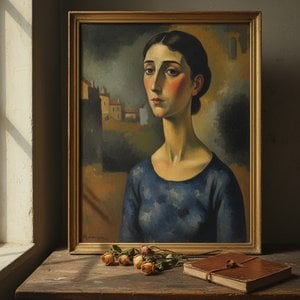
Delve into the haunting beauty of Amedeo Modigliani's portraits. Explore the intersection of Expressionism and Modernism through an expert analysis of his iconic elongated forms, melancholic gazes, and profound influence on art history.


 效果预览
效果预览
 分享
分享 分享
分享
 详情
详情

 下载
下载
 相似作品
相似作品 X射线
X射线 幻灯片播放
幻灯片播放 统计数据
统计数据
 展开详情
展开详情









 玻璃选项仅适用于110厘米以下的尺寸。


