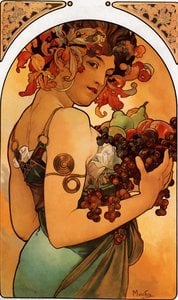
博物馆级艺术微喷或帆布版画,制作高效,并提供多种饰面选择。 ( 订购纯手工绘制画作 切换至数字图像销售渠道)





























您可以从与原作比例一致的预设尺寸中进行选择。

请输入您所需的宽度和高度,以适配您的画框或墙面。由于印刷品只能进行裁剪,无法超出原图尺寸,因此若比例不一致,画面的一部分将会被裁切。在正式印刷之前,我们会为您发送一份数字效果图供您确认。本页面显示的图片并非最终裁剪后的效果——只有效果图才能展示真实的裁剪情况。
Topaz
复刻品尺寸
Alphonse Maria Mucha (1860 – 1939), born in Ivanačice, Moravia, stands as a monumental figure within the Art Nouveau movement—a stylistic revolution that swept across Europe between 1890 and 1910. Rejecting the academic conventions of his time, Mucha forged an utterly original path, prioritizing fluidity, ornamentation, and a profound connection to nature’s rhythms.
His formative years were marked by a rebellious spirit; disillusioned with the rigid formalism of Prague’s Academy of Fine Arts, he abandoned traditional painting for illustration—a decision that proved pivotal in shaping his distinctive aesthetic. Paris beckoned in 1887, offering him not only artistic freedom but also exposure to influential avant-garde circles.
Mucha's style is instantly recognizable: a mesmerizing blend of organic forms and stylized lines reminiscent of flowing drapery and blossoming flowers. Heavily influenced by artists like Pierre-Auguste Renoir and Gustave Moreau, Mucha developed a technique characterized by meticulous watercolor washes layered upon textured paper—a process that captured the ethereal beauty he sought to convey.
His most celebrated works exemplify this approach. “The Slavonic Uprising,” for instance, brilliantly synthesizes Czech folklore with Art Nouveau’s decorative sensibilities. The painting depicts a woman warrior adorned in flowing robes and intricate floral motifs, embodying strength and grace simultaneously. Mucha's masterful use of color—particularly vibrant yellows and oranges—amplifies the emotional resonance of the scene.
Beyond mere decoration, Mucha imbued his images with symbolic meaning. Recurring motifs such as lilies, peacocks, and serpents represent purity, nobility, and primal forces respectively – elements carefully orchestrated to communicate complex narratives within a visually captivating framework. His illustrations for publications like “Salon des Cent” and “Young Farmers Breaking Flax” further cemented his reputation as a visionary artist who transcended stylistic boundaries.
The legacy of Alphonse Mucha extends far beyond the confines of Art Nouveau itself. His influence can be discerned in subsequent artistic endeavors, demonstrating the enduring power of his aesthetic principles. Today, reproductions of Mucha’s paintings continue to inspire interior designers and collectors alike—testament to the timeless beauty and intellectual depth of a singular artistic genius.

1860 - 1939 , 捷克

Explore 25 iconic Modigliani masterpieces and their soulful stories. Discover the full collection online at WahooArt.com.

Explore the profound evolution of Early Modernism. From Post-Impressionist structure to the radical fragmentation of Cubism, discover how the avant-garde redefined perception through a masterclass in art history and aesthetic revolution.

Explore the profound transition from Cézanne’s structural Post-Impressionism to the revolutionary fractured forms of Cubism. A sophisticated journey through the evolution of modern art for the discerning collector and connoisseur of fine art history.

Discover the enchanting world of Art Nouveau. Explore the flowing lines of Alphonse Mucha and learn how to integrate these timeless, organic masterpieces into your collection with expert guidance on fine art appreciation and preservation.

 实景预览
实景预览
 分享
分享 分享
分享
 详情
详情 指南
指南

 下载作品
下载作品
 相似作品
相似作品 X射线
X射线 幻灯片播放
幻灯片播放 问答
问答
 统计数据
统计数据

 展开全文
展开全文









 玻璃选项仅适用于110厘米以下的尺寸。