
x


 1904
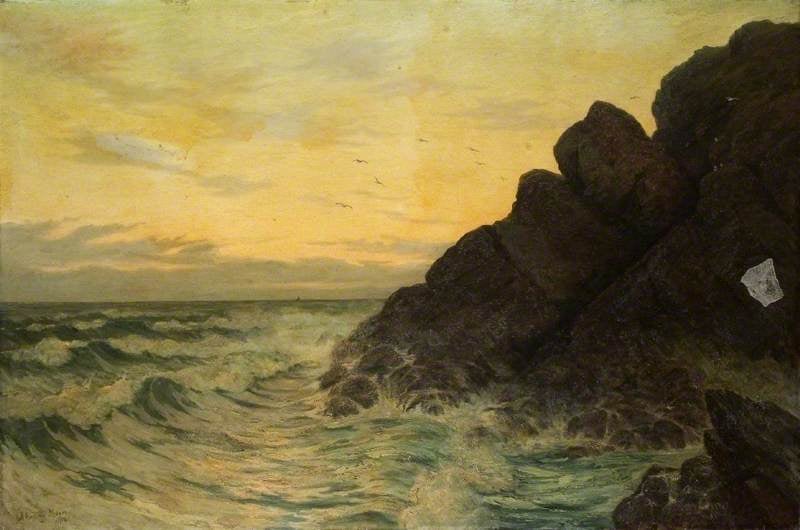
1904 99.0 x 137.0 cm
从与原作比例一致的预设尺寸中进行选择。

您可以输入自定义尺寸,以适配特定的画框或空间。如果您选择的尺寸与原图比例不符,我们将对作品进行裁剪,或通过镜像填充/纯色填充边缘的方式来扩展图像。在开始制作之前,我们会向您发送一份数字效果图供您确认。
请注意,屏幕上的预览并不能反映实际的裁剪或扩展效果。只有效果图才能准确展示最终的构图。
虽然我们提供定制尺寸,但为了保持原图比例,我们建议您从预设列表中选择尺寸。

Seascape
复制品尺寸

To wander through the canvases of Alfred Harvey Moore is to embark on a nostalgic journey along the windswept edges of the British Isles. A painter whose work breathes with the salt spray of the English Channel and the quietude of Kentish estuaries, Moore occupied a unique space in the late Victorian and Edwardian art worlds. While his biographical details are often shrouded in the soft mist of history, his artistic presence remains strikingly clear. Born in the mid-19th century—with records suggesting a life spanning from 1843 to 1905—Moore emerged as a master of the seascape, a genre that allowed him to explore the profound intersection of natural light and maritime life.
His artistic journey was one defined by a deep, personal connection to his subject matter. Eschewing the rigid constraints of formal academic training in favor of a more intuitive, observational method, Moore developed a style rooted in the rhythms of the natural world. His formative years in Liverpool, a bustling port city, likely provided the foundational imagery for his later works. The sight of heavy merchant vessels, the rhythmic movement of tides, and the industriousness of coastal communities became the vocabulary of his brush. This commitment to realism was not merely about anatomical or geographical accuracy; it was an attempt to capture the very essence of a moment—the way light fractures on a wave or how a sudden fog softens the silhouette of a distant pier.
The brilliance of Moore’s work lies in his ability to manipulate atmosphere. Influenced by the principles of Impressionism and Luminism, he moved away from harsh, definitive outlines, opting instead for a painterly approach that emphasized tonal gradations. He looked toward masters like Frederic Church and George Inness, finding inspiration in their ability to render the ephemeral qualities of light. Through soft brushstrokes and a palette of muted, sophisticated colors, Moore could transform a simple depiction of a harbor into a profound meditation on tranquility and time.
His technique allowed him to achieve a remarkable sense of depth and texture. In his depictions of scenes such as The Thames off Yantlett Creek or the ruggedness of The Old Water Mill, Walton on the Naze, one can almost feel the dampness of the air and the shifting weight of the water. His work often features:
Throughout his career, Moore achieved significant recognition within the British art community. His exhibitions in London served as a platform to showcase his evocative coastal scenes to an audience captivated by the understated elegance of his compositions. As a respected member of the Watermill Art Gallery, he contributed to a movement that celebrated the beauty of the British landscape and the quiet dignity of maritime existence. His paintings resonated with collectors who sought more than just a landscape; they sought a connection to the enduring spirit of the coast.
The historical significance of Alfred Harvey Moore resides in his ability to bridge the gap between traditional realism and the emotive power of modern light-focused movements. He did not merely document the coastline; he interpreted it through a lens of profound respect and emotional resonance. Today, his works remain cherished by those who find beauty in the fleeting moments of nature—the way a tide recedes or how the sun dips below a Kentish horizon. His legacy is one of tranquility, a permanent record of a vanished era of maritime splendor, preserved forever in the soft, luminous strokes of his brush.


第一时间获取最新的艺术新闻、独家优惠及装饰灵感。
向我们介绍您的项目需求,我们的艺术专家将为您提供 3 个个性化的艺术品推荐。
由我们的专家为您精选 3 款心仪之作 —— 完全免费!

 效果预览
效果预览
 购买手绘画作
 分享
分享 分享
分享
 详情
详情

 下载
下载
 相似作品
相似作品 X射线
X射线 幻灯片播放
幻灯片播放 展开详情
展开详情






































 玻璃选项仅适用于110厘米以下的尺寸。


