
 Oil On CanvasWallArtAcademic Realism
 1865
1865 238.0 x 170.0 cm
 Musee National du Chateau de Compiegne
博物馆级艺术微喷或帆布版画,制作高效,并提供多种饰面选择。 ( 购买手绘画作 切换至数字图像销售渠道)





























从与原作比例一致的预设尺寸中进行选择。

您可以输入自定义尺寸,以适配特定的画框或空间。如果您选择的尺寸与原图比例不符,我们将对作品进行裁剪,或通过镜像填充/纯色填充边缘的方式来扩展图像。在开始制作之前,我们会向您发送一份数字效果图供您确认。
请注意,屏幕上的预览并不能反映实际的裁剪或扩展效果。只有效果图才能准确展示最终的构图。
虽然我们提供定制尺寸,但为了保持原图比例,我们建议您从预设列表中选择尺寸。

Emperor Napoleon III
复制品尺寸
Alexandre Cabanel's “Emperor Napoleon III” is more than just a portrait; it’s a meticulously crafted tableau of imperial authority and subtle introspection. Painted in 1865, this monumental work—measuring an impressive 238 x 170 cm—captures the essence of a man grappling with the weight of his reign and the legacy of his predecessor. Commissioned by Napoleon III himself, it stands as a testament to Cabanel’s mastery of academic painting, showcasing a profound understanding of light, texture, and the psychological nuances of portraiture.
Cabanel, a leading figure in the French Salon movement, was renowned for his ability to render the human form with breathtaking realism and an almost sculptural quality. He achieved this through painstaking observation and a rigorous adherence to classical principles—a discipline instilled within him at the École des Beaux-Arts. “Emperor Napoleon III” exemplifies this approach; every detail, from the rich velvet of the emperor’s attire to the delicate folds of his drapery, is rendered with exquisite precision. The painting isn't merely a likeness but an embodiment of power and dignity, reflecting the carefully constructed image Napoleon III sought to project.
The composition immediately draws the eye to the central figure – Napoleon III himself. He stands in a commanding pose, his gaze direct and unwavering, projecting an aura of self-assurance. However, it’s not simply a display of strength; Cabanel subtly introduces elements of contemplation. The emperor's hand rests lightly on his hip, suggesting both control and a certain weariness—a quiet acknowledgment of the burdens of leadership. The inclusion of a crown resting upon a table, alongside an open book, is laden with symbolism. The crown represents imperial authority, while the book hints at Napoleon III’s intellectual pursuits and desire to be perceived as more than just a military leader.
Cabanel masterfully employs chiaroscuro—the dramatic contrast between light and shadow—to heighten the sense of drama and depth. Light falls primarily upon the emperor's face and upper body, drawing attention to his features while leaving the background in relative darkness. This technique not only creates a visually striking image but also serves to emphasize Napoleon III’s importance within the scene. The subtle use of color further enhances this effect; rich reds and deep blues dominate the palette, evoking a sense of grandeur and formality.
“Emperor Napoleon III” was created during a pivotal moment in French history—the Second Empire (1852-1870). Under Napoleon III’s rule, France experienced significant economic growth, modernization, and territorial expansion. However, the era was also marked by political tensions and ultimately culminated in the Franco-Prussian War of 1870. The portrait reflects this complex period, capturing the emperor's ambition and authority while subtly hinting at the challenges he faced.
Cabanel’s work is considered a quintessential example of academic painting—a style characterized by its realism, meticulous detail, and adherence to classical conventions. His influence extended far beyond his own lifetime, shaping the artistic landscape of 19th-century France. “Emperor Napoleon III” stands as a powerful testament to Cabanel’s skill and artistry, offering a captivating glimpse into the world of imperial France and the complex personality of its ruler. It remains a significant work in the collection of the Musée National du Château de Compiegne, inviting viewers to contemplate the enduring legacy of this remarkable portrait.


1875 - 1889 , 法国

Explore the rich history of French art, from the Salon to Impressionism & beyond. Discover iconic masters, key movements, and expert guidance for collecting timeless masterpieces. WahooArt.

Explore the captivating world of Alexandre Cabanel, master of French Academic painting. Discover his iconic works, Salon success & lasting influence on art history. High-quality reproductions available at WahooArt.

Explore the life & art of Charles Le Brun, master of French Baroque Classicism. Discover his royal commissions, influence on Versailles, and enduring legacy through detailed analysis & stunning artworks.
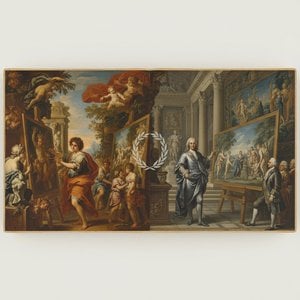
Explore the life & art of Simon Vouet, a pivotal French Baroque painter who introduced Italian styles to France. Discover his masterpieces and lasting influence on 17th-century art.

Explore the captivating world of Paul Huet (1803-1869), a master of French Romantic landscape painting. Discover his influence on Barbizon & Impressionism, and browse high-quality reproductions at WahooArt.


 效果预览
效果预览
 分享
分享 分享
分享
 详情
详情

 下载
下载
 相似作品
相似作品 X射线
X射线 幻灯片播放
幻灯片播放 统计数据
统计数据 展开详情
展开详情









 玻璃选项仅适用于110厘米以下的尺寸。


