
 PaintingContemporary Realism
 2003Contemporary
 130.0 x 140.0 cm
 Museum of the Arts of the University of Guadalajara
博物馆级艺术微喷或帆布版画,制作高效,并提供多种饰面选择。 ( 购买手绘画作 切换至数字图像销售渠道)





























从与原作比例一致的预设尺寸中进行选择。

您可以输入自定义尺寸,以适配特定的画框或空间。如果您选择的尺寸与原图比例不符,我们将对作品进行裁剪,或通过镜像填充/纯色填充边缘的方式来扩展图像。在开始制作之前,我们会向您发送一份数字效果图供您确认。
请注意,屏幕上的预览并不能反映实际的裁剪或扩展效果。只有效果图才能准确展示最终的构图。
虽然我们提供定制尺寸,但为了保持原图比例,我们建议您从预设列表中选择尺寸。

The Roasted Swan
复制品尺寸
In the captivating realm of contemporary Mexican art, Alejandro Nava Tovar invites viewers into a world where the mundane and the profound collide. His work, "The Roasted Swan," serves as a masterful exploration of domesticity and presence, presented through a lens that feels both intimate and expansive. At first glance, the composition draws the eye toward a central chair, an object that stands as a silent protagonist amidst a sea of scattered artifacts. This is not merely a study of objects, but a complex tapestry of textures and colors that breathes life into the stillness of a captured moment. The painting possesses a remarkable depth, where every element—from a solitary cup to a weathered suitcase—contributes to a larger, unspoken story about journey, rest, and the remnants of human activity.
The technique employed by Nava Tovar is nothing short of visceral. Utilizing a bold, vibrant palette that echoes the rich traditions of Mexican muralism, he applies paint with a confidence that emphasizes texture and form. The interplay of light and shadow across the various surfaces—the leather of a handbag, the metallic sheen of a cup, or the sturdy wood of a chair—creates a tactile experience for the observer. This painterly approach allows the artwork to transcend simple representation; it becomes an atmospheric environment. For the discerning collector or interior designer, this piece offers a sophisticated focal point that commands attention through its layered complexity and the rhythmic arrangement of its subjects.
Beyond the physical arrangement of items, "The Roasted Swan" is imbued with a profound sense of human interaction. While the objects dominate the visual field, the subtle presence of two figures—one positioned to the left and another toward the right—anchors the composition in a shared reality. These figures act as silent witnesses to the scene, suggesting a narrative of departure or arrival. The suitcase and handbag are not merely accessories; they are symbols of transition, movement, and the baggage of memory that we carry through life. There is an evocative tension between the permanence of the chair and the transient nature of the belongings scattered around it.
The emotional impact of the piece lies in this very duality. It evokes a sense of nostalgia and quiet contemplation, making it an ideal selection for spaces designed for reflection, such as a private study or a serene living area. The artwork does not demand attention through loud or aggressive imagery, but rather through a magnetic, soulful resonance. For those seeking to curate an environment filled with intellectual depth and artistic prestige, this reproduction offers a window into the soul of contemporary Mexican expressionism, blending the everyday with the extraordinary in a way that continues to haunt and inspire the viewer long after they have turned away.
Born in Brooklyn, New York, in 1960 to Haitian and Puerto Rican parents, Jean-Michel Basquiat’s life was a collision of cultures and experiences that profoundly shaped his art. His early years were marked by movement – leaving home at fifteen to live in Lower Manhattan, immersing himself in the vibrant, often chaotic world of New York City's downtown scene. He found work as a messenger boy, a dishwasher, and even a nightclub bouncer, absorbing the energy and grit of the city while simultaneously honing his artistic skills through sketching and painting on whatever surfaces he could find – walls, floors, jackets, anything that offered a canvas.
Initially, Basquiat’s work was deeply rooted in the graffiti subculture. He adopted the pseudonym “SAMO” (short for “same old, same old”) and began tagging city walls with cryptic statements alongside fellow artists like Al Diaz. These early pieces, often incorporating phrases like "SAMO © 4 THE SO-CALLED AVANT-GARDE," were a direct challenge to the established art world, questioning its conventions and reflecting the frustrations of marginalized communities. This street art background—the immediacy, the raw energy, and the deliberate disruption – would become a defining characteristic of his later work.
The turning point arrived in 1980 with the “Times Square Show,” an unauthorized exhibition organized by a group of artists who transformed a vacant building into a makeshift gallery. Basquiat’s paintings, characterized by their bold colors, fragmented imagery, and layered text, immediately attracted attention from critics and collectors alike. The influential article "The Radiant Child" in The New York Times Magazine, written by Rene Ricard, catapulted him to international fame, framing him as a “new original” – a figure both deeply personal and profoundly critical of the art market’s tendency to commodify and distort artistic expression.
This period was particularly significant because it coincided with the "culture wars" of the 1980s—a time of intense social and political polarization. Basquiat's work resonated powerfully with this context, addressing issues of race, identity, and power dynamics within the art world itself. He wasn’t simply creating beautiful images; he was engaging in a dialogue about representation, exclusion, and the complex relationship between artist and audience.
Basquiat's visual language is instantly recognizable—a dense tapestry of symbols, words, and imagery that often defy easy interpretation. He drew heavily on sources ranging from African art and mythology to American pop culture, jazz music, and historical documents. His paintings frequently incorporate anatomical diagrams, lists, inventories, maps, and cryptic phrases, creating a sense of intellectual stimulation alongside emotional resonance.
Technically, Basquiat’s style evolved rapidly throughout his career. Initially influenced by the gestural energy of Abstract Expressionism and the raw immediacy of graffiti, he gradually developed a more controlled and layered approach, employing techniques such as collage, painting, drawing, and assemblage. His use of bright colors—particularly blues, reds, and yellows—contrasted sharply with the black-and-white imagery often associated with street art, creating a dynamic visual tension.
Despite his tragically short life – he died of a heroin overdose in 1988 at the age of twenty-seven – Jean-Michel Basquiat left an indelible mark on the art world. His work continues to be celebrated for its raw honesty, its critical engagement with social issues, and its innovative visual language. His paintings have achieved astonishing levels of value, demonstrating a remarkable return on investment over time, as evidenced by Sotheby’s index.
More importantly than the monetary value, Basquiat's legacy lies in his ability to challenge conventions, to speak truth to power, and to give voice to marginalized communities. His art remains relevant today, prompting viewers to confront uncomfortable truths about race, identity, and the complexities of contemporary society. He is remembered not just as a brilliant artist but as a cultural icon—a testament to the transformative power of creativity and the enduring importance of artistic expression.

1982 - , Mexico
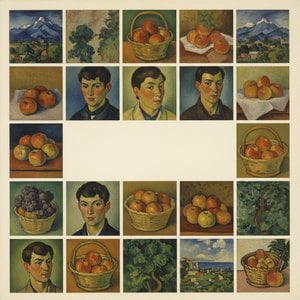
探索保罗·塞尚25幅经典杰作!深入了解后印象派大师的艺术生涯、独特技法与色彩运用。WahooArt提供高清油画复制品,为您的家居带来博物馆级艺术体验。立即发现更多名画,点亮生活空间!

Explore the rich history of texture in art! Discover how artists from Van Gogh to contemporary masters use materiality & technique to create captivating tactile experiences. Deepen your art appreciation with WahooArt.

Experience art's raw power! Explore 10 iconic paintings – Van Gogh, Kahlo & more – that define 'bold'. Discover the stories behind these expressive masterpieces and find museum-quality reproductions for your home at WahooArt.com.

探索罗伊·利希滕斯坦25幅波普艺术杰作!深入了解这位美国艺术家标志性的漫画风格与色彩运用。在WahooArt.com发现高品质艺术复制品,为您的家居空间增添现代艺术灵感。立即浏览完整系列。

Journey through Wassily Kandinsky's 25 most iconic abstract paintings. Explore his revolutionary use of color, form & spiritual expressionism. Find museum-quality Kandinsky reproductions and elevate your home decor with WahooArt.com. Discover all masterpieces on WahooArt.com!


 效果预览
效果预览
 分享
分享 分享
分享
 详情
详情

 下载
下载
 相似作品
相似作品 X射线
X射线 幻灯片播放
幻灯片播放 统计数据
统计数据 展开详情
展开详情









 玻璃选项仅适用于110厘米以下的尺寸。


