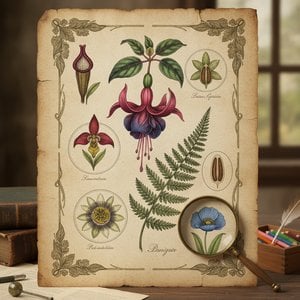
A Symphony of Color and Detail: Exploring Albrecht Dürer’s “Orchids”
The oil painting "Orchids" by Albrecht Dürer, though its precise dimensions remain elusive, stands as a testament to the artist's unparalleled mastery of observation and artistic expression during the High Renaissance. More than just a depiction of flowers—a subject favored by artists across Europe—Dürer’s work delves into profound themes of beauty, fragility, and the interconnectedness of nature, reflecting the humanist ideals that characterized his era.
- Subject Matter: Dürer's focus is undeniably on orchids – a selection of exquisitely rendered specimens showcasing an astonishing range of hues and forms. The artist doesn’t simply portray them; he captures their essence, conveying not only their visual splendor but also the subtle nuances of their lifecycle.
- Style: Dürer's style aligns perfectly with the prevailing realism of the time, yet transcends mere imitation. He achieves a remarkable level of detail—evident in the meticulous depiction of individual petals, veins, and insect wings—creating an image that feels palpably alive. This stylistic choice underscores Dürer’s commitment to capturing the natural world with uncompromising accuracy.
Technique: Precision and Texture – The Marks of a Master Craftsman
Dürer employed oil paint—a relatively new medium at the time—to achieve breathtaking textural effects. Layers upon layers of pigment were applied with painstaking care, allowing for subtle gradations of color and capturing the velvety sheen of orchid petals. Furthermore, Dürer skillfully utilized hatching and stippling techniques to render the foliage background, creating depth and simulating the dappled light filtering through leaves. These meticulous brushstrokes speak volumes about Dürer’s dedication to craftmanship and his desire to convey not just what he saw but how it felt.
Historical Context: Renaissance Ideals of Beauty and Scientific Inquiry
“Orchids” emerged from the crucible of the German Renaissance, a period marked by renewed interest in classical art and philosophy alongside burgeoning scientific exploration. The humanist movement championed observation and rational thought—principles that fueled Dürer’s artistic endeavors. Like many artists of his time, he sought to represent nature accurately, mirroring the growing conviction that understanding the natural world was crucial for comprehending God's creation.
Symbolism: Fragility and Transcendence – Reflections on Life’s Ephemeral Nature
Beyond its aesthetic beauty, “Orchids” carries symbolic weight. Orchids, known for their delicate blossoms that quickly wither away, serve as a poignant reminder of the transient nature of existence—a theme frequently explored in Renaissance art. Simultaneously, however, Dürer elevates the subject to something greater than mere ornamentation; he suggests an appreciation for beauty’s inherent value and its capacity to inspire contemplation on spiritual truths. The inclusion of insects and birds reinforces this notion, portraying them as integral components of a harmonious ecosystem.
Emotional Impact: Capturing the Essence of Natural Wonder
Ultimately, “Orchids” succeeds in evoking a profound emotional response. Its vibrant colors—primarily greens, blues, and purples—transport the viewer to a lush botanical garden, immersing them in the sensory experience of witnessing extraordinary beauty. The artist’s masterful rendering captures not only the visual splendor but also the quiet reverence associated with encountering something sublime—a feeling that resonates deeply within the contemplative spirit of the Renaissance.
常见问题与解答
是否可以下载"Orchids"的高分辨率版本?
若想获取 阿尔布雷希特·丢勒 的《Orchids》 的数字版文件,请前往其 高分辨率数字图像 页面进行 高分辨率数字图像下载。
“Orchids”这一Realism背后蕴含着怎样的国族渊源?
《Orchids》由出生于 意大利 的 阿尔布雷希特·丢勒 在 Realism 运动背景下创作而成。艺术家的原籍地使这部作品与 意大利 艺术家所实践的 Realism 风格紧密相连。
针对 阿尔布雷希特·丢勒 的《Orchids》 的版画,推荐的尺寸和方向是什么?
建议将 阿尔布雷希特·丢勒 的《Orchids》 打印为 Large 大小,并采用 Portrait 构图。