
购买高分辨率增强版数字图像,其品质远超在线预览。
每一份文件都由我们的内部专家使用先进工具与专业的后期润色技术精心打造。我们确保每一张图像都具备卓越的清晰度、精准的色彩还原度以及细腻的细节表现。
最终文件将在 72 小时内通过电子邮件交付,并针对专业、编辑及印刷用途进行了优化。其品质与顶级设计工作室、出版社和画廊所信赖的标准完全一致。
选择 WahooArt.com,您获得的不仅仅是一张图像——您收到的是经过专业级增强、精雕细琢的数字艺术作品,并享有满意保证。以下是您的订单中自动包含的所有内容:

您的高分辨率数字图像文件将在下单后 72 小时内通过电子邮件发送给您 —— 即可立即使用。

您的艺术品经过专业优化,结合先进的 AI 技术与人工修饰,确保呈现极致的细节、清晰度与色彩准确度。

不小心删除了文件或找不到了?没关系——我们将随时为您免费重发。

即刻拥有您的艺术作品,无需支付任何关税、税费或运费——数字下载始终免税。

我们通过专业工具与色彩管理技术,确保您的数字图像尽可能真实地还原原作色彩。

如果您对所购数字图像不满意,我们将在100天内为您进行修改或提供100%的全额退款——无需任何理由。

不满意?在收到数字文件后的100天内,您可以申请全额退款——无需任何理由。

购买 3 张图片可享 10% 折扣 - 购买 5 张可享 15% 折扣 - 购买 10+ 张可享 20% 折扣。非常适合创意项目、画廊和机构使用。
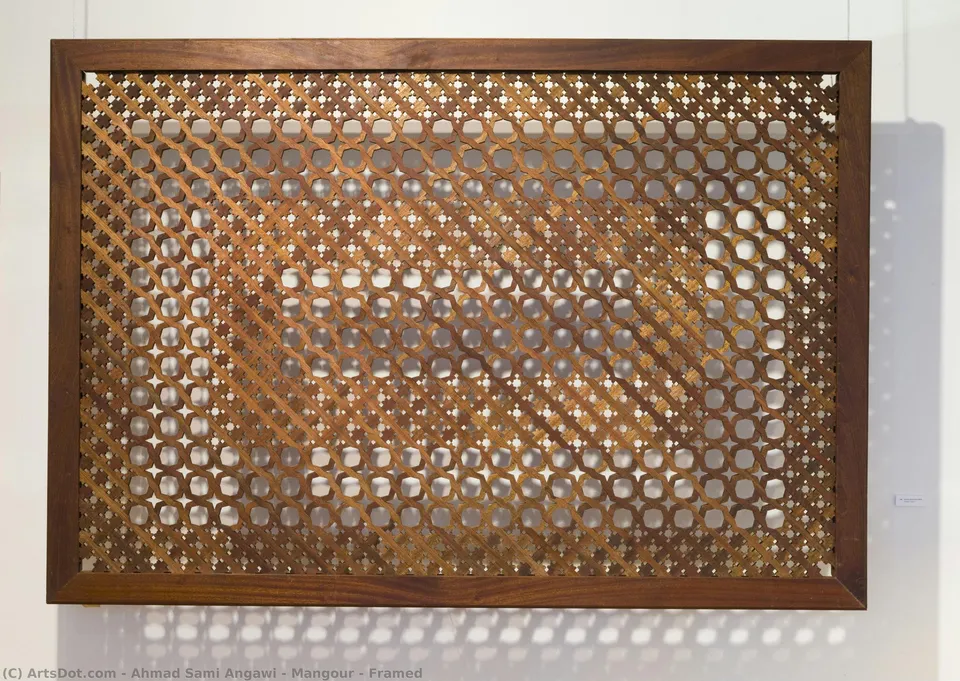
In the heart of Jeddah, where the ancient whispers of the Hejaz region meet the contemporary pulse of Saudi Arabia, lies an architectural soul captured in wood and geometry. Mangour - Framed is not merely a visual composition; it is a profound meditation on the concept of duality. Inspired by the traditional mangour screens that have long graced the historic windows of Jeddah, this work by Ahmad Sami Angawi serves as a bridge between the structural legacies of the past and the minimalist elegance of modern design. The piece invites the viewer into a rhythmic dialogue between what is hidden and what is revealed, creating an atmosphere where light and shadow perform a silent, eternal dance.
The artwork draws its strength from the intricate lattice patterns that define Hejazi architecture. These screens were historically engineered with a brilliant functional intelligence: to temper the harsh desert sun, to allow for cooling breezes, and to provide privacy without isolation. In this framed reproduction, Angawi translates these architectural principles into a captivating visual texture. The composition is a sophisticated arrangement of circular motifs and geometric intersections that create a sense of depth and movement. As light hits the surface, the interplay of the dark wooden lattice against the patterned background evokes the sensation of sunlight filtering through a window at midday, casting complex, mesmerizing shadows that change with the viewer's perspective.
The technique employed in this piece reflects Angawi’s unique multidisciplinary background, blending his training in industrial design from the Pratt Institute with a deep reverence for traditional arts. The precision of the geometric shapes suggests a mathematical harmony, yet there is an organic warmth to the execution that prevents the work from feeling cold or purely clinical. Each circle and void within the lattice acts as a vessel for light, embodying the philosophical notion of duality—the balance between heat and cool, concealment and exposure, presence and absence. This tension makes the artwork an emotionally resonant piece, offering a sense of tranquility and structural stability.
For the discerning collector or interior designer, Mangour - Framed offers unparalleled versatility. Its neutral yet textured palette allows it to serve as a sophisticated focal point in a variety of high-end settings. In a contemporary minimalist room, it provides much-needed organic texture and cultural depth; in a more classical, opulent space, it acts as a subtle nod to historical craftsmanship. This reproduction is more than a decorative element; it is an invitation to experience the architectural poetry of Saudi Arabia, bringing the timeless elegance of Jeddah’s heritage into the modern home through a lens of sophisticated, contemporary art.

In the heart of Jeddah, where the ancient rhythms of the Hejaz region meet the pulse of modern Saudi Arabia, the work of Ahmad Sami Angawi emerges as a profound meditation on equilibrium. Born in 1981, Angawi has cultivated a creative practice that does not merely observe tradition but breathes new life into it through a sophisticated dialogue between the past and the present. His artistic journey is defined by a rare duality; he possesses the technical precision of an industrial designer and the soulful reverence of a master of traditional arts. This unique intellectual foundation, forged at the Pratt Institute in New York and refined at The Prince's School of Traditional Arts in London, allows him to navigate the complexities of contemporary aesthetics while remaining deeply anchored in his cultural roots.
Angawi’s work is profoundly shaped by the concept of Al-Mizan, or balance. This Islamic principle serves as both a spiritual compass and a structural blueprint for his compositions. To Angawi, balance is not a static state but a dynamic pursuit of harmony between light and shadow, geometry and organic form, and heritage and innovation. His explorations are heavily influenced by the colorful diversity of the Hejaz region and his Moroccan lineage, drawing inspiration from the intricate architectural details that define Western Saudi Arabia. Through his eyes, the historical patterns of his ancestors are transformed into a living language capable of speaking to a global, modern audience.
The breadth of Angawi’s multidisciplinary practice is nothing short of extraordinary, spanning sculptural installations, textiles, and graphic design. He approaches each medium as an opportunity to investigate the human condition and our relationship with the environment. One of his most celebrated achievements lies in his reimagining of Mangour—the traditional wooden lattice screens used in Hejazi architecture to regulate light and airflow. In his hands, these screens transcend their functional origins to become mesmerizing works of art. By manipulating intricate geometric patterns and vibrant color palettes, Angativ creates immersive environments where the interplay of sunlight and shadow evokes a sense of timelessness.
His commitment to the preservation of artisanal skills is further evidenced by his entrepreneurial spirit. Through platforms such as Design Studio Shai and Zawiya 97, Angawi has created vital spaces for collaborative creativity. These initiatives are dedicated to the concept of a "living tradition," ensuring that ancient techniques are not relegated to museums but are instead integrated into contemporary design projects. His work with the Albukhary Foundation Gallery of Islamic World stands as a testament to this mission, showcasing how traditional motifs can be scaled into monumental installations that transform architectural spaces into profound cultural experiences.
Ultimately, the significance of Ahmad Sami Angawi lies in his ability to bridge disparate worlds. His art serves as a vital link between:
As he continues to push the boundaries of his practice, Angawi remains a pivotal figure in the Saudi art landscape, reminding us that true innovation is most powerful when it honors the foundations upon which it is built.

1981 - , Saudi Arabia

 切换至版画销售渠道
 分享
分享 分享
分享
 详情
详情

 下载
下载
 相似作品
相似作品 幻灯片播放
幻灯片播放 统计数据
统计数据


 展开详情
展开详情


