
 Graphite PencilWallArtMinimalism
 1962
1962 28.0 x 26.0 cm
 纽约现代艺术博物馆
博物馆级艺术微喷或帆布版画,制作高效,并提供多种饰面选择。 ( 订购此收藏品的纯手工复刻画作 切换至数字图像销售渠道)





























您可以从与原作比例一致的预设尺寸中进行选择。

请输入您所需的宽度和高度,以适配您的画框或墙面。由于印刷品只能进行裁剪,无法超出原图尺寸,因此若比例不一致,画面的一部分将会被裁切。在正式印刷之前,我们会为您发送一份数字效果图供您确认。本页面显示的图片并非最终裁剪后的效果——只有效果图才能展示真实的裁剪情况。
Tremolo
复刻品尺寸说明
Agnes Martin’s ‘Tremolo,’ painted in 1962, stands as an emblem of Minimalism – a movement that sought to strip away extraneous ornamentation and focus solely on fundamental geometric forms. More than just lines on paper, it's an invitation to stillness, prompting contemplation about the interplay between order and imperfection.
The artwork’s composition is dominated by a rectangular grid comprised of numerous thin, horizontal lines. These lines aren’t uniformly spaced or thick; rather, they exhibit subtle variations—a deliberate tremor or ‘tremolo,’ as suggested by the title—creating an ethereal visual effect reminiscent of distant ripples on water. This intentional irregularity disrupts any sense of rigid formality, hinting at a process rooted in organic spontaneity.
Martin’s artistic journey began in Saskatchewan, Canada, where she experienced a nomadic upbringing shaped by her father's passing early in life. This formative period instilled within her a profound appreciation for expansive landscapes and fostered an aesthetic sensibility that would permeate her subsequent work. Her formal education culminated in degrees from Western Washington University College of Education and Teachers College, Columbia University, establishing a foundation for her exploration into art and literature.
The stylistic influence of Minimalism is palpable in ‘Tremolo.’ Rejecting representational imagery, Martin prioritized geometric abstraction—specifically the grid—as a vehicle for conveying emotion and spiritual contemplation. This approach aligns with broader philosophical currents of the time, reflecting a desire to distill artistic expression to its purest essence.
Beyond its structural simplicity, ‘Tremolo’ possesses a subtle symbolic resonance. The repetitive nature of the grid can be interpreted as representing stability and control—a deliberate counterpoint to the inherent dynamism of human experience. Simultaneously, the slight variations in line thickness and spacing evoke vulnerability and imperfection, suggesting that even within meticulously crafted frameworks, traces of spontaneity remain.
Consider incorporating this artwork into interior spaces seeking tranquility and understated elegance. Its muted beige and grey palette complements neutral color schemes beautifully, creating a serene atmosphere conducive to relaxation and reflection. The textural surface adds depth without overwhelming the visual impact—a testament to Martin’s masterful technique and her enduring legacy as one of Minimalism's foremost practitioners.
Source Inspiration: MoMA Collection

1912 - 2004 , 加拿大

探索费尔南·莱热25幅经典杰作!深入了解这位立体主义大师的管形主义风格、机械美学与色彩构成。WahooArt提供高清艺术复制品,为您的家居带来现代艺术气息。立即发现更多名画,打造专属艺术空间!

Find serenity with 10 minimalist masterpieces! Explore Agnes Martin, Rothko & more. Discover the stories behind iconic abstract art, neutral palettes & calming designs. Museum-quality reproductions at WahooArt.com – elevate your home decor today!

A professional procurement guide for hotel designers and architects. Discover how to integrate large-scale contemporary abstract art into hospitality projects through high-volume, custom-sized oil reproductions, multi-panel layouts, and reliable global logistics.

探索几何抽象艺术的十大杰作!康定斯基、蒙德里安等大师作品,色彩构成与非具象之美。WahooArt.com提供博物馆级艺术复制品,为您的家居带来现代艺术灵感。立即在线探索完整系列!
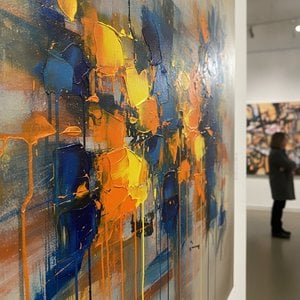
Master the high-impact world of contemporary abstraction. Discover how bold colors, textures, and modern movements like Abstract Expressionism can transform your space with premium, high-energy art curated for the design-conscious professional.


 实景预览
实景预览
 发送
发送 分享
分享
 详情
详情 指南
指南

 下载图片
下载图片
 相似作品
相似作品 X射线
X射线 幻灯片播放
幻灯片播放 统计数据
统计数据 阅读全文
阅读全文









 玻璃选项仅适用于110厘米以下的尺寸。


![Abstract Composition [triptych] — Vaclav Vytlacil, Abstract Expressionism](/media/artworks/images-thumb/08/3c/083c0675045645fd42d4e6c6d63f1ced.jpg)


