
购买高分辨率增强版数字图像,其品质远超在线预览。
每一份文件都由我们的内部专家使用先进工具与专业的后期润色技术精心打造。我们确保每一张图像都具备卓越的清晰度、精准的色彩还原度以及细腻的细节表现。
最终文件将在 72 小时内通过电子邮件交付,并针对专业、编辑及印刷用途进行了优化。其品质与顶级设计工作室、出版社和画廊所信赖的标准完全一致。
下载高分辨率文件,用于个人展示、打印及创意项目。 ( 切换至版画销售渠道 订购此收藏品的纯手工复刻画作)
选择 WahooArt.com,您获得的不仅仅是一张图像——您收到的是经过专业级增强、精雕细琢的数字艺术作品,并享有满意保证。以下是您的订单中自动包含的所有内容:

您的高分辨率数字图像文件将在下单后 72 小时内通过电子邮件发送给您 —— 即可立即使用。

您的艺术品经过专业优化,结合先进的 AI 技术与人工修饰,确保呈现极致的细节、清晰度与色彩准确度。

不小心删除了文件或找不到了?没关系——我们将随时为您免费重发。

即刻拥有您的艺术作品,无需支付任何关税、税费或运费——数字下载始终免税。

我们通过专业工具与色彩管理技术,确保您的数字图像尽可能真实地还原原作色彩。

如果您对所购数字图像不满意,我们将在100天内为您进行修改或提供100%的全额退款——无需任何理由。

不满意?在收到数字文件后的100天内,您可以申请全额退款——无需任何理由。

购买 3 张享 10% 折扣 - 购买 5 张享 15% 折扣 - 购买 10 张以上享 20% 折扣。非常适合创意项目、画廊及机构使用。
Georges Seurat’s “La Grenouillère” – literally “The Pond” – stands as an emblem of Impressionism's audacious embrace of scientific inquiry. Painted in 1876, this monumental canvas depicts a Parisian café scene brimming with life, yet it’s far from merely capturing a snapshot of everyday existence. Instead, Seurat meticulously constructed his artwork using a revolutionary technique known as Pointillisme, pioneered alongside Paul Signac.
The scene itself is deceptively simple—a café terrace populated by men and women enjoying drinks and conversation. However, beneath the surface lies a profound exploration of color and perception. Seurat’s palette utilizes bold hues – reds, blues, yellows – arranged in discrete patches that shimmer with reflected light. This deliberate fragmentation contributes to an unsettling yet captivating effect; it invites viewers to actively participate in constructing the image.
Symbolism:The pond itself—a recurring motif in Seurat’s oeuvre—represents both physical space and psychological depth. It symbolizes tranquility amidst urban bustle, mirroring the artist's own quest for intellectual clarity and artistic innovation. The figures within the café are rendered with meticulous detail, yet their faces remain largely obscured, emphasizing the importance of emotion and intuition over precise representation.
“La Grenouillère” remains a cornerstone of Impressionist art history and continues to inspire artists and collectors alike. Its enduring appeal lies not only in its aesthetic beauty but also in its audacious intellectual ambition—a testament to Seurat’s unwavering belief that art could illuminate the mysteries of human consciousness.

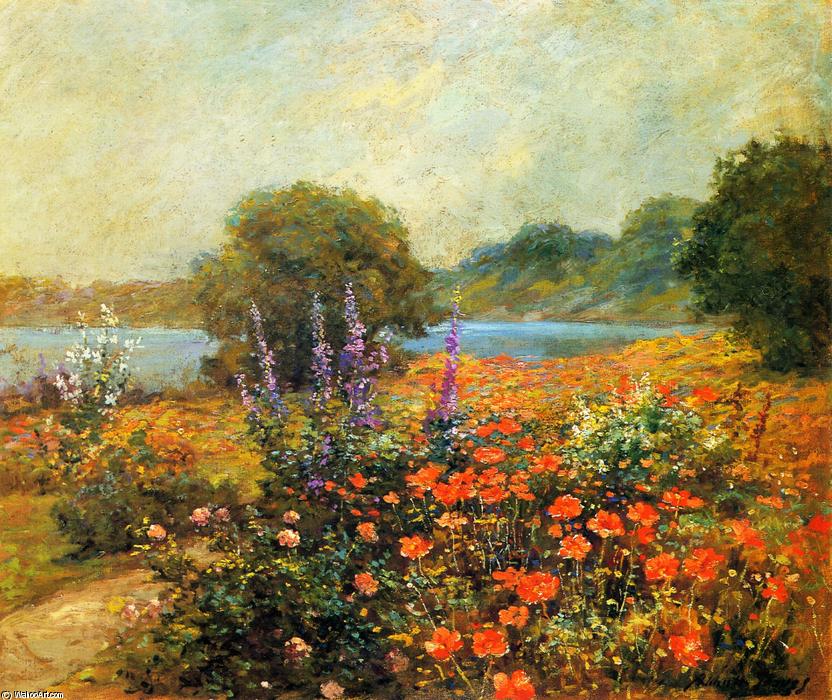
Abbott Fuller Graves was an American painter and illustrator whose brush captured the delicate intersection of nature and light. Born in Weymouth, Massachusetts, his early aspirations leaned toward the structured world of architecture, leading him to attend the Massachusetts Institute of Technology. However, a profound calling toward the ephemeral beauty of the natural world eventually redirected his path. This journey took him far beyond the borders of New England, as he traveled to Paris and Italy to refine his skills. In the vibrant art centers of Europe, Graves immersed himself in the study of floral painting and figure work, absorbing the revolutionary techniques that would later define his signature style.
During his formative years in Paris, Graves studied at the Académie Julian, learning under masters such as Fernand Cormon, Jean- Paul Laurens, and Paul Gervais. This rigorous academic training provided him with a foundation in realism, yet it was the burgeoning influence of European Impressionism that truly ignited his creative spirit. His time in Europe also allowed him to room with Edmund C. Tarbell, fostering connections within a circle of artists who were reshaping American art. Upon returning to Boston, Graves became a teacher at the Cowles Art School, working alongside notable figures like Childe Hassam, a relationship that undoubtedly enriched their mutual artistic development.
As his career matured, Graves found a permanent sanctuary in the coastal town of Kennebunkport, Maine. It was here that his work truly blossomed, as he began to specialize in decorative open-air garden paintings and floral still-lifes. His mastery lay in the ability to blend Impressionistic light with Realistic observation. He did not merely seek to replicate the appearance of a garden; he sought to capture how sunlight filtered through foliage, casting dappled shadows and illuminating blossoms with an ethereal glow. His use of thick brushstrokes and vibrant colors allowed him to translate the textures of roses, lilies, and lush landscapes onto the canvas, creating scenes that felt both alive and deeply serene.
His subject matter often celebrated the rhythms of local life and the splendor of the natural world. While many of his works focused on the intricate beauty of exotic gardens—sometimes reaching as far as Spain and South America—he remained deeply rooted in the American landscape. His paintings frequently featured genre scenes of Kennebunkport, portraying fishermen, farmers, and sea captains, often rendered with a charming, nostalgic quality that led to his work being widely reproduced on postcards and calendars. This ability to elevate everyday coastal life into a symphony of color and light remains his most enduring legacy.
Beyond the canvas, Graves possessed a unique vision for the integration of art and living space. In 1905, he applied his architectural sensibilities to design the Abbott Graves House in Kennebunkport. This structure, notable as one of the rare examples of the Prairie School of architecture in Maine, stands as a testament to his multifaceted talent. The house reflects the same harmony between form and nature that characterized his paintings, showcasing a sophisticated understanding of design and space.
In his later years, Graves moved between the creative energy of New York City and the tranquility of the coast. His membership in prestigious organizations such as the National Academy of Design, the Salmagundi Club, and the Allied Artists of America solidified his standing within the American art community. Through his dedication to capturing the fleeting beauty of a petal or the shifting light on a coastal shoreline, Abbott Fuller Graves left behind a body of work that continues to resonate with those who find poetry in the natural world.

1859 - 1936 , 美国

 实景预览
实景预览
 发送
发送 分享
分享
 详情
详情 指南
指南

 下载图片
下载图片
 相似作品
相似作品 X射线
X射线 幻灯片播放
幻灯片播放 统计数据
统计数据

 阅读全文
阅读全文


