William Langley: A Vision of the British Landscape
The art world often remembers figures in fleeting glimpses, but William Langley (1880-1920) deserves a more sustained appreciation as a quietly powerful voice within late 19th and early 20th century British landscape painting. Born in London, Langley’s artistic journey began not with formal training, but through a deep immersion in the natural world – a fascination that would profoundly shape his distinctive style and subject matter. He wasn't a flamboyant innovator or a revolutionary; rather, he possessed an innate ability to capture the subtle beauty of the British countryside, imbuing his canvases with a serene sense of place and a remarkable sensitivity to light and atmosphere.
Langley’s early influences are somewhat elusive, though it’s clear that the Romantic tradition – particularly the works of Turner and Constable – held a significant sway. The atmospheric perspective, the emphasis on capturing fleeting moments of light, and the depiction of vast landscapes resonated deeply with him. However, Langley wasn't simply replicating these masters; he developed his own unique approach, characterized by a restrained palette, meticulous detail, and an almost meditative quality to his compositions. He avoided dramatic gestures or overtly emotional scenes, instead focusing on quietly observing and translating the essence of his subjects onto canvas.
The Palette of Pastoral England
Langley’s paintings are immediately recognizable for their muted color schemes – a deliberate choice that contributes significantly to their evocative power. He rarely employed bright, saturated hues, preferring instead a range of soft browns, greens, and blues. This restrained palette allowed him to create a sense of depth and atmosphere, suggesting the subtle shifts in light and shadow across the landscape. His brushwork is generally smooth and blended, creating an almost velvety texture that further enhances the feeling of tranquility. He was particularly adept at capturing the nuances of color in water – reflecting skies, shimmering surfaces, and the interplay of light on ripples.
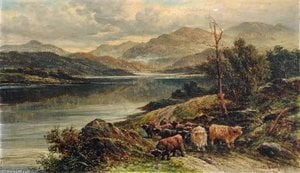
Subjects dominated by rural England were his specialty. He frequently depicted scenes from the Welsh countryside, including dramatic mountain streams and expansive moorlands. His paintings of Highland cattle are iconic examples of his skill, capturing not just the animals themselves but also the rugged beauty of their surroundings. These works aren’t merely depictions of livestock; they're imbued with a sense of timelessness, suggesting an enduring connection between man and nature.
Key Works & Artistic Development
Among Langley’s most celebrated paintings is “Mountain Stream In Wales” (1912), a breathtaking depiction of a cascading waterfall set amidst towering peaks. The painting's composition—the dynamic flow of the water contrasted with the stillness of the surrounding landscape—demonstrates his mastery of atmospheric perspective and his ability to convey both movement and tranquility. Similarly, "Highland Cows On The Edge Of A Loch" (1908) showcases his talent for capturing the drama of a Highland scene, with the cattle silhouetted against the moody backdrop of a loch.
Langley’s style evolved subtly over time. Early works tend to be more tightly composed and meticulously detailed, while later paintings display a greater sense of looseness and spontaneity. This evolution reflects his deepening understanding of light and color, as well as his increasing confidence in his artistic vision. His work is often compared to that of the Hudson River School painters, though Langley’s focus on British landscapes distinguishes him from his American counterparts.
Legacy & Historical Context
William Langley's contribution to British landscape painting may not be widely recognized in the same way as some of his contemporaries, but his quietly assured style and evocative depictions of the countryside have earned him a devoted following. He represents a crucial link between the Romantic tradition and the emerging trends of early 20th-century art. His paintings offer a poignant glimpse into a vanishing world – a time when rural England was still largely untouched by industrialization and urbanization.
His work is now held in collections such as the William Evans Bequest at Bangor University, and the Williams College Museum of Art in Massachusetts, testament to his enduring appeal. Langley’s legacy lies not in grand gestures or revolutionary ideas, but in his ability to capture the quiet beauty of the British landscape with remarkable sensitivity and skill – a gift that continues to resonate with viewers today.