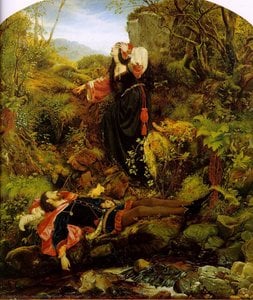
A Scottish Visionary: The Life and Art of Sir Joseph Noel Paton
Sir Joseph Noel Paton, a name synonymous with the evocative beauty of Victorian fairy paintings and allegorical scenes, was born in Dunfermline, Scotland, on December 13, 1821. His early life, steeped in the intricate designs of damask weaving – his parents were skilled designers and weavers themselves – instilled within him an unparalleled appreciation for detail and pattern, a characteristic that would profoundly shape his artistic style. Though initially involved in the family business, directing design at a muslin factory, Paton’s true passion lay in the realm of art, fueled by a deep love for storytelling and a fascination with Celtic legends and religious narratives. A brief period of study at the Royal Academy in London in 1843 exposed him to the artistic currents of his time, yet he ultimately chose to forge his own distinctive path, rooted firmly in his Scottish heritage.The Pre-Raphaelite Connection and Artistic Development
While never formally joining the Pre-Raphaelite Brotherhood, Sir Joseph Noel Paton’s work bears a striking resemblance to their aesthetic principles. His early paintings, such as “The Quarrel of Oberon and Titania” (1847), now a cornerstone of the National Gallery of Scotland's collection, demonstrate his remarkable ability to capture fantastical scenes with breathtaking realism. This painting, inspired by Shakespeare’s *A Midsummer Night’s Dream*, is not merely a depiction of fairies; it’s a portrayal of their passions, conflicts, and vulnerabilities – imbued with psychological complexity that set him apart from many of his contemporaries. The invitation he received from John Everett Millais to join the Brotherhood underscores his connection to this influential movement, even as he developed a unique artistic voice. Paton's meticulous attention to detail, evident in the intricate costumes, landscapes, and facial expressions, reflects a deep understanding of both visual representation and narrative storytelling. He wasn’t simply illustrating tales; he was breathing life into them with an extraordinary level of skill and emotional depth.Weaving Myth and Morality: A Unique Artistic Style
Paton's artistic journey was characterized by a remarkable synthesis of diverse influences. His upbringing amidst the intricate designs of damask weaving—his parents were skilled designers and weavers themselves—instilled in him an unparalleled appreciation for detail and pattern, a characteristic that would profoundly shape his artistic style. Though initially involved in the family business, directing design at a muslin factory, Paton’s true passion lay in the realm of art, fueled by a deep love for storytelling and a fascination with Celtic legends and religious narratives. A brief period of study at the Royal Academy in London in 1843 exposed him to the artistic currents of his time, yet he ultimately chose to forge his own distinctive path, rooted firmly in his Scottish heritage. His work is not just visually stunning but also intellectually stimulating, inviting viewers to contemplate profound questions about faith, morality, and the human condition. He explored religious themes with equal fervor, as evidenced in works like “Luther discovering justification by faith,” revealing a deep engagement with theological concepts. His paintings are not merely historical artifacts; they are living embodiments of imagination, faith, and artistic vision.Major Works and Royal Recognition
Throughout his career, Paton consistently produced masterpieces that blended historical accuracy with imaginative storytelling. “Puck and Fairies” (1857), a vibrant depiction of the mischievous sprite Puck leading a group of fairies through a moonlit forest, exemplifies his mastery of capturing the ethereal beauty and playful spirit of the fairy world. “The Man of Sorrows” (1875), now housed in the Laing Art Gallery in Newcastle upon Tyne, is a particularly poignant work that showcases Paton’s ability to convey profound emotion through carefully rendered detail. In 1866, he was appointed as Queen's Limner for Scotland – a prestigious position signifying his status as the foremost artist in the country – and subsequently knighted by Queen Victoria in 1867, recognizing his significant contributions to Scottish art and culture. These honors cemented his place as a leading figure in Victorian society.Themes, Symbolism, and Lasting Legacy
Paton’s work is deeply imbued with symbolism, reflecting both personal beliefs and the broader cultural anxieties of the Victorian era. His fascination with Celtic legends speaks to a growing interest in national identity and folklore during this period. The fairy paintings, while seemingly whimsical, often carry underlying moral messages about temptation, innocence, and the dangers of unchecked desire. Religious works, such as those depicting scenes from the life of Martin Luther, explore themes of faith, redemption, and the struggle against oppression.- His meticulous attention to detail—evident in the intricate costumes, landscapes, and facial expressions—adds layers of meaning to his compositions.
- The use of dramatic lighting and rich color palettes enhances the emotional impact of his paintings.
- Paton’s works often feature allegorical figures representing abstract concepts like love, death, and justice.
Питання та відповіді
На які періоди поділено кар'єру Сайж Ноел Патон?
Сторінка Хронологія творчого шляху митця Сайж Ноел Патон — це інтерактивна хронологічна стрічка, що представляє роботи художника в послідовному порядку, згруповані за етапами творчого шляху.
Чи можу я переглянути роботи Сайж Ноел Патон за ключовими словами?
Роботи Сайж Ноел Патон можна переглянути за ключовими словами на сторінці митця За ключовими словами. Кожне ключове слово об'єднує відповідні витвори мистецтва.
Чи можу я переглянути роботи Сайж Ноел Патон за художніми напрямами?
Сторінка Усі художні напрями групує твори Сайж Ноел Патон за художніми напрямами.