A Harmonious Blend of Tradition and Contemporary Vision: The Art of Ou Dawei
Ou Dawei, a Taiwanese artist born in Taipei in 1965, embodies a rare synthesis of deep-rooted artistic heritage and a distinctly modern sensibility. His journey began amidst the rich cultural landscape of Taiwan, where he cultivated an early appreciation for the elegance of Chinese calligraphy and painting. While many artists choose to specialize, Dawei embarked on a path of holistic mastery, immersing himself in both traditional techniques and contemporary themes—a pursuit that would define his unique artistic voice. He isn’t merely replicating the past; rather, he is actively engaging with it, reinterpreting its principles through a lens attuned to the present day. This dedication has led to numerous solo and group exhibitions across Taiwan and internationally, solidifying his position as a significant figure in contemporary Chinese art.
Early Influences and Artistic Formation
Dawei’s formative years were deeply influenced by the legacy of literati painting—a tradition that valued not only technical skill but also intellectual depth and personal expression. He began studying calligraphy and seal-engraving at the age of fourteen under the tutelage of Guangdong master Wu Zifu, a pivotal figure in 20th-century Chinese calligraphy. This rigorous training instilled in him a profound understanding of brushwork, ink control, and the nuanced relationship between form and content. However, Dawei’s artistic exploration didn't end with formal instruction. He self-taught landscape painting and classical poetry, recognizing that these disciplines were intrinsically linked to his calligraphic practice. This self-directed learning allowed him to forge a path independent of established schools, drawing inspiration from a wide range of historical sources while simultaneously developing his own distinct style. His early works already hinted at the fusion he would later become known for—a delicate balance between reverence for tradition and an emerging contemporary aesthetic.
The Evolution of Style: Calligraphy as Painting, Painting as Poetry
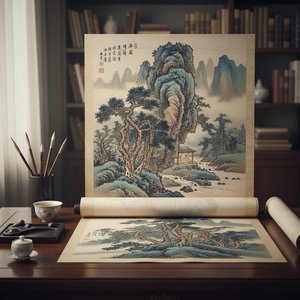
Over decades of dedicated practice, Dawei’s artistic vision matured into a remarkable unity of calligraphy, painting, and seal carving. He skillfully arranges characters to form captivating compositions, elevating calligraphy beyond mere writing to the realm of visual art. His landscape paintings are particularly striking, employing brushstrokes reminiscent of seal and clerical scripts to depict mountain ranges, while clouds and water are rendered in flowing running and cursive styles. This innovative approach demonstrates a profound understanding of how different calligraphic techniques can be translated into pictorial form. He doesn’t simply *illustrate* poetry; he *embodies* it within his paintings, creating works that resonate with both visual beauty and intellectual depth. The use of dry brushes in landscape painting became a hallmark of his style, allowing for subtle gradations of tone and texture that evoke a sense of atmosphere and emotion. His art is characterized by casual strokes and seasoned lines, coupled with varied shades—a testament to years of immersion in the intricacies of ink and brushwork.
Recognition and Legacy: Bridging East and West
Ou Dawei’s contributions to the art world have been widely recognized through numerous awards and exhibitions. In 1989, he received the Hong Kong Urban Council Fine Arts Award in Calligraphy, followed by further accolades in Seal Engraving and Artistic Development in 1998. More recently, his work was honored with the Grand Prize of the World Calligraphy Biennale of Jeollabuk-do in South Korea (2015). A significant exhibition, “Nature in Ink and Brush,” held at the Sun Museum in Hong Kong (2019), showcased around 40 pieces of his calligraphy, landscape paintings, and seals, highlighting his commitment to rejuvenating traditional Chinese art. Dawei’s work has also been featured in exhibitions organized by The Leisure and Cultural Services Department, demonstrating a broad appeal within both academic and public spheres. He serves as an art advisor for the Leisure and Cultural Services Department and is a member of the China Calligraphers Association, further solidifying his role as a leading figure in contemporary Asian art. His publications—including the Selected Seals by Ou Da Wei series and the Selected Brushworks series—offer valuable insights into his artistic process and philosophy.
A Continuing Dialogue with Tradition
Ou Dawei’s enduring legacy lies not only in his technical mastery but also in his ability to bridge the gap between tradition and contemporary expression. He is a rare artist who has successfully integrated poetry, painting, calligraphy, and seal-carving into a cohesive artistic practice. His works are a testament to the power of art to transcend cultural boundaries and connect with audiences on a deeply emotional level. He continues to create and inspire, reminding us that true artistry lies not in simply replicating the past but in engaging with it—reinterpreting its principles and forging new paths for future generations. His pursuit of excellence embodies the spirit of literati art, offering a unique vision that resonates with both classic elegance and eccentric boldness.