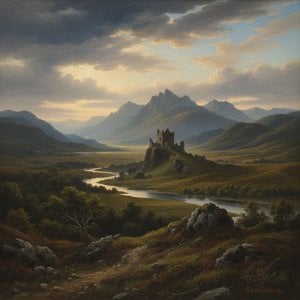
Jonas Mackevičius: A Baltic Romantic Landscape Painter
Jonas Mackevičius (1872 – 1954) stands as a pivotal figure in Lithuanian art history, recognized primarily for his masterful depictions of the Baltic landscape and portraits imbued with romantic sensibilities. Born in Rūga, Panevežys County, Lithuania, Mackevičius embarked on an artistic journey marked by rigorous academic training and extensive travels across Europe—a formative experience that profoundly shaped his distinctive style and worldview.
- Early Life & Education:
Mackevičius’s formal education began at the Moscow Art Promotion School, where he honed his skills in drawing and composition under the tutelage of Princess Taniševa’s renowned art studio.
- St. Petersburg Academy of Arts:
Continuing his artistic pursuits, he enrolled at St. Petersburg Academy of Arts, delving deeper into painting techniques and mastering classical aesthetics. His professors included Vasily Makovskis and Pavel Kovalevskis, figures who instilled in him a commitment to realism and artistic excellence.
European Travels & Artistic Influences
Mackevičius’s artistic development was inextricably linked to his travels throughout Europe. He immersed himself in the vibrant cultural milieu of Italy, Germany, France, Spain, and Turkey—absorbing inspiration from Impressionism and plein air painting traditions. These experiences fueled his passion for capturing fleeting moments of beauty and conveying emotional depth within his canvases. Notably, he participated in the inaugural Lithuanian Art Exhibition in Vilnius (1907) and joined the Lithuanian Artists’ Association, cementing his role as a champion of Lithuanian artistic identity.
- Lithuanian Artistic Landscape:
Mackevičius's landscapes are characterized by meticulous detail and luminous color palettes—particularly evident in works like “Capri Salos prieplauka” (circa 1921) and “Aguonų laukas,” which exemplify the Romantic movement’s fascination with dramatic skies and evocative vistas.
- Portraiture & Psychological Depth:
Beyond landscapes, Mackevičius excelled in portrait painting, capturing not merely physical likeness but also psychological nuance. His portraits of Tsar Nicholas II (1904) and prominent Lithuanian figures demonstrate his ability to convey inner emotions and character traits.
Notable Achievements & Legacy
Mackevičius’s artistic legacy extends beyond individual masterpieces; he played a crucial role in establishing Lithuania's artistic presence on the international stage. His involvement with the Vytautas the Great War Museum—particularly his monumental paintings “Lithuanian Army March in Vilnius” and “The Priest A. Mackevičius Blesses Rebels’ of the Year 1863 Flags”—served as powerful visual narratives of Lithuanian history and national identity. Furthermore, he contributed significantly to the artistic discourse of his time, advocating for realism and romanticism as expressive mediums.
- Recognition & Awards:
Mackevičius received considerable acclaim during his lifetime, culminating in the Order of Gediminas III degree (1938) – a testament to his dedication and contribution to Lithuanian culture.
- Post-War Career & Artistic Expression:
Following World War II, Mackevičius relocated to Switzerland, where he continued teaching art and producing evocative works reflecting the melancholic beauty of Alpine landscapes. His enduring influence can be seen in the continuing appreciation for Lithuanian Romantic landscape painting.
Collections & Exhibitions
Mackevičius’s paintings are housed in prestigious museums across Lithuania and internationally, including the National Museum of Art in Vilnius—a testament to their enduring artistic merit. His oeuvre continues to inspire artists and scholars alike, ensuring that Jonas Mackevičius's contribution to Lithuanian art history remains firmly established for generations to come.