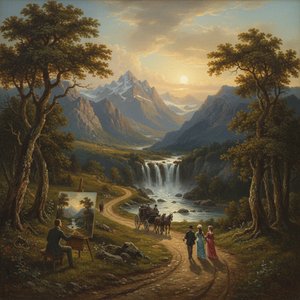
The Quiet Observer of Pennsylvania
Frederick A. Spang lived a life shaped by the shifting landscapes of the nineteenth century. Born in Norristown, Pennsylvania, his early years were spent in the shadow of the local industry, finding his way toward the brush through formal study in Philadelphia. He learned the weight of oil and the texture of canvas under the guidance of J. R. Lambdin. His hands were not only used for painting; they were called to service during the Civil War, a period of upheaval that preceded his settled life in Reading, Pennsylvania. He moved through different spaces, including a time in San Francisco during the late 1860s and early 1870s, before returning to the familiar air of his home state.
His work reveals a man who looked closely at the small, often overlooked details of existence. He did not seek the grand or the dramatic, but rather the stillness of a fruit bowl or the specific light hitting a bird's wing. His subjects were the quiet inhabitants of the domestic and natural world.
Subjects and Studies
The paintings left behind suggest a varied interest in the textures of life. He moved between the formal requirements of portraiture and the more intimate studies of nature and childhood. His catalog shows a steady hand across several decades, capturing both the human face and the wilder elements of the landscape.
- Portraiture and character studies
- Still lifes involving fruit and domestic objects
- Studies of birds and animals, such as the Great Horned Owl
- Genre scenes of children and social interactions
- Landscapes and local landmarks like the Old Powder Mill at Adamstown
In his portraits, there is a sense of the sitter's presence that goes beyond a mere likeness. He captured the way light falls on a man's features or the specific way a child might hold themselves in a moment of play. His bird studies, like the Great Horned Owl, show a patience for the stillness required to observe a living creature.
A Legacy in Reading
Much of his life's work remains held within the Reading Public Museum, a collection that preserves the visual record of his development. From his early works in the 1860s to his later pieces in the 1880s, his output reflects a consistent engagement with his surroundings. He documented the local geography, such as Lover's Leap in Berks County, and the industrial remnants of the region. His death in Reading in 1891 marked the end of a career spent observing the world through a lens of careful, unhurried detail.
Питання та відповіді
До якого історичного періоду належить творчість Frederick A. Spang?
Frederick A. Spang працював у період 19th Century. Цей період визначає місце творчості митця в історії.
Як я можу переглянути всі роботи Frederick A. Spang?
З усіма роботами Frederick A. Spang на цей сайт можна ознайомитися на сторінці Усі роботи митця митця.
Які кольори Frederick A. Spang використовував найчастіше?
Використання кольору в роботах Frederick A. Spang, представлених на цей сайт, можна дослідити на сторінці художника Геном палітри.
Як я можу простежити за творчістю Frederick A. Spang рік за роком?
Сторінка Хронологія творів митця представляє роботи Frederick A. Spang, впорядковані за датою, рік за роком.