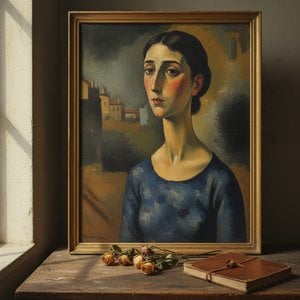
The Estonian Landscape in Focus
Edgar Voss remains a significant figure for those studying the evolution of Estonian painting through the mid-to-late twentieth century. His work does not rely on grandiosity but on a grounded, often blunt observation of life and land. Born in 1936, his roots were firmly planted in the Põdrametsa family farm in Misso village, a connection that provided a constant, unyielding reference point for his visual language. He died in 2002, leaving behind a body of work that transitioned from the structured social observations of the 1960s to a more expansive, atmospheric engagement with nature.
His early output was marked by a certain directness. During the late 1960s, he produced works that captured the essence of labor and family without the artifice of formal posing. These were not idealized subjects; they were people and places as they existed. His ability to move between oil and oil pastel allowed him to experiment with texture and form, particularly when documenting the human condition or the specific light of his surroundings.
Evolution of Subject and Form
The trajectory of Voss's career shows a clear shift in focus. While his early years were preoccupied with the immediate social and familial environment, his later years turned toward the openness of the Estonian landscape. This was not a retreat from reality, but a change in scale. He moved from the intimate, sometimes grotesque depictions of workers to the wide, liberating vistas of the coast and the countryside.
Key developments in his catalog include:
- The social realism of his 1960s oil works, such as those depicting workers and family figures.
- The use of oil pastel to explore specific motifs, notably his 1968 studies.
- A transition in the 1980s toward landscape painting, capturing the specific character of Estonian locations.
This progression demonstrates a painter who was constantly refining his relationship with his subject matter. He moved from the heavy, grounded presence of the figure to the airy, light-filled qualities of the natural world.
The Weight of Place
Voss's significance is cemented by the presence of his work in major Estonian institutions, including the Art Museum of Estonia and the Tartu Art Museum. His paintings are not mere decorations; they are records of a specific time and place. Whether he was painting the village of Tärkma or the juniper fields of Kassari, he captured a sense of space that felt both specific and universal. His work from the 1980s, often utilizing tempera or watercolor on cardboard, shows a mastery of light and a preference for the quiet, unadorned beauty of the Estonian terrain. He did not seek to embellish the world, but to document its essential character.
Питання та відповіді
Де можна переглянути роботи Edgar Voss, розподілені за тематикою?
Сторінка Атлас тематик дозволяє знайти твори Edgar Voss за тематикою.
Чи можу я відвідати віртуальний музей творів Edgar Voss?
3D-музей Edgar Voss — це сторінка, на якій роботи митця представлені у віртуальній тривимірній галереї.
Чи можу я переглянути роботи Edgar Voss за художніми напрямами?
Сторінка Усі художні напрями групує твори Edgar Voss за художніми напрямами.
Як я можу переглянути всі роботи Edgar Voss?
З усіма роботами Edgar Voss на цей сайт можна ознайомитися на сторінці Усі роботи митця митця.