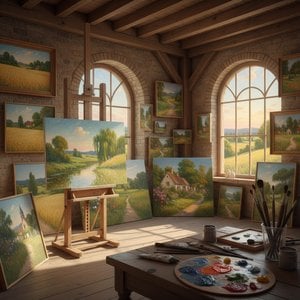
The Visionary Architect of Light and Color
Born into the vibrant, cultured atmosphere of Milan in 1851, Vittore Grubicy de Dragon was far more than a mere painter; he was a profound catalyst for change within the Italian art world. Raised in a wealthy family where art was an essential element of daily life, his early years were steeped in the humanistic traditions that would later inform his critical intellect. Following the passing of his father in 1870, Grubicy found himself drawn into the bohemian orbit of the Scapigliatura, a movement of Milanese artists and poets dedicated to blurring the boundaries between art and existence. This period of intense cultural immersion laid the groundwork for his dual legacy as both a creator of evocative imagery and a formidable tastemaker who would reshape the trajectory of late 19th-century Italian painting.
His entrepreneurial spirit led him to establish the Galleria Fratelli Grubicy alongside his brother, Alberto. This institution was revolutionary, operating on an early modern concept of representing living artists as dedicated clients. While his brother managed the financial intricacies, Vittore acted as a wandering scout for the new, traversing the great art capitals of Europe—from London and Paris to Antwerp—to identify emerging trends. Initially, the gallery championed the soft, atmospheric aesthetics of the Scapigliatura masters like Tranquillo Cremona and Daniele Ranzoni, but Grubicy’s true genius lay in his ability to recognize the potential of a burgeoning movement that would eventually define an era.
The Dawn of Divisionism
Between 1882 and 1885, Grubicy’s travels took him to the Netherlands, where he encountered the Hague School. It was here that his encounter with Anton Mauve proved transformative; Mauve became a mentor who materially directed his approach to the brush. This European exposure, combined with an interest in the optical theories of color, allowed Grubacy to bridge the gap between international trends and Italian sensibilities. Upon his return to Italy, he began to champion Divisionism, a technique characterized by the separation of colors into individual dots or strokes that the eye then blends optically. He did not merely promote this style; he became its theoretical guide, translating complex scientific theories of light into an emotional language for painters.
Grubicy’s influence was instrumental in the careers of some of Italy's most celebrated artists. He possessed a rare, prophetic ability to recognize talent, securing contracts for masters such as:
- Giovanni Segantini, whose monumental landscapes became synonymous with the movement;
- Emilio Longoni, who brought a profound sense of realism to the divisionist technique;
- Angelo Morbelli, whose delicate touch captured the quietude of contemporary life.
Through his writings and his gallery, he convinced these artists to embrace light not just as a physical phenomenon, but as an emotional force. He famously pushed Segantini to refine his approach, ensuring that the movement possessed both technical rigor and symbolic depth.
A Legacy of Light and Symbolism
As his career progressed, Grubicy’s own painting practice became an extension of his critical theories. His work often reflected a deep connection to the landscapes of Lake Como, particularly around Lierna, where he frequently worked en plein air. In these works, one can observe the marriage of Divisionist precision with a Symbolist soul. His canvases often evoke a sense of melancholy or spiritual transcendence, using muted tones and textured impasto to create atmospheres that feel both tangible and dreamlike. Whether capturing the quietude of an evening landscape or the rugged majesty of mountain scenes, his brushwork sought to capture the very essence of luminosity.
The historical significance of Vittore Grubicy de Dragon cannot be overstated. He was the bridge between the old world of romanticism and the new era of modern optical science. By integrating the influences of the Hague School and even the burgeoning energy of Van Gogh into the Italian context, he ensured that Italian art remained at the forefront of European innovation. Though his life ended in 1920, his impact remains etched in the vibrant, fractured light of every Divisionist masterpiece, a testament to a man who saw the world not just as it appeared, but as it felt through the prism of color.



 Переглянути в інтер'єрі
 Перейти до друку
 Надіслати як листівку
 Поділитися
 Детальніше

 Завантажити
 Схожі експонати
 Рентгенівське дослідження
 Слайд-шоу
 Статистика
 Читати далі






































 Скляний варіант доступний лише для розмірів до 110 см