


 Modernism
 500.0 x 200.0 cm
 Данський парламент
Написана вручну олією на полотні у вашому розмірі та рамі, виготовлена на замовлення нашими художниками. ( Замовити принт Купити цифрове зображення)
Обирайте з наших стандартних розмірів, що відповідають оригінальним пропорціям твору мистецтва.

Ви можете вказати власні розміри, щоб репродукція ідеально підійшла до конкретної рами або інтер'єру. Якщо вибраний вами розмір не відповідає пропорціям оригіналу, ми або обріжемо полотно, або доповнимо картину додатковими елементами, промальованими вручну. Цифровий макет буде надіслано вам на затвердження перед початком виробництва.
Зверніть увагу, що попередній перегляд на екрані не відображає фактичне обрізання або розширення зображення. Тільки макет точно покаже остаточну композицію.
Хоча ми можемо виготовити виріб у нестандартному розмірі, для збереження оригінальних пропорцій рекомендуємо обирати варіанти зі встановленого списку.
Доставка по всьому світу () за 3–4 тижні замість стандартних 5 тижнів. (6 Вересень). Без жодних компромісів у якості.


Lognbrá
Розмір репродукції

Tróndur Patursson, born in 1944 in the remote village of Kirkjubøur on the Faroe Islands, is an artist whose work is inextricably linked to the dramatic beauty and elemental power of his homeland. More than simply a painter or sculptor, Patursson embodies a spirit of exploration—both artistic and literal—that has shaped a career spanning six decades. His journey began with sculpture, but it was the allure of color and light, coupled with an intimate connection to the sea, that ultimately defined his unique vision.
Growing up in Kirkjubøur, steeped in Faroese history and folklore, instilled in Patursson a deep reverence for nature. The islands themselves—rugged cliffs plunging into the Atlantic, windswept moors, and ever-changing skies—became his primary source of inspiration. This early immersion wasn’t merely observational; it was visceral. His family background, tied to the land and traditional ways of life, fostered an understanding of the delicate balance between humanity and the natural world. This foundation would prove crucial as he navigated his artistic development.
Patursson’s formal training took him to Norway, where he initially focused on sculpture. However, it was during this period that he began to recognize the limitations of three-dimensional form in expressing the vastness and emotional depth he sought to convey. He found himself increasingly drawn to painting, a medium that allowed for greater fluidity and nuance in capturing the ethereal qualities of light and atmosphere. This transition wasn’t abrupt; it was a gradual evolution driven by an inner need to find the most effective means of translating his experiences onto canvas.
His early paintings were characterized by a raw energy, often depicting abstract landscapes that hinted at the underlying forces shaping the Faroese environment. He experimented with texture and color, seeking to evoke not just the *appearance* of nature but its very essence—its power, its melancholy, its enduring spirit. This exploration led him towards a distinctive style marked by bold brushstrokes, vibrant hues, and a sense of dynamic movement.
A pivotal moment in Patursson’s life came in 1976 when he joined Tim Severin on a transatlantic voyage aboard the Brendan—a replica 6th-century leather-hulled currach. This wasn't simply an adventure; it was a profound immersion into the history and mythology of seafaring, a journey that would irrevocably alter his artistic perspective. The experience of being at the mercy of the ocean, surrounded by endless horizons, ignited a new level of passion within him.
The voyage became a metaphor for the human condition—a testament to resilience, courage, and the enduring power of exploration. Upon his return, Patursson’s work underwent a significant transformation. His paintings became more abstract, infused with a cosmic quality that reflected the infinite space he had encountered at sea. He began to explore themes of migration, isolation, and the interconnectedness of all things.
Throughout his career, Patursson has achieved widespread recognition for his unique artistic vision. His work has been exhibited extensively throughout the Nordic countries, Europe, and the United States. A particularly notable achievement was his 2013 installation “Migration” at the John F. Kennedy Center in Washington D.C., featuring approximately ninety of his signature stained glass birds suspended in the Grand Foyer—a breathtaking spectacle that captured the imagination of audiences worldwide.
More recently, Patursson’s light art installations within the Eysturoy and Norðoyatunnilin tunnels have become iconic landmarks in the Faroe Islands. These luminous creations, often bathed in shades of blue, transform the subterranean spaces into immersive environments that evoke the depths of the ocean and the vastness of the cosmos.
Tróndur Patursson’s significance extends beyond his technical skill or aesthetic innovation. He is a cultural icon—a symbol of Faroese identity and artistic expression. His work serves as a powerful reminder of the enduring connection between humanity and nature, and his legacy will continue to inspire generations of artists to come.

1944 - , Faroe Islands
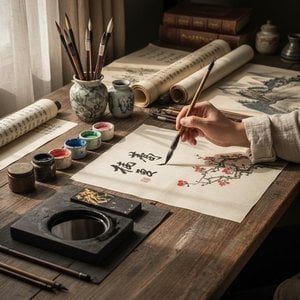
Embark on a sophisticated exploration of ink wash painting and Sumi-e. Uncover the profound historical lineages, Zen philosophies, and technical mastery behind this timeless medium in our authoritative guide for fine art enthusiasts.

Discover the profound serenity of timeless pastoral landscapes. From Impressionist masterpieces to bespoke oil commissions, explore how curated fine art brings the enduring beauty and tranquility of nature into your luxury home interior.

 Переглянути в інтер'єрі
 Надіслати як листівку
 Поділитися
 Детальніше

 Завантажити
 Схожі експонати
 Рентгенівське дослідження
 Слайд-шоу
 Читати далі




































 Скляний варіант доступний лише для розмірів до 110 см


