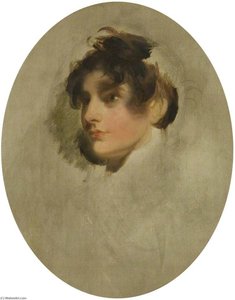
Біографія митця
Early Life and Artistic Foundations
Thomas Phillips, born in Dudley, Worcestershire, in 1770, emerged from relatively modest beginnings to become a prominent figure in the British art scene of the late 18th and early 19th centuries. His initial artistic training wasn’t within the traditional confines of painting, but rather in the craft of glass-painting under Francis Eginton in Birmingham. This foundational experience instilled in him a meticulous attention to detail and an understanding of color and light – skills that would later prove invaluable in his portraiture. The intricate designs and vibrant hues of stained glass demanded precision and a keen eye for composition, shaping his early artistic sensibilities. A pivotal moment arrived in 1790 when Phillips journeyed to London, armed with an introduction to Benjamin West, a leading artist of the time and a key figure in the Royal Academy. West’s guidance proved transformative, opening doors to opportunities within the established art world and providing him with invaluable mentorship. This connection secured him employment on the painted-glass windows of St George's Chapel at Windsor Castle – a project that allowed him to hone his skills within a grand architectural context, mastering large-scale decorative work and developing an appreciation for narrative storytelling through visual imagery. The sheer scale of these commissions demanded a sophisticated understanding of perspective and color theory, further refining his artistic abilities.
A Rising Portraitist: Style and Subject Matter
Phillips quickly found his niche in portraiture, though not without navigating a competitive landscape already populated by renowned artists like Thomas Lawrence and John Hoppner. Initially, his sitters were largely unknown individuals – tradesmen, local dignitaries, and members of the gentry – but through dedication, technical skill, and an increasingly discerning eye, he steadily ascended the social ladder, attracting increasingly prominent figures to his studio. His style was characterized by a meticulous realism, reflecting both the influence of his early training in glass-painting and the prevailing artistic tastes of the era. He possessed an ability to capture not just physical likeness, but also something of the sitter’s character – their intellect, demeanor, and even their inner life. This talent wasn't merely about replicating a face; it was about conveying personality through subtle gestures, expressions, and carefully chosen details. He often employed a restrained palette, favoring muted tones that allowed the subject’s features to emerge with clarity and dignity. His portraits were not flamboyant displays of wealth or status, but rather thoughtful representations of individuals, imbued with a sense of quiet elegance.
Royal Patronage and Academic Recognition
The year 1804 marked a significant turning point in Phillips’ career with his election as an associate of the Royal Academy, alongside William Owen. This recognition solidified his position within the artistic establishment and signaled a period of increased demand for his services. Shortly thereafter, he relocated to 8 George Street, Hanover Square – a prestigious address that would remain his home and studio for the next four decades. This move reflected his growing success and provided him with a more suitable environment for conducting his business. His clientele continued to expand dramatically, encompassing members of the royal family (including Prince of Wales later King George IV), the aristocracy, prominent politicians, and leading figures in science, literature, and exploration. He painted portraits of the Marchioness of Stafford, Lord Thurlow, and many other notable individuals who sought his artistic services. The demand for his work was a testament to his reputation as a skilled portraitist capable of capturing both likeness and character with remarkable precision.
Major Achievements and Artistic Evolution
Phillips’s career spanned several decades, during which he produced a vast body of work that showcased his evolving style and technical mastery. He began with landscapes and historical scenes, but quickly established himself as a leading portrait painter. His early works, such as “The Death of Talbot, Earl of Shrewsbury, at the Battle of Castillon,” demonstrated a strong command of composition and dramatic lighting. However, it was in the 1800s that he truly flourished, producing some of his most celebrated portraits – including those of William Blake, Sir Joseph Banks, Lord Byron, and Michael Faraday. The portrait of William Blake, now housed in the National Portrait Gallery, is particularly noteworthy for its sensitive portrayal of the poet’s intense gaze and visionary spirit. He also produced a series of impressive diploma works, demonstrating his versatility and ambition as an artist. His later work often incorporated elements of Romanticism, reflecting the era's fascination with emotion, imagination, and the sublime.
Legacy and Historical Significance
Phillips’s contributions to British art extend beyond the individual portraits he created. He played a role in shaping the artistic landscape of his time, fostering a tradition of meticulous realism and psychological insight in portraiture. His dedication to artistic education – as evidenced by his lectures on painting – further cemented his legacy as a significant figure in the development of British art. While his later years saw a slight decline in public acclaim, Thomas Phillips remains remembered as one of the most accomplished portraitists of the 19th century, whose works offer valuable insights into the lives and personalities of some of Britain’s most influential figures. His attention to detail, combined with a sensitivity to character, ensures his place as a significant figure in 19th-century British art.



 Переглянути в інтер'єрі
 Перейти до друку
 Надіслати
 Поділитися
 Деталі
 Посібник

 Завантажити
 Схожі предмети колекціонування
 Рентгенівське дослідження
 Слайд-шоу
 Статистика переглядів


 Читати далі






































 Скляний варіант доступний лише для розмірів до 110 см