Переглянути в інтер'єрі Примірка в AR Перейти до друку Перейти до цифрових зображень Надіслати
Деталі Посібник Додати до улюблених Завантажити Схожі предмети колекціонування Рентгенівське дослідження Слайд-шоу Статистика переглядів

Composition with half values

Explore Theo van Doesburg's 'Composition with half values,' a pivotal De Stijl masterpiece from 1928. Geometric abstraction & limited color define this iconic work now at Kunstmuseum Basel.

Тео ван Досбурґ – революціонер мистецтва! Його De Stijl та Неопластицизм вплинули на архітектуру, дизайн та абстрактне мистецтво. Геометричні форми, чисті кольори, новаторський погляд!

Олійная репродукція ручної роботи

Написана вручну олією на полотні у вашому розмірі та рамі, виготовлена на замовлення нашими художниками. ( Перейти до друку Перейти до цифрових зображень)

Corner sample of the P118B picture frame: формований полістирол, 5 cm wide and 3 cm thick
P118B 10
Corner sample of the P118H picture frame: формований полістирол, 5 cm wide and 3 cm thick
P118H 10
Corner sample of the P118W picture frame: формований полістирол, 5 cm wide and 3 cm thick
P118W 10
Corner sample of the P438Z picture frame: формований полістирол, 5.5 cm wide and 3.5 cm thick
P438Z 10
Corner sample of the P508JH picture frame: формований полістирол, 7 cm wide and 3.5 cm thick
P508JH 12
Corner sample of the P508YH picture frame: формований полістирол, 7 cm wide and 3.5 cm thick
P508YH 12
Corner sample of the P805H picture frame: формований полістирол, 5 cm wide and 3.5 cm thick
P805H 10
Corner sample of the P805Z picture frame: формований полістирол, 5 cm wide and 3.5 cm thick
P805Z 10
Corner sample of the P919BZ picture frame: формований полістирол, 7 cm wide and 3.5 cm thick
P919BZ 10
Corner sample of the P919G picture frame: формований полістирол, 7 cm wide and 3.5 cm thick
P919G 10
Corner sample of the P919XJ picture frame: формований полістирол, 7 cm wide and 3.5 cm thick
P919XJ 10
Corner sample of the P959ZH picture frame: формований полістирол, 5 cm wide and 3 cm thick
P959ZH 10
Corner sample of the P968JZ picture frame: формований полістирол, 6 cm wide and 4 cm thick
P968JZ 12
Corner sample of the W106C picture frame: масив дерева, 5 cm wide and 3 cm thick
W106C 8
Corner sample of the W218G picture frame: масив дерева, 5 cm wide and 3 cm thick
W218G 10
Corner sample of the W218JH picture frame: масив дерева, 5 cm wide and 3 cm thick
W218JH 8
Corner sample of the W218Y picture frame: масив дерева, 5 cm wide and 3 cm thick
W218Y 10
Corner sample of the W307PJ picture frame: масив дерева, 6 cm wide and 3 cm thick
W307PJ 10
Corner sample of the W316G picture frame: масив дерева, 6 cm wide and 3 cm thick
W316G 10
Corner sample of the W316PJ picture frame: масив дерева, 6 cm wide and 3 cm thick
W316PJ 8
Corner sample of the W316Y picture frame: масив дерева, 6 cm wide and 3 cm thick
W316Y 10
Corner sample of the W398PJ picture frame: масив дерева, 5 cm wide and 3 cm thick
W398PJ 8
Corner sample of the W4111J picture frame: масив дерева, 6.5 cm wide and 3.5 cm thick
W4111J 10
Corner sample of the W500HY picture frame: масив дерева, 7 cm wide and 5 cm thick
W500HY 15
Corner sample of the W500JH picture frame: масив дерева, 7 cm wide and 5 cm thick
W500JH 15
Corner sample of the W692G picture frame: масив дерева, 8 cm wide and 4 cm thick
W692G 12
Corner sample of the W849H picture frame: масив дерева, 5 cm wide and 3 cm thick
W849H 8
Corner sample of the W940BG picture frame: масив дерева, 7.5 cm wide and 4.5 cm thick
W940BG 15
Corner sample of the W953PJ picture frame: масив дерева, 6 cm wide and 3.5 cm thick
W953PJ 8

Стандартний розмір
на замовлення
CM
INCH

Обирайте з наших стандартних розмірів, що відповідають оригінальним пропорціям твору мистецтва.

ширина
висота

Введіть необхідну ширину та висоту, щоб картина підійшла до вашої рами або стіни. Оскільки це ручний розпис, для розміру іншої форми художник може написати трохи більше навколо картини або трохи обрізати її — вибір за вами. Перед початком роботи ми надішлемо вам цифровий макет для затвердження. Зображення, показане на цій сторінці, не є реальним результатом — лише макет відображає майбутній вигляд.

Приклади можливих змін: замінити обличчя на фото клієнта; додати домашню тварину (наприклад, замінити кота на собаку); додати приховане повідомлення на фоні; змінити ландшафт або елементи фону.
Після оформлення замовлення команда WahooArt.com зв'яжеться з клієнтом електронною поштою для отримання інструкцій та надасть попередній макет

Доставка по всьому світу () за 3–4 тижні замість стандартних 5 тижнів. (18 Жовтень). Без жодних компромісів у якості.

Безкоштовна експрес-доставка по всьому світу
Високоякісне лляне полотно
Повне страхове покриття доставки
Гарантія повернення митних зборів
Гарантія точного відтворення кольорів
Політика повернення протягом 100 днів (лише у разі виявлення дефектів)
Гарантія повернення 100% коштів
Знижка на оптові замовлення

Загальна вартість

₴ 12157

Composition with half values

Техніка репродукції

Розмір репродукції

-

Загальна вартість

₴ 12157

Короткі факти

  • Title: Composition with half values
  • Year: 1928
  • Artist: Theo van Doesburg
  • Artistic style: Neoplasticism
  • Influences: Piet Mondrian
  • Notable elements or techniques:
    • Geometric shapes
    • Limited color palette

Тест на знання мистецтва

У кожному запитанні лише одна правильна відповідь.

Запитання 1:
What artistic movement is Theo van Doesburg’s ‘Composition with half values’ most closely associated with?
Запитання 2:
Which of the following best describes the color palette used in ‘Composition with half values’?
Запитання 3:
What is a key characteristic of the geometric shapes used in this artwork?
Запитання 4:
Where is ‘Composition with half values’ currently housed?

Composition with Half Values: A De Stijl Masterpiece

Theo van Doesburg's "Composition with half values," created in 1928, stands as a pivotal work within the De Stijl movement. This oil on canvas painting exemplifies the artist’s dedication to geometric abstraction and his exploration of visual harmony through carefully balanced forms and colors. Housed in the Kunstmuseum Basel, Switzerland, this piece is more than just an aesthetic arrangement; it's a testament to a revolutionary artistic philosophy.

The De Stijl Movement and Its Principles

To fully appreciate "Composition with half values," understanding the De Stijl movement is crucial. Founded in 1917 by Piet Mondrian and van Doesburg, De Stijl (meaning “The Style” in Dutch) aimed to create a universal artistic language based on pure abstraction. The movement rejected representational art, believing that it distracted from underlying mathematical principles of harmony and order. Key tenets included:

  • Geometric Forms: A preference for straight lines, squares, and rectangles over curves or organic shapes.
  • Primary Colors: Limited palette consisting primarily of red, yellow, blue, black, white, and grey.
  • Spatial Relationships: Emphasis on the relationships between forms and colors to create a sense of balance and dynamism.
  • Rejection of Perspective: A flattening of space, eliminating traditional perspective techniques.

De Stijl artists believed that by reducing art to its essential elements, they could reveal universal truths about the universe and contribute to a more harmonious society.

Analyzing "Composition with Half Values"

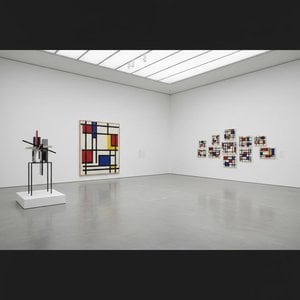
The painting itself is a striking example of these principles. It features a grid-like structure dominated by rectangular shapes in muted blues and whites. A large, vibrant blue square disrupts the otherwise orderly arrangement at the top, while a yellow rectangle anchors the composition at the bottom. The interplay between these elements creates a dynamic tension.

The title "Composition with half values" refers to van Doesburg's exploration of visual balance. He sought to create compositions where opposing forces – like color and shape – were in equilibrium, representing a sense of harmony. While Mondrian favored strict right angles, van Doesburg later reintroduced diagonals into his work, as seen here, pushing the boundaries of De Stijl’s established rules.

Symbolism and Emotional Impact

Although abstract, "Composition with half values" evokes a range of emotions. The rigid geometry can convey a sense of order and control, while the contrasting colors introduce an element of surprise and visual excitement. The painting's lack of representational imagery encourages viewers to engage directly with the forms and colors themselves, prompting introspection and contemplation.

Beyond its aesthetic qualities, the artwork symbolizes a search for universal harmony and balance through reduction to fundamental geometric elements. It reflects a broader cultural shift towards abstraction in the early 20th century, as artists sought new ways to express their ideas and challenge traditional artistic conventions. "Composition with half values" remains a powerful testament to the enduring legacy of De Stijl and its profound influence on modern art and design.

Запитання та відповіді

Про що твір "Composition with half values" і яку атмосферу він передає?

«Composition with half values» Тео ван Досбурґ зображує abstract, geometric, composition, rectangles, primary colors, de stijl, grid, minimalism у Modern настрої. Поєднання сюжету та атмосфери повністю розкриває цей твір.

До якого художнього напряму належить «Composition with half values» Тео ван Досбурґ?

«Composition with half values» — це твір у стилі De Stijl. Назва течії вказує на художню традицію, до якої належить цей твір.

Наскільки гармонійними є кольори у творі «Composition with half values» Тео ван Досбурґ?

Кольори твору «Composition with half values» Тео ван Досбурґ демонструють Discordant Palette гармонію. Гармонія описує взаємозв'язок кольорів між собою.


Біографія митця

The Architect of Abstraction: A Life in Geometric Harmony

Theo van Doesburg, born Christian Emil Marie Küpper in 1883 in Utrecht, Netherlands, wasn’t merely a painter; he was a revolutionary force who fundamentally reshaped the very foundations of modern art. His journey began amidst the lingering echoes of Impressionism and Post-Impressionism – initially mirroring styles reminiscent of Vincent van Gogh – both in subject matter and emotional intensity. However, this early phase served as a crucial prelude, a necessary stepping stone toward the radical transformation that would define his enduring legacy. A pivotal moment arrived in 1913 with his encounter with Wassily Kandinsky’s *Rückblicke*. This text sparked within van Doesburg a profound realization: true artistic expression lay not in replicating the external world but in channeling an inner, spiritual reality through pure abstraction. It was this conviction that birthed Neoplasticism – more commonly known as De Stijl – a movement he founded and fiercely championed, becoming its most ardent advocate.

Forging a New Visual Language: The Principles of De Stijl

De Stijl wasn’t merely an artistic style; it was a comprehensive philosophical manifesto translated into visual form. Van Doesburg believed in stripping art down to its most essential elements – straight lines, right angles, and the primary colors of red, yellow, and blue, alongside black, white, and gray. This austere palette wasn't born from limitation but from a desire for universality—a belief that these fundamental forms resonated with an underlying cosmic order. He envisioned a *total* work of art, extending beyond the canvas to encompass architecture, design, and even everyday objects. Collaboration was key; van Doesburg worked closely with architects like J.J.P. Oud and Gerrit Rietveld, designing stained glass windows, furniture, and entire interiors that embodied the principles of De Stijl. His collaborations extended to fellow artists such as Piet Mondrian, with whom he co-founded the influential journal *De Stijl*, a platform for disseminating their ideas and attracting like-minded creatives. However, despite their shared origins, tensions arose between van Doesburg and Mondrian regarding the rigidity of Neoplasticism. Van Doesburg introduced “Elementarism” in 1926, advocating for diagonal lines and more dynamic compositions – a departure that ultimately led to a schism within the movement, revealing his restless spirit and constant pursuit of artistic evolution.

A Multifaceted Artistic Vision: Beyond Painting

While celebrated as a painter, Theo van Doesburg’s artistic pursuits were remarkably diverse. He was a prolific writer, poet, and critic, using his pen to articulate the theoretical underpinnings of De Stijl and challenge conventional notions of art. His engagement with Dadaism in the early 1920s further broadened his artistic horizons, leading to experimental works that incorporated collage and typography. This period also saw him teaching at the Bauhaus, where he shared his ideas with a new generation of artists and designers. He wasn’t content to remain within the confines of traditional art forms; van Doesburg actively sought to integrate art into everyday life, believing it had the power to transform society. His designs for interiors and furniture weren't merely aesthetic exercises but attempts to create harmonious living spaces that reflected the principles of De Stijl. A prime example is his collaboration with Sophie Taeuber-Arp and Georges Vantongerloo on designing artist residences, showcasing a holistic approach to artistic creation – an attempt to build a world *in* the image of his ideals.

Key Influences & Developments

Van Doesburg’s artistic development was shaped by a complex interplay of influences. Initially drawn to the emotive power of Van Gogh's work, he quickly moved beyond mere imitation, seeking a more profound and universal language for art. The encounter with Kandinsky’s *Rückblicke* proved transformative, pushing him toward abstraction as a means of expressing inner spiritual realities. His early engagement with Futurism, though ultimately rejected due to its focus on dynamism, exposed him to new ideas about movement and technology. The impact of the Bauhaus school further solidified his commitment to functional design and the integration of art into everyday life. Crucially, his association with Piet Mondrian was both a source of inspiration and a point of contention, leading to the development of Elementarism – a departure from Neoplasticism that emphasized dynamism and complexity.

Legacy & Enduring Influence

Theo van Doesburg’s life was tragically cut short in 1931 at the age of 47, yet his impact on modern art remains profound. De Stijl, though relatively short-lived as a cohesive movement, exerted an enormous influence on subsequent artistic developments, including Bauhaus design, Minimalism, and Constructivism. His emphasis on geometric abstraction, pure color, and functionalism continues to resonate with artists and designers today. His work serves as a reminder that art is not merely about representation but about the exploration of fundamental forms and ideas. Van Doesburg’s legacy extends beyond his paintings and designs; it lies in his unwavering commitment to artistic innovation and his belief in the transformative power of abstraction. His vision of a unified, harmonious world – expressed through the language of De Stijl – continues to inspire those who seek to create a more beautiful and meaningful environment.

Notable Works

  • Study for Simultaneous Compositions XXII (1922): A quintessential example of Neoplasticism, showcasing the movement’s signature geometric forms and limited color palette.
  • Composition with half values (1928): Demonstrates van Doesburg's exploration of tonal variations within the De Stijl aesthetic.
  • Dancers (1917-1918): Represents a transitional phase in his work, blending figurative elements with emerging abstract tendencies.
  • Collaboration on *De Stijl* journal: A crucial platform for disseminating the movement’s ideas and fostering dialogue among artists and intellectuals.
  • Elementarism (1926): Van Doesburg's attempt to inject dynamism into Neoplasticism, introducing diagonal lines and a more fluid approach to composition.
Van Doesburg’s influence can be seen in countless aspects of modern design – from architecture and furniture to graphic design and typography. He remains a pivotal figure in the history of art, a true pioneer who dared to challenge conventions and envision a new visual language for the 20th century and beyond—a legacy etched in straight lines and primary hues.

Тео ван Досбурґ

Тео ван Досбурґ

1883 - 1931 , Нідерланди

Довідкова інформація

  • Artistic Movement Or Style: Де Стьйль, Неопластицизм
  • Artists Or Movements Influenced By This Artist:
    • Баухаус
    • Мінімалізм
    • Конструктивизм
  • Artists Who Influenced This Artist:
    • Ван Гог
    • Кандінковський
  • Date Of Birth: 30 серпня 1883
  • Date Of Death: 7 березня 1931
  • Full Name: Theo van Doesburg
  • Nationality: Нідерландський
  • Notable Artworks:
    • Дослідження для одночасних композицій XXII
    • Композиція з напівцінностями
    • Танцюристи
  • Place Of Birth: Утрехт, Нідерланди
Досліджуйте твори мистецтва, впорядковані за темами, стилями та характеристиками.