Переглянути в інтер'єріПереглянути в інтер'єрі Перегляд в ARПерегляд в AR Замовити репродукцію ручної роботи Замовити репродукцію ручної роботиПерейти до цифрових зображень Перейти до цифрових зображень Надіслати як листівкуНадіслати як листівку
ДетальнішеДетальніше Додати до улюблених Додати до улюблених ЗавантажитиЗавантажити Схожі експонатиСхожі експонати Рентгенівське дослідженняРентгенівське дослідження Слайд-шоуСлайд-шоу СтатистикаСтатистика

The idol,1965, private

Рене Маґрітт – бельгійський сюрреаліст, що створював загадкові та дивовижні картини, які кидають виклик нашому сприйняттю реальності. Відкрийте світ його шедеврів! #Маґрітт #Сюрреалізм

Гікле / Художній принт

Музейна якість друку جيкле або на полотні з оперативним виготовленням та різноманітними варіантами фінішної обробки. (Замовити репродукцію ручної роботи Замовити репродукцію ручної роботиПерейти до цифрових зображень Перейти до цифрових зображень)

P118B $10
P118H $10
P118W $10
P438Z $10
P508JH $12
P508YH $12
P805H $10
P805Z $10
P919BZ $10
P919G $10
P919XJ $10
P959ZH $10
P968JZ $12
W106C $8
W218G $10
W218JH $8
W218Y $10
W307PJ $10
W316G $10
W316PJ $8
W316Y $10
W398PJ $8
W4111J $10
W500HY $15
W500JH $15
W692G $12
W849H $8
W940BG $15
W953PJ $8

Стандартний розмір
індивідуальний
CM
INCH

Обирайте з наших стандартних розмірів, що відповідають оригінальним пропорціям твору мистецтва.

ширина
висота

Ви можете вказати власні розміри, щоб репродукція ідеально підійшла до конкретної рами або інтер'єру. Якщо обраний вами розмір не відповідає пропорціям оригіналу, ми або обріжемо полотно, або розширимо зображення за допомогою дзеркального відображення чи суцільної заливки країв. Перед початком виробництва вам буде надіслано цифровий макет для затвердження.
Будь ласка, зверніть увагу, що попередній перегляд на екрані не відображає фактичне обрізання або розширення. Тільки макет точно покаже фінальну композицію.
Хоча можливість замовлення індивідуальних розмірів доступна, ми рекомендуємо обирати формат із попередньо визначеного списку, щоб зберегти оригінальні пропорції.

Доставка по всьому світу () за 2 тижні замість стандартних 4/5 тижнів. (14 Вересень)

why_choose_icon
Безкоштовна експрес-доставка по всьому світу
why_choose_icon
Високоякісне лляне полотно
why_choose_icon
Повне страхове покриття доставки
why_choose_icon
Гарантія відшкодування митних зборів
why_choose_icon
Гарантія точного відтворення кольорів
why_choose_icon
Політика повернення протягом 100 днів (тільки у разі виявлення дефектів)
why_choose_icon
Гарантія повернення 100% коштів
why_choose_icon
Пропозиція на оптові замовлення

Загальна вартість

$ 68

reproduction

The idol,1965, private

Гікле / Художній принт

Розмір репродукції

-

Підсумкова вартість

$ 68

Основна інформація

  • Subject or theme: Nature's Wonders
  • Notable elements or techniques: Stone bird, rocky terrain
  • Location: Private Collection
  • Title: The Idol
  • Artist: René Magritte
  • Movement: Surrealism
  • Artistic style: Symbolic Painting

Квіз про мистецтво

У кожному запитанні лише одна правильна відповідь.

Запитання 1:
What artistic movement is René Magritte’s ‘The Idol’ associated with?
Запитання 2:
The image depicts a bird flying over what natural element?
Запитання 3:
What is the primary symbolic representation conveyed by Magritte in ‘The Idol’?
Запитання 4:
What material is the bird depicted in ‘The Idol’ primarily composed of?
Запитання 5:
Why might Magritte's use of stone for the bird be interpreted as a reflection of his preoccupation with themes explored in his earlier works?

The Idol: A Surrealist Meditation on Perception

René Magritte’s “The Idol,” painted in 1965, stands as a quintessential example of Surrealism—a movement that sought to liberate the imagination from rational constraints and explore the subconscious mind. More than just a depiction of a bird soaring over an ocean landscape, this seemingly simple composition is laden with symbolic significance, prompting viewers to question their understanding of reality itself.

  • Subject Matter: The artwork presents a solitary bird traversing a rocky shoreline beneath a tranquil sea expanse. This deliberate choice of subject matter—a commonplace animal in an unremarkable setting—immediately establishes the Surrealist ethos of juxtaposing familiar elements in unexpected ways.
  • Style & Technique: Executed in oil on canvas, Magritte employs meticulous brushwork to render the stone-like bird and the rocks with remarkable detail. However, it’s precisely this realism that serves as a deceptive veneer over the underlying Surrealist intent. The artist skillfully utilizes shading and texture to create an illusion of solidity and permanence, contrasting sharply with the bird's improbable flight.
  • Historical Context: Magritte’s work emerged during the height of Surrealism’s influence in Europe—a reaction against the anxieties of post-war society and a fervent embrace of dreamlike imagery. Artists like André Breton championed the exploration of irrational thought and automatic writing as methods for accessing hidden truths, mirroring Magritte's artistic approach.

Symbolism & Emotional Impact: The bird itself is arguably the artwork’s most potent symbol. Representing aspiration, freedom, and perhaps even vulnerability, it embodies the desire to transcend limitations—a core preoccupation of Surrealist artists. Simultaneously, its stony appearance undermines any notion of effortless grace or natural beauty, suggesting that even seemingly grounded elements can harbor hidden complexities. The juxtaposition of stone and flight creates a palpable tension, mirroring the inherent instability of perception and prompting contemplation on what lies beneath the surface of appearances.

“The Idol” continues to resonate with audiences today because it encapsulates the Surrealist fascination with destabilizing conventional notions of reality. Magritte’s masterful technique—combining meticulous realism with unsettling symbolism—transforms a familiar landscape into an invitation to delve into the depths of the unconscious, leaving viewers pondering the elusive nature of truth and beauty.


Біографія митця

Early Life and the Seeds of Surrealism

René Magritte, born René François Ghislain Magritte on November 21, 1898, in Lessines, Belgium, emerged into a world that would profoundly shape his enigmatic artistic vision. His early years were marked by an unsettling event – the suicide of his mother when he was just thirteen. The image of her body being recovered from the River Sambre, with her dress obscuring her face, became a haunting motif that would subtly permeate his later work, manifesting in veiled figures and a persistent exploration of hidden realities. This early trauma instilled within him a fascination with mystery, loss, and the unsettling power of what remains unseen. While details of his childhood remain somewhat elusive, it’s clear this formative experience laid the groundwork for his lifelong questioning of perception and representation. He began drawing lessons at age ten, revealing an innate inclination towards visual expression, but initially explored Impressionism before embarking on a path that would lead him to become one of the most significant figures in Surrealist art.

Artistic Development and Influences

Magritte’s artistic journey was not immediate or straightforward. He studied at the Académie Royale des Beaux-Arts in Brussels, yet found its traditional methods stifling. His early work experimented with Futurism and Cubism, absorbing elements of these avant-garde movements but ultimately rejecting their purely formal concerns. It wasn't until encountering Giorgio de Chirico’s painting *The Song of Love* in 1922 that Magritte discovered a resonance that would irrevocably alter his artistic course. De Chirico’s dreamlike landscapes and unsettling juxtapositions unlocked within Magritte a new way of seeing – a world where the familiar could be rendered strange, and the ordinary imbued with profound mystery. This encounter sparked his commitment to Surrealism, though he often maintained a unique distance from its more overtly psychological or automatic approaches. He preferred a meticulous, almost clinical precision in his painting, using realistic techniques to depict illogical scenarios.

The Heart of Surrealism: Challenging Reality

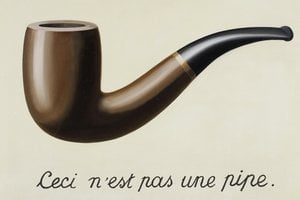
By 1926, Magritte had fully embraced the tenets of Surrealism, producing *Le Jockey Perdu (The Lost Jockey)*, widely considered his first truly surrealist work. However, his brand of Surrealism was distinct. He wasn’t interested in exploring the subconscious through free association or dream imagery in the manner of some of his contemporaries. Instead, Magritte sought to challenge viewers' perceptions of reality by presenting ordinary objects in unexpected contexts, forcing them to question their assumptions about the world around them. Iconic works like *The Treachery of Images (This is not a pipe)* (1929) brilliantly deconstructs the relationship between image and object, reminding us that a representation is never the thing itself. *Les Amants (The Lovers)* (1927-1928), with its shrouded figures, echoes the trauma of his mother’s death while simultaneously exploring themes of concealment and intimacy. *Time Transfixed* (1938) presents a locomotive bursting through a brick wall, disrupting our sense of space and time. And *The Human Condition* (1933), a canvas within a canvas, blurs the boundaries between representation and reality, prompting us to consider how we perceive and interpret the world.

Later Life, Recognition, and Enduring Legacy

Despite initial struggles for recognition, Magritte’s work gradually gained prominence, particularly in the United States with exhibitions in 1936 and later retrospective shows at the Museum of Modern Art (1965) and the Metropolitan Museum of Art (1992). He remained politically engaged throughout his life, advocating for artistic autonomy. He continued to refine his signature style, exploring themes of repetition, illusion, and the power of language in paintings that are both intellectually stimulating and visually arresting. Magritte died on August 15, 1967, leaving behind a body of work that continues to captivate and challenge audiences worldwide. His influence extends far beyond the realm of painting, impacting pop art, minimalist art, conceptual art, and even advertising and film. Today, his paintings are held in major museum collections around the globe, including the Musées royaux des beaux-arts de Belgique in Brussels, which houses the Magritte Museum – dedicated entirely to his work and boasting the world’s largest collection of his creations.
  • Museum Collections: Musées royaux des beaux-arts de Belgique, Brussels; Magritte Museum.
Magritte's enduring legacy lies in his ability to make us see the familiar anew, to question our assumptions about reality, and to appreciate the power of art to provoke thought and inspire wonder. He wasn’t simply painting images; he was crafting visual paradoxes that continue to resonate with viewers decades after their creation, solidifying his position as a true master of Surrealism and a pivotal figure in 20th-century art.

Рене Маґрітт

Рене Маґрітт

1898 - 1967 , Бельгія

Короткі факти

  • Artistic Movement Or Style: Сюрреалізм
  • Artists Or Movements Influenced By This Artist:
    • Поп-арт
    • Мінімалізм
    • Концептуальне мистецтво
  • Artists Who Influenced This Artist: ['Джорджо де Кіріко']
  • Date Of Birth: 21 листопада 1898
  • Date Of Death: 15 серпня 1967
  • Full Name: René François Ghislain Magritte
  • Nationality: Бельгійський
  • Notable Artworks:
    • Любовні
    • Обман зображень
    • Застиглий час
    • Умова людини
  • Place Of Birth: Лесене, Бельгія
Досліджуйте твори мистецтва, впорядковані за темами, стилями та характеристиками.