БЕЗКОШТОВНА КОНСУЛЬТАЦІЯ З МИСТЕЦТВА

x
Замовити репродукцію Замовити репродукціюКупити цифрове зображення Купити цифрове зображення НадіслатиНадіслати
ДеталіДеталі Додати до улюблених Додати до улюблених ЗавантажитиЗавантажити Схожі виробиСхожі вироби Рентгенівське дослідженняРентгенівське дослідження Слайд-шоуСлайд-шоу

Binodini

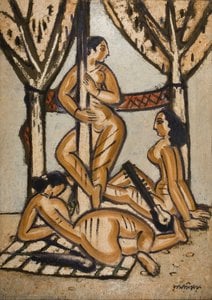
Experience the captivating inner conflict of Binodini, a striking portrait by Ramkinkar Baij (1949), whose textured oil work invites you to discover its depth.

Ramkinkar Baij (1906-1980) was a pioneering Indian sculptor & painter, considered the father of modern Indian sculpture. Known for contextual modernism and blending Western & Indian styles in works like 'Santal Family'. Explore his legacy at WahooArt

Гікле / Художній принт

Музейна якість друку جيкле або на полотні з оперативним виготовленням та різноманітними варіантами фінішної обробки.

P118B $10
P118H $10
P118W $10
P438Z $10
P508JH $12
P508YH $12
P805H $10
P805Z $10
P919BZ $10
P919G $10
P919XJ $10
P959ZH $10
P968JZ $12
W106C $8
W218G $10
W218JH $8
W218Y $10
W307PJ $10
W316G $10
W316PJ $8
W316Y $10
W398PJ $8
W4111J $10
W500HY $15
W500JH $15
W692G $12
W849H $8
W940BG $15
W953PJ $8

Standard
custom
CM
INCH

Обирайте з наших стандартних розмірів, що відповідають оригінальним пропорціям твору мистецтва.

ширина
висота

Ви можете вказати власні розміри, щоб репродукція ідеально підійшла до конкретної рами або інтер'єру. Якщо обраний вами розмір не відповідає пропорціям оригіналу, ми або обріжемо полотно, або розширимо зображення за допомогою дзеркального відображення чи суцільної заливки країв. Перед початком виробництва вам буде надіслано цифровий макет для затвердження.
Будь ласка, зверніть увагу, що попередній перегляд на екрані не відображає фактичне обрізання або розширення. Тільки макет точно покаже фінальну композицію.
Хоча можливість замовлення індивідуальних розмірів доступна, ми рекомендуємо обирати формат із попередньо визначеного списку, щоб зберегти оригінальні пропорції.

Доставка по всьому світу () за 2 тижні замість стандартних 4/5 тижнів. (5 Липень)

why_choose_icon
Безкоштовна експрес-доставка по всьому світу
why_choose_icon
Високоякісне лляне полотно
why_choose_icon
Повне страхове покриття доставки
why_choose_icon
Гарантія відшкодування митних зборів
why_choose_icon
Гарантія точного відтворення кольорів
why_choose_icon
Політика повернення протягом 60 днів (лише у разі виявлення дефектів)
why_choose_icon
Гарантія повернення 100% коштів
why_choose_icon
Знижка на багатоелементні замовлення

Загальна вартість

-

reproduction

Binodini

Гікле / Художній принт

Розмір репродукції

-

Підсумкова ціна

-

Основні факти

  • Year: 1949
  • Notable elements or techniques: Thick layers of paint, tactile quality
  • Artist: Ramkinkar Baij
  • Artistic style: Modern Indian art
  • Subject or theme: Portrait of a young woman
  • Medium: Oil on gunny cloth

Вікторина з мистецтва

Для кожного питання є лише одна правильна відповідь.

Запитання 1:
Who is the artist of the painting 'Binodini'?
Запитання 2:
What medium was 'Binodini' painted on?
Запитання 3:
The subject of the portrait, Binodini, belonged to which region?
Запитання 4:
What characteristic is noted about Ramkinkar Baij's approach to painting portraits?
Запитання 5:
What technique did Ramkinkar Baij use with paint on 'Binodini' to give it a tactile quality?

Опис експоната

The Enigma in White: Exploring Ramkinkar Baij's 'Binodini'

To stand before Binodini is not merely to observe a portrait; it is to step into a moment of profound, suspended contemplation. This masterful work by Ramkinkar Baij captures the essence of an inner life—a beautiful young woman from Manipur’s aristocratic lineage, caught in what seems to be a delicate confluence of thought and emotion. The painting transcends simple representation, offering instead a window into the complexities of the human spirit. Baij, whose genius was rooted in his ability to perceive the soul beneath the surface, has gifted us an image that resonates with both timeless elegance and modern psychological depth.

Technique and Tactility: A Masterclass in Medium

What immediately draws the eye is the remarkable texture achieved by Baij. Executed in oil upon gunny cloth—a material choice that speaks to his daring experimentation—the surface itself becomes a participant in the artwork’s narrative. He has not simply painted; he has built up layers of pigment, creating a palpable, almost sculptural quality to the paint. This thick application gives the slim figure an undeniable volume, making the portrait feel intensely present. The artist's handling is both tender and robust, allowing the viewer to sense the physical weight of the subject while simultaneously feeling the lightness of her dilemma.

Symbolism and the Gaze: Capturing Inner Conflict

The subject’s gaze is perhaps the most arresting element. Her eyes, wide and directed straight out of the canvas, meet the viewer's scrutiny with an unnerving directness. It is a look that seems to ask questions without uttering a single word. The flowing white dress enhances this sense of ethereal vulnerability, contrasting beautifully with the warm, yellowish embrace of the background. Noticeable details, such as the books placed near her—one in the lower left and another toward the upper right—suggest themes of knowledge, study, or perhaps conflicting narratives vying for her attention. These elements anchor the emotional ambiguity, suggesting that her internal conflict is intellectual as much as it is emotional.

Historical Resonance and Enduring Appeal

Painted in 1949, Binodini stands at a pivotal moment in Indian modern art. Ramkinkar Baij was not content with tradition; he was forging a new visual language for India. This portrait exemplifies his lifelong fascination with capturing the subject’s inner self rather than merely documenting her outward appearance. For collectors and designers alike, this piece offers more than mere decoration; it is an heirloom of artistic revolution. Reproducing this work allows one to bring home not just a painting, but a tangible connection to the pioneering spirit of modern Indian art.

Схожі витвори мистецтва


Біографія митця

Ramkinkar Baij: The Father of Modern Indian Sculpture

Ramkinkar Baij (1906-1980) stands as a monumental figure in the annals of Indian art history, rightfully recognized as the progenitor of modern Indian sculpture. Born on May 25th, 1906, in Bankura, West Bengal, Baij’s artistic journey wasn't merely about crafting stone; it was about redefining aesthetic sensibilities and forging a path toward a uniquely Indian form of expression within the burgeoning international modernist movement. His legacy continues to inspire artists and scholars alike, cementing his place as one of India’s most influential sculptors.

Early Life and Artistic Awakening

Baij's formative years were steeped in rural Bengal’s traditions. Growing up in a modest family, he absorbed the rhythms of village life and developed an innate appreciation for craftsmanship—skills that would prove invaluable to his artistic pursuits. Notably, Baij gained early recognition thanks to journalist Ramananda Chatterjee who spotted his striking portraits depicting Indian freedom fighters during the Nonviolent Resistance movement against British rule. This initial exposure ignited a passion for capturing human emotion and narrative through visual art. Four years later, he enrolled at Visva-Bharati University in Santiniketan, where he studied under the visionary Nandalal Bose—a connection that profoundly shaped his artistic worldview. Rabindranath Tagore’s influence fostered an environment of intellectual liberation, encouraging Baij to explore new ideas and techniques.

Santiniketan and Contextual Modernism

Baij's tenure at Santiniketan proved transformative. He became a faculty member at Kala Bhavana, the art school established by Tagore, playing a pivotal role in establishing Santiniketan as India’s premier center for modern art. Here, he championed contextual modernism—a stylistic approach that deliberately blended Western artistic principles with indigenous Indian traditions. This fusion is vividly exemplified in his monumental sculpture “Santal Family,” which powerfully portrays the dignity and resilience of tribal peasants using innovative materials like cement and laterite mortar. The sculpture’s enduring impact speaks to Baij's ability to distill universal human experience into a distinctly Indian visual language. His work can be found prominently displayed in museums across India, including the National Gallery of Modern Art in New Delhi.

Technique and Artistic Style

Baij’s sculptural technique was revolutionary for its time. He skillfully combined Western influences—particularly Cubism—with elements drawn from Hindu iconography and pre-classical sculpture. This deliberate juxtaposition resulted in figures imbued with both dynamism and spiritual depth, reflecting Baij's profound understanding of Indian artistic heritage. His sculptures are characterized by a meticulous attention to detail and an expressive use of form—qualities that distinguish him from many of his contemporaries.

Legacy and Recognition

Ramkinkar Baij’s contribution to Indian art transcends mere stylistic innovation; he fundamentally reshaped the conceptual framework of sculpture itself. He established himself as the undisputed father of modern Indian sculpture, inspiring generations of artists to embrace experimentation and explore new avenues for artistic expression. His enduring influence continues to resonate within the broader context of India's cultural landscape—a testament to his unwavering commitment to preserving and reimagining India’s artistic traditions.
Ramkinkar Baij

Ramkinkar Baij

1906 - 1980 , India

Короткі факти

  • Artistic Movement Or Style: Contextual Modernism
  • Artists Or Movements Influenced By This Artist: ['Santiniketan']
  • Artists Who Influenced This Artist: ['Nandalal Bose']
  • Date Of Birth: May 25, 1906
  • Date Of Death: August 2, 1980
  • Full Name: Ramkinkar Baij
  • Nationality: Indian
  • Notable Artworks:
    • Portrait of Rabindranath Tagore
    • Santal Family
    • Picnic
  • Place Of Birth: Bankura, India