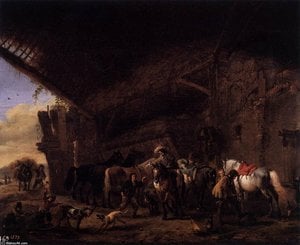
Philips Wouwerman: A Master of Dutch Life and Movement
Philips Wouwerman, born in Haarlem on May 24, 1619, and passing away on May 19, 1668, stands as a pivotal figure within the vibrant artistic landscape of the Dutch Golden Age. More than just a painter, he was a keen observer of human activity, a master of capturing movement and atmosphere, and a remarkably prolific artist whose works continue to captivate viewers today. His legacy rests not only on his technical skill but also on his ability to weave compelling narratives into scenes ranging from bustling hunting parties to quiet moments of rural life.
Early Influences and Artistic Training
Details surrounding Wouwerman’s early artistic training remain somewhat elusive, shrouded in the mists of history. He was the son of Pouwels Joostsz Wouwerman, a painter himself, though his father's work didn’t achieve widespread renown. While it’s believed he received some instruction from Frans Hals (1581/85–1666), Haarlem’s celebrated portraitist—Hals’ distinctive style didn’t profoundly shape Wouwerman’s mature oeuvre, the foundational training undoubtedly provided a crucial starting point. Initially, Wouwerman was deeply influenced by the *bamboccianti* tradition, a movement originating in Rome that focused on depicting scenes of everyday life – peasants playing dice, soldiers relaxing, and laborers engaged in various tasks. The works of Pieter van Laer (1592/99–after 1642), known for his lively depictions of these commoners, served as a significant model during this early phase of his artistic development.
The Emergence of a Distinct Style
As Wouwerman’s career progressed through the mid-1640s, a recognizable stylistic shift began to emerge. He moved beyond simple genre scenes and developed a characteristic compositional technique that would become instantly identifiable with his work. This involved frequently employing a diagonal slope of land – often incorporating a tree acting as a repoussoir (a device used to create depth and drama) – alongside figures, predominantly accompanied by horses. These dynamic compositions captured the essence of movement and space in a way that resonated deeply with viewers. His subjects expanded beyond everyday life, encompassing cavalry battles, military encampments, festive gatherings of peasants, and landscapes populated by travelers. This period marked a significant departure from his earlier *bamboccianti* influences, establishing Wouwerman’s own unique artistic voice.
Mastery of the Horse – A Defining Characteristic
Perhaps Wouwerman's most enduring legacy lies in his unparalleled skill in depicting horses. Art historians widely acknowledge him as “undoubtedly the most accomplished and successful 17th-century Dutch painter of horses,” a title earned through decades of dedicated observation and masterful execution. He didn’t simply paint horses; he captured their power, grace, and movement with breathtaking realism. His paintings showcase an astonishing range of breeds – from sturdy warhorses to elegant hunters – each rendered with meticulous detail and a profound understanding of equine anatomy. Frederik J. Duparc famously noted this exceptional talent, recognizing Wouwerman's ability to convey the very spirit of these magnificent animals.
A Flourishing Career and Lasting Impact
Wouwerman joined the Haarlem Guild of St. Luke in 1640, marking a significant step in his professional life. He quickly established himself as a successful painter, commanding considerable demand for his works throughout Europe. His paintings were highly sought after by wealthy collectors and princely houses alike – from Dresden to St. Petersburg, evidence of his enduring popularity remains. Beyond his artistic achievements, Wouwerman was also involved in estate management within Haarlem, reflecting the multifaceted nature of a successful artist during that era. While many works attributed to him were created by his brothers, Jan (1629–1666) and Pieter (1623–1682), often influenced by Philips’ style, they each developed their own distinct artistic identities. Wouwerman's influence extended beyond his immediate family; he inspired numerous artists who followed in his footsteps, solidifying his place as a cornerstone of the Dutch Golden Age art scene.
A Legacy Enduring Through Time
Philips Wouwerman’s contribution to the artistic heritage of the Netherlands is undeniable. His ability to capture the dynamism of life – whether it be the thrill of the hunt, the bustle of a marketplace, or the drama of a battlefield – continues to resonate with audiences today. His paintings offer a captivating glimpse into the world of 17th-century Dutch society, revealing not only artistic brilliance but also a keen understanding of human nature and the beauty of the natural world. The retrospective exhibition in Kassel and The Hague (2009/2010) served as a powerful testament to his enduring legacy, ensuring that his remarkable talent would continue to be appreciated for generations to come.



 Переглянути в інтер'єрі
 Перейти до друку
 Надіслати як листівку
 Поділитися
 Детальніше

 Завантажити
 Схожі експонати
 Рентгенівське дослідження
 Слайд-шоу
 Статистика

 Читати далі






































 Скляний варіант доступний лише для розмірів до 110 см