Переглянути в інтер'єрі Перегляд в AR Перейти до друку Перейти до цифрових зображень Надіслати як листівку
Деталі витвору Посібник Додати до улюблених Завантажити Схожі екземпляри Рентгенівське дослідження Слайд-шоу Статистика

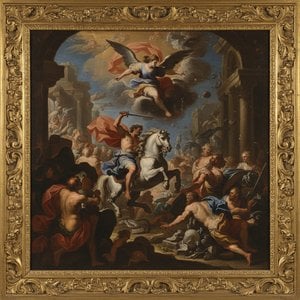
Venus Weeping over Adonis

Experience Nicolas Poussin's 'Venus Weeping over Adonis,' a stunning Baroque masterpiece depicting loss and beauty. Explore the classicism, mythology, and emotional depth of this iconic painting.

Нікола Пуссін | Національний музей мистецтва України

Олійная репродукція ручної роботи

Написана вручну олією на полотні у вашому розмірі та рамі, виготовлена на замовлення нашими художниками. ( Перейти до друку Перейти до цифрових зображень)

Corner sample of the P118B picture frame: формований полістирол, 5 cm wide and 3 cm thick
P118B ₴10
Corner sample of the P118H picture frame: формований полістирол, 5 cm wide and 3 cm thick
P118H ₴10
Corner sample of the P118W picture frame: формований полістирол, 5 cm wide and 3 cm thick
P118W ₴10
Corner sample of the P438Z picture frame: формований полістирол, 5.5 cm wide and 3.5 cm thick
P438Z ₴10
Corner sample of the P508JH picture frame: формований полістирол, 7 cm wide and 3.5 cm thick
P508JH ₴12
Corner sample of the P508YH picture frame: формований полістирол, 7 cm wide and 3.5 cm thick
P508YH ₴12
Corner sample of the P805H picture frame: формований полістирол, 5 cm wide and 3.5 cm thick
P805H ₴10
Corner sample of the P805Z picture frame: формований полістирол, 5 cm wide and 3.5 cm thick
P805Z ₴10
Corner sample of the P919BZ picture frame: формований полістирол, 7 cm wide and 3.5 cm thick
P919BZ ₴10
Corner sample of the P919G picture frame: формований полістирол, 7 cm wide and 3.5 cm thick
P919G ₴10
Corner sample of the P919XJ picture frame: формований полістирол, 7 cm wide and 3.5 cm thick
P919XJ ₴10
Corner sample of the P959ZH picture frame: формований полістирол, 5 cm wide and 3 cm thick
P959ZH ₴10
Corner sample of the P968JZ picture frame: формований полістирол, 6 cm wide and 4 cm thick
P968JZ ₴12
Corner sample of the W106C picture frame: масив дерева, 5 cm wide and 3 cm thick
W106C ₴8
Corner sample of the W218G picture frame: масив дерева, 5 cm wide and 3 cm thick
W218G ₴10
Corner sample of the W218JH picture frame: масив дерева, 5 cm wide and 3 cm thick
W218JH ₴8
Corner sample of the W218Y picture frame: масив дерева, 5 cm wide and 3 cm thick
W218Y ₴10
Corner sample of the W307PJ picture frame: масив дерева, 6 cm wide and 3 cm thick
W307PJ ₴10
Corner sample of the W316G picture frame: масив дерева, 6 cm wide and 3 cm thick
W316G ₴10
Corner sample of the W316PJ picture frame: масив дерева, 6 cm wide and 3 cm thick
W316PJ ₴8
Corner sample of the W316Y picture frame: масив дерева, 6 cm wide and 3 cm thick
W316Y ₴10
Corner sample of the W398PJ picture frame: масив дерева, 5 cm wide and 3 cm thick
W398PJ ₴8
Corner sample of the W4111J picture frame: масив дерева, 6.5 cm wide and 3.5 cm thick
W4111J ₴10
Corner sample of the W500HY picture frame: масив дерева, 7 cm wide and 5 cm thick
W500HY ₴15
Corner sample of the W500JH picture frame: масив дерева, 7 cm wide and 5 cm thick
W500JH ₴15
Corner sample of the W692G picture frame: масив дерева, 8 cm wide and 4 cm thick
W692G ₴12
Corner sample of the W849H picture frame: масив дерева, 5 cm wide and 3 cm thick
W849H ₴8
Corner sample of the W940BG picture frame: масив дерева, 7.5 cm wide and 4.5 cm thick
W940BG ₴15
Corner sample of the W953PJ picture frame: масив дерева, 6 cm wide and 3.5 cm thick
W953PJ ₴8

Стандартний розмір
індивідуальний розмір
CM
INCH

Обирайте з наших стандартних розмірів, що відповідають оригінальним пропорціям твору мистецтва.

ширина
висота

Введіть необхідну ширину та висоту, щоб картина підійшла до вашої рами або стіни. Оскільки це ручний розпис, для зміни пропорцій художник може дописати трохи більше по краях або дещо обрізати композицію — вибір за вами. Перед початком роботи ми надішлемо вам цифровий макет для затвердження. Зображення, показане на цій сторінці, не є реальним результатом — лише макет відображає майбутній вигляд.

Приклади можливих змін: замінити обличчя на фото клієнта; додати домашню тварину (наприклад, замінити кота на собаку); додати приховане повідомлення на фоні; змінити ландшафт або елементи фону.
Після оформлення замовлення команда WahooArt.com зв'яжеться з клієнтом електронною поштою для отримання інструкцій та надасть попередній макет

Доставка по всьому світу () за 3–4 тижні замість стандартних 5 тижнів. (28 Жовтень). Без жодних компромісів у якості.

Безкоштовна експрес-доставка по всьому світу
Високоякісне лляне полотно
Повне страхове покриття доставки
Гарантія повернення митних зборів
Гарантія точного відтворення кольорів
Політика повернення протягом 100 днів (лише у разі виявлення дефектів)
Гарантія повернення 100% коштів
Пропозиція на оптові замовлення

Загальна вартість

₴ 12191

Venus Weeping over Adonis

Матеріал репродукції

Розмір репродукції

-

Підсумкова вартість

₴ 12191

Основна інформація

  • Influences: Italian Renaissance
  • Medium: Oil on canvas
  • Notable elements: Mythological scene
  • Location: Musée des Beaux-Arts de Caen
  • Title: Venus Weeping over Adonis
  • Subject or theme: Love, Loss, Mythology

Квіз про мистецтво

У кожному запитанні лише одна правильна відповідь.

Запитання 1:
What is the primary subject matter of Nicolas Poussin’s ‘Venus Weeping over Adonis’?
Запитання 2:
In what artistic movement is ‘Venus Weeping over Adonis’ primarily classified?
Запитання 3:
Approximately when was ‘Venus Weeping over Adonis’ painted?
Запитання 4:
What is the significance of the doves in the painting?
Запитання 5:
The painting’s muted color palette contributes to which of the following effects?

A Moment of Profound Sorrow: Poussin’s “Venus Weeping Over Adonis”

Nicolas Poussin's "Venus Weeping Over Adonis," painted around 1626, is more than just a depiction of a classical myth; it’s a poignant meditation on love, loss, and the cyclical nature of life and death. This masterpiece, currently residing in the Musée des Beaux-Arts de Caen, France, transcends its mythological subject matter to resonate with an enduring emotional power that continues to captivate viewers centuries later. Poussin, deeply influenced by the artistic ideals of antiquity and the Venetian masters he admired, masterfully blended classical composition with a distinctly personal sensibility, creating works that are both intellectually stimulating and profoundly moving.

The scene itself is deceptively simple yet intensely dramatic. Venus, her face etched with grief, kneels beside the lifeless body of Adonis, the young hunter slain by a boar. The setting—a softly lit landscape hinting at dawn or dusk—contributes to the painting’s melancholic atmosphere. Notice the careful attention to detail: the delicate folds of Venus's drapery, the subtle play of light on the water, and the meticulously rendered foliage all speak to Poussin’s technical virtuosity. He employed a technique known as *sfumato*, blurring lines and softening edges to create an ethereal quality, further enhancing the sense of sorrow and transience.

The Mythic Narrative and Symbolism

The story depicted is drawn from Ovid's *Metamorphoses*, where Venus, consumed by grief over Adonis’s death, attempts to restore him to life by transforming his blood into anemones—small blue flowers that bloom in the spring. This transformation symbolizes both loss and renewal, a poignant reminder that even in death, beauty and new beginnings can emerge. The presence of the doves, often associated with love and mourning, reinforces this theme. The figure representing the river Adonis, lying prone at the base of the composition, adds another layer of symbolism—a representation of the passage of time and the inevitable decay of all things.

Beyond the immediate narrative, Poussin imbues the scene with broader allegorical meanings. The painting can be interpreted as a meditation on the fleeting nature of beauty and youth, the pain of separation, and the enduring power of love. The contrast between the vibrant colors of Venus’s garments and the muted tones of the landscape further emphasizes this duality—the vibrancy of life juxtaposed against the stillness of death.

Poussin's Classical Influence and Artistic Technique

Poussin was a staunch devotee of classical art, and his work is characterized by its rigorous adherence to principles of proportion, perspective, and harmony. He meticulously studied ancient sculptures and ruins, seeking to emulate their idealized forms and balanced compositions. His use of *contrapposto*, a technique where the figure’s weight shifts slightly off-center, creates a sense of naturalism and dynamism. The careful arrangement of elements within the composition—the placement of Venus, Adonis, and the surrounding landscape—is designed to create a visually pleasing and intellectually engaging experience for the viewer.

Furthermore, Poussin’s mastery of color is evident in his subtle gradations and delicate blending techniques. He employed a limited palette of earth tones, blues, and reds, creating a sense of depth and atmosphere. The use of light—particularly the soft, diffused glow that illuminates the scene—is particularly effective in conveying the painting's emotional impact. The artist’s ability to capture the fleeting effects of light and shadow is a hallmark of his style.

A Timeless Masterpiece: Resonance and Reproduction

"Venus Weeping Over Adonis" remains one of Poussin’s most celebrated works, admired for its technical brilliance, emotional depth, and enduring appeal. It's a testament to the artist's ability to transform a classical myth into a profound meditation on the human condition. Today, high-quality reproductions of this iconic painting offer art lovers a chance to experience its beauty and power in their own homes. WahooArt’s meticulously crafted hand-painted reproductions capture the essence of Poussin’s original masterpiece, allowing you to bring this timeless work of art into your space with confidence and authenticity.

Питання та відповіді

Чи є "Venus Weeping over Adonis" однією з найпопулярніших робіт Нікола Пуссен?

«Venus Weeping over Adonis» роботи Нікола Пуссен має Iconic рівень популярності. Ця класифікація відображає ступінь впізнаваності цього твору.

Чи є твір «Venus Weeping over Adonis» авторства Нікола Пуссен суспільним надбанням, і чому?

«Venus Weeping over Adonis» за авторством Нікола Пуссен перебуває у є суспільним надбанням — термін дії авторського права закінчився. Термін дії авторського права розраховується з року смерті митця; Нікола Пуссен помер(ла) у 1665.

Яка насиченість та інтенсивність кольорів у «Venus Weeping over Adonis» роботи Нікола Пуссен?

Насиченість кольору у творі "Venus Weeping over Adonis" становить Clear Color Presence, а його інтенсивність — Vivid.


Біографія митця

Nicolas Poussin: A Life Steeped in Classical Reverie

Nicolas Poussin, a name synonymous with the grandeur of French Baroque painting, was nonetheless a soul deeply rooted in Italian soil for much of his artistic life. Born in Le Havre, Normandy, in June 1594, his early years remain somewhat veiled in mystery, yet they undoubtedly laid the foundation for a career that would become pivotal in shaping the classical tradition within French art. Though he briefly studied in Paris during the early 1610s, absorbing influences from lesser-known artists of the time, it was his journey to Rome in 1624 that truly ignited his artistic destiny. This wasn’t merely a geographical relocation; it was an immersion into the heart of antiquity, a pilgrimage to the very source of inspiration that would define his aesthetic vision. Poussin's initial forays into painting were marked by a sensuous quality reminiscent of Venetian masters like Titian, yet even in these early works, a nascent sense of order and intellectual rigor began to emerge—a foreshadowing of the style he would so masterfully refine.

Early Artistic Development & Parisian Influences

Nicolas Poussin’s formative years were spent honing his craft in Le Havre, where he studied with Quentin Varin, a respected artist who instilled in him an appreciation for meticulous observation and skillful execution. His early paintings demonstrated a fascination with Venetian color palettes and techniques—a stylistic echo of the artistic fervor that characterized Venice at the time. However, even amidst this initial exuberance, Poussin’s burgeoning intellect recognized the limitations of purely decorative pursuits. He sought to elevate his art beyond mere visual spectacle, striving for a deeper engagement with philosophical concepts and historical narratives. His Parisian studies provided exposure to emerging trends in artistic thought, fostering connections with fellow artists who championed humanist ideals—a crucial step toward shaping his distinctive worldview.

The Roman Years: Forging a Classical Ideal

Rome proved to be more than just a studio for Poussin; it became his intellectual crucible. He found himself amidst a vibrant circle of scholars, archaeologists, and fellow artists, notably Cassiano dal Pozzo, whose profound understanding of classical antiquity profoundly influenced the artist’s approach. Dal Pozzo's dedication to meticulously documenting ancient remains instilled in Poussin a deep respect for historical accuracy and a desire to imbue his paintings with a sense of timelessness. This period saw Poussin move away from the flamboyant exuberance of some of his contemporaries, instead embracing a style characterized by clarity, balance, and a deliberate emphasis on linear composition. He meticulously studied Raphael’s works, absorbing their harmonious arrangements and graceful forms—a formative experience that would shape his artistic sensibilities for decades to come. Simultaneously, he drew inspiration from ancient sculptures and literary sources like Ovid's *Metamorphoses*, recognizing the power of myth and allegory to convey profound truths about human existence.

A Style Defined by Order & Harmony

Poussin’s distinctive style—a hallmark of French Classicism—was characterized by a remarkable restraint and precision. He eschewed dramatic gestures and emotional displays, favoring instead carefully constructed landscapes populated with idealized figures rendered in luminous colors. His compositions were governed by strict geometric principles—often employing pyramidal structures to convey stability and grandeur—reflecting the influence of Renaissance humanist thought. Unlike many Baroque painters who prioritized spectacle, Poussin sought to capture not merely what he saw but what he believed—a testament to his unwavering commitment to intellectual rigor and artistic integrity. His meticulous attention to detail—particularly in depicting drapery folds and architectural elements—demonstrated an unparalleled mastery of technique.

Legacy & Influence: Shaping French Art

Despite spending the majority of his career abroad, Nicolas Poussin’s impact on French art was undeniable. He briefly returned to Paris in 1640 at the behest of Cardinal Richelieu, appointed as First Painter to the King—a position that afforded him considerable prestige and patronage but also imposed constraints upon his creative freedom. However, he soon retreated to Rome, where he continued to paint until his death in 1665—a final pilgrimage to the birthplace of Western art. His dedication to classical ideals served as a beacon for subsequent generations of French artists—influencing figures like Jacques-Louis David and Paul Cézanne who championed a similar aesthetic vision. Artists recognized Poussin’s profound understanding of humanist philosophy and his unwavering commitment to artistic excellence, securing his place as one of the most revered masters of French Baroque painting and establishing him as an enduring symbol of classical beauty and intellectual contemplation.
Нікола Пуссен

Нікола Пуссен

1594 - 1665 , Франція

Короткі факти

  • Artistic Movement Or Style: Бароко, Класицизм
  • Artists Or Movements Influenced By This Artist:
    • Жак-Луї Давид
    • П’єр Сезан
  • Artists Who Influenced This Artist:
    • Рафаель
    • Тіціан
  • Date Of Birth: 1594
  • Date Of Death: 1665
  • Full Name: Nicolas Poussin
  • Nationality: Француз
  • Notable Artworks:
    • Зруйновання Єрусалимського Храму
    • Веніс подає зброю Енейсу
    • Хрещення Ісуса Христа
  • Place Of Birth: Ле Havre, Франція
Досліджуйте твори мистецтва, впорядковані за темами, стилями та характеристиками.