


Друк جيкле або на полотні музейної якості з оперативним виготовленням та різноманітними варіантами фінішної обробки. ( Замовити картину ручної роботи Перейти до цифрових зображень)
Обирайте з наших стандартних розмірів, що відповідають оригінальним пропорціям твору мистецтва.

Введіть необхідну ширину та висоту, щоб принт ідеально підійшов до вашої рами або стіни. Принт можна лише обрізати, але не можна зробити більшим за оригінал, тому при зміні пропорцій частина зображення буде втрачена. Перед друком ми надсилаємо вам цифровий макет для затвердження. Зображення на цій сторінці не відображає реальну обрізку — її можна побачити лише на макеті.
Доставка по всьому світу () за 2 тижні замість стандартних 4/5 тижнів. (22 Листопад)
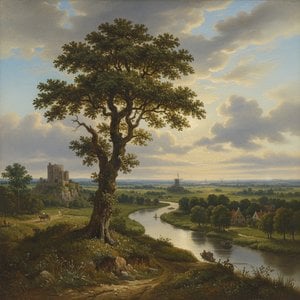
Monastic landscape
Розмір репродукції

Simon Johannes van Douw was a Flemish painter and draughtsman whose career spanned several significant cities. While his exact place of birth remains unconfirmed, he was likely born in Antwerp, Belgium. He achieved status as a master in the Antwerp Guild of Saint Luke in 1655, and by 1656, he had married Johanna Soolmaeckers. His professional journey took him from Antwerp to Middelburg, where he became a member of the Guild of Saint Luke in 1656, and later to Rotterdam, where he was recorded as a burgher and painter. His activity in Rotterdam and Antwerp appears to have overlapped during the latter part of his life, with his last documented work dating from 1677.
The oeuvre of Simon Johannes van Douw is characterized by a diverse range of subjects, evolving throughout his career. His early works focused on cavalry skirmishes and battles, often adhering to the cabinet painting tradition through the use of atmospheric palettes and stage-like settings. As his style progressed, he turned his attention toward:
He was particularly noted for his accurate and lively depictions of animals, especially horses. His imaginary landscapes often featured numerous figures engaged in various activities, such as herding flocks or trading in a market scene. His human figures were frequently depicted with plump, round faces.

1630 - 1677 , Belgium

Explore the groundbreaking art of Antonello da Messina, a pivotal figure of the Renaissance. Discover his innovative oil painting techniques, captivating portraits, and lasting influence on Italian masters. Learn more at WahooArt.

Explore the history of serene landscape art & discover artists who evoke tranquility. Find the perfect calming artwork for your home with expert guidance from WahooArt.

Explore the evolution of landscape art from Constable to Impressionism with expert historical insight. Trace the history of nature on canvas.

Explore 25 iconic works from Museum Boijmans Van Beuningen, from Van Gogh to Dalí. Discover all masterpieces on WahooArt.com.
Explore the life & work of Jacob van Ruisdael, the preeminent Dutch landscape painter. Discover his technical brilliance, symbolic depth, and lasting influence on art history. Learn about collecting Ruisdael's masterpieces.
 Переглянути в інтер'єрі

 Надіслати як листівку
 Поділитися
 Деталі витвору
 Посібник


 Завантажити
 Схожі екземпляри
 Рентгенівське дослідження
 Слайд-шоу
 Питання та відповіді

 Статистика

 Розгорнути текст






































 Скляний варіант доступний лише для розмірів до 110 см


