A Submerged World: Exploring Max Ernst’s Dreamlike Composition
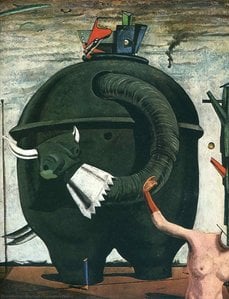
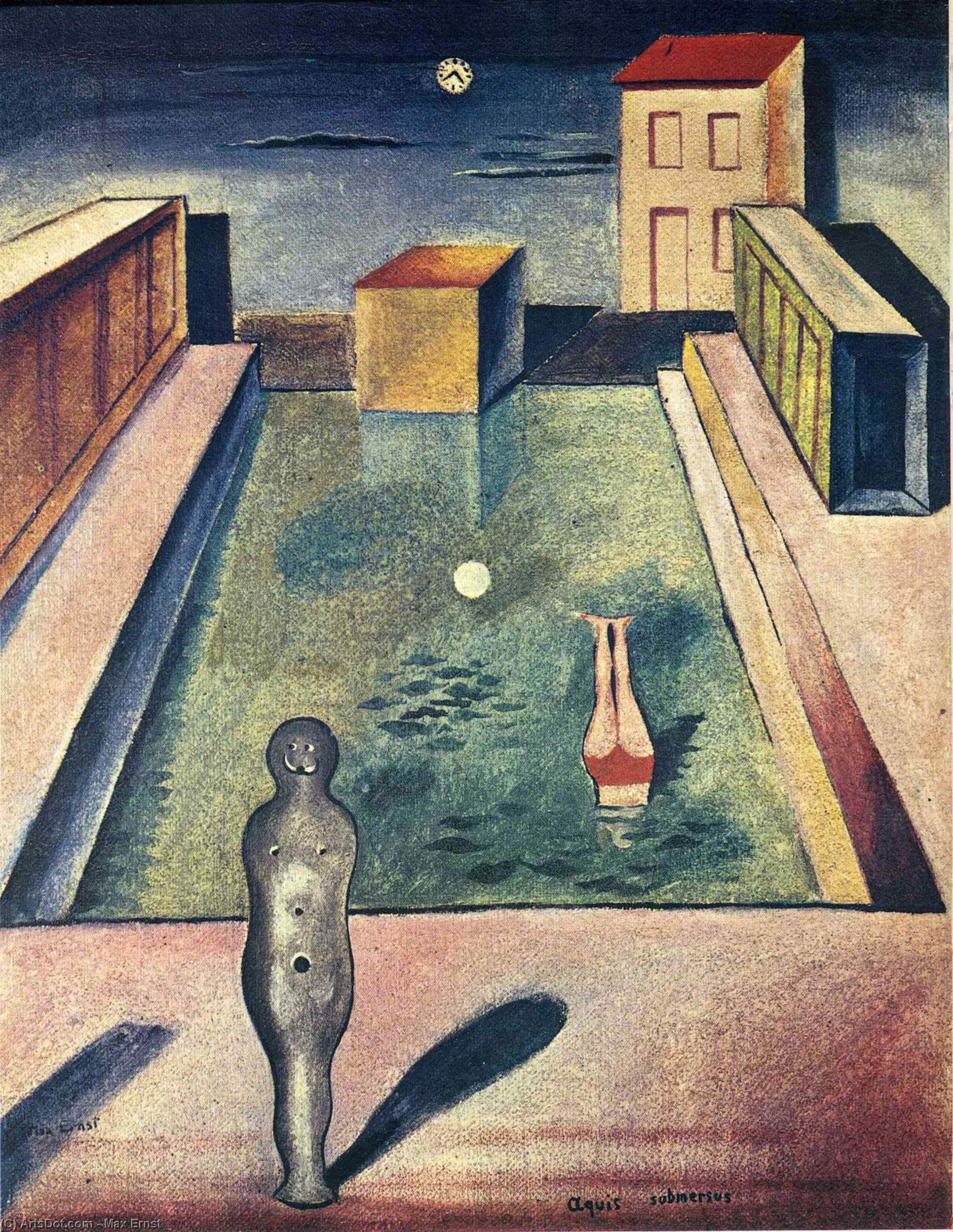
This untitled work by Max Ernst, created sometime during his prolific career, presents a captivating and unsettling scene – a solitary figure submerged within the confines of a geometrically defined pool. The painting is a quintessential example of Ernst's contribution to Surrealism, inviting viewers into a realm where logic dissolves and the subconscious takes form.
Style & Technique: Echoes of Surrealism
Ernst’s style in this piece clearly aligns with the core tenets of Surrealism, a movement he helped pioneer alongside André Breton and Salvador Dalí. The artwork shares stylistic affinities with Giorgio de Chirico's *pittura metafisica*, particularly in its use of stark architectural forms and unsettling spatial arrangements.
Oil paint is employed with visible brushstrokes, creating a textured surface that adds to the dreamlike quality. The simplified shapes and bold lines contribute to an overall sense of artificiality, distancing the scene from reality and emphasizing its symbolic weight.
Subject & Composition: Isolation and Introspection
The composition is dominated by strong geometric elements – the rectangular pool, rigid walls, and a distant building – creating a feeling of enclosure and constraint. The submerged figure, rendered in warm yellows and ochres against a cool blue-green palette, immediately draws the eye. This contrast highlights the figure’s vulnerability and isolation. The flattened perspective further enhances this sense of detachment, preventing the viewer from fully entering the depicted space.
The scene isn't about depicting a literal event but rather evoking an emotional state.
Symbolism & Interpretation: Diving into the Subconscious
The symbolism within the painting is rich and open to interpretation. The pool itself can be seen as representing the subconscious mind – a deep, often murky realm containing hidden thoughts and emotions. The submerged figure may symbolize vulnerability, isolation, or even a descent into psychological depths. Is it drowning? Is it peaceful submersion? Ernst leaves these questions unanswered, allowing viewers to project their own interpretations onto the work.
- The geometric forms suggest an artificial construct, perhaps representing societal constraints.
- The contrast between warm and cool colors could symbolize a conflict between consciousness and the subconscious.
- The figure’s ambiguous state invites contemplation on themes of mortality and existential angst.
Historical Context: A Pioneer of Avant-Garde Art
Max Ernst (1891-1976) was a German-born artist who played a pivotal role in the development of both Dadaism and Surrealism. His artistic journey was marked by experimentation with various techniques, including frottage and collage, all aimed at unlocking the creative potential of the unconscious mind. Ernst’s work often reflected his personal experiences – particularly the trauma of World War I – and his fascination with psychology and mythology. This painting exemplifies his ability to translate complex psychological themes into visually arresting imagery. His works are held in major museums worldwide, including The Menil Collection in Houston and Museum Folkwang in Essen, Germany.
Emotional Impact & Aesthetic Appeal
“untitled (8299)” evokes a sense of quiet contemplation and melancholic beauty. It’s a work that lingers in the mind long after viewing, prompting introspection and inviting multiple interpretations. Its muted color palette and dreamlike atmosphere make it a compelling addition to any collection, particularly for those drawn to Surrealist aesthetics or seeking artwork with psychological depth. The painting's geometric precision combined with its emotional resonance also makes it an intriguing choice for modern interiors, adding a touch of sophisticated mystery to any space.



 Замовити друк
 Надіслати
 Поділитися
 Деталі

 Завантажити
 Схожі вироби
 Рентгенівське дослідження
 Слайд-шоу

 Розгорнути текст






































 Скляний варіант доступний лише для розмірів до 110 см