Переглянути в інтер'єріПереглянути в інтер'єрі Перегляд в ARПерегляд в AR Перейти до друку Перейти до друкуЗамовити репродукцію ручної роботи Замовити репродукцію ручної роботи Надіслати як листівкуНадіслати як листівку
ДетальнішеДетальніше Додати до улюблених Додати до улюблених ЗавантажитиЗавантажити Схожі експонатиСхожі експонати Рентгенівське дослідженняРентгенівське дослідження Слайд-шоуСлайд-шоу СтатистикаСтатистика

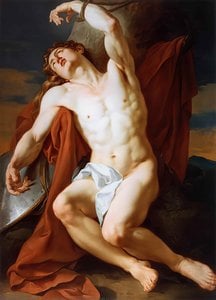
St Sebastian

Experience the dramatic intensity of Mattia Preti’s 1660 masterpiece, St Sebastian, a quintessential Baroque painting showcasing suffering and faith through masterful chiaroscuro and realistic detail – discover this iconic artwork or commission a hand-painted reproduction.

Маттіа Преті – видатний італійський художник епохи бароко, відомий своїми драматичними фресками та експресивним стилем. Його твори, зокрема в Соборі Святого Іоанна в Валетті, вражають динамікою та емоційним навантаженням, демонструючи його майстерність у передачі світла та тіні.

Придбайте цифрову копію високої роздільної здатності з покращеною якістю, що значно перевершує онлайн-перегляд.

Кожен файл ретельно підготовлений нашими фахівцями за допомогою сучасних інструментів та професійної ручної ретуші. Ми гарантуємо виняткову чіткість, точну передачу кольору та високу деталізацію кожного зображення.

Фінальний файл надсилається електронною поштою протягом 72 годин і оптимізований для негайного використання у професійних виданнях та друкованих матеріалах. Таку якість обирають провідні дизайнерські студії, видавництва та галереї.

Цифрове зображення

Завантажте файл високої роздільної здатності для особистого використання, друку та творчих проєктів. (Перейти до друку Перейти до друкуЗамовити репродукцію ручної роботи Замовити репродукцію ручної роботи)

Підсумкова вартість

$ 24,90

Переваги кожного замовлення цифрових зображень

Експертна цифрова доставка з гарантією якості

Обираючи WahooArt.com, ви отримуєте не просто зображення — ви отримуєте професійно вдосконалений цифровий витвір мистецтва, створений з надзвичайною точністю та підкріплений гарантією задоволення. Ось усе, що автоматично додається до вашого замовлення:

shipping_icon
Швидка доставка на email

Ваш цифровий файл із зображенням високої роздільної здатності буде надісланий вам електронною поштою протягом 72 годин після оформлення замовлення — він буде готовий до негайного використання.

canvas_icon
Цифровий файл із покращенням ШІ

Ваш витвір мистецтва професійно оптимізовано за допомогою передових інструментів штучного інтелекту та ручної корекції, що забезпечує максимальну деталізацію, чіткість і точність передачі кольорів.

insurance_icon
Безкоштовне повторне завантаження назавжди

Випадково видалили або втратили файл? Не хвилюйтеся — ми надішлемо його вам повторно в будь-який час безкоштовно.

tax_icon
Без митних зборів — ніколи

Насолоджуйтесь вашим витвором мистецтва миттєво без жодних мит, зборів або плати за доставку — цифрові завантаження завжди не оподатковуються.

color_icon
Гарантія точності кольорів

Ми гарантуємо максимально точне відтворення оригінальних кольорів на вашому цифровому зображенні завдяки використанню професійних інструментів та систем управління кольором.

return_icon
100-денна гарантія задоволення

Якщо ви не задоволені придбаним цифровим зображенням, ми внесемо правки або повернемо 100% вартості протягом 100 днів — без зайвих запитань.

guarantee_icon
Гарантія повернення 100% коштів

Незадоволені покупкою? Отримайте повне повернення коштів протягом 100 днів після отримання цифрового файлу — без зайвих запитань.

discount_icon
Знижки на оптові замовлення

Купуйте 3 зображення — заощаджуйте 10% — Купуйте 5 — заощаджуйте 15% — Купуйте 10+ — заощаджуйте 20%. Чудово підходить для творчих проєктів, галерей та агентств.

Основна інформація

  • Artistic style: Realistic, detailed
  • Movement: Baroque
  • Notable elements: Chiaroscuro, realism
  • Subject or theme: Martyrdom of Sebastian
  • Artist: Mattia Preti
  • Year: 1660

A Study in Suffering: Mattia Preti’s St Sebastian

Mattia Preti's "St Sebastian" (c. 1660) is not merely a depiction of a biblical martyr; it’s a profoundly moving exploration of human suffering and faith, rendered with the dramatic intensity characteristic of the Calabrian Knight himself. This painting, showcasing St. Sebastian’s agonizing martyrdom – his imprisonment and self-flagellation after being shot with arrows – immediately draws the viewer into a world of palpable anguish. Preti, deeply influenced by Caravaggio's masterful use of *chiaroscuro*, employs this technique to devastating effect, sculpting the figure’s muscular form from pools of deep shadow while simultaneously illuminating his exposed flesh and contorted expression. The ropes and chains binding him to the post are not simply restraints; they become extensions of his torment, emphasizing his vulnerability against a backdrop of brutal reality.

Baroque Drama and Calabrian Roots

Born in Taverna, Calabria, in 1613, Mattia Preti’s artistic development was inextricably linked to the vibrant Baroque movement sweeping through Italy. His early training under Giovanni Battista Caracciolo provided a crucial foundation, introducing him to the Caravaggist style – a commitment to realism, dramatic lighting, and emotionally charged narratives. This influence is powerfully evident in “St Sebastian,” where Preti doesn’t shy away from depicting the raw physicality of suffering. The subdued color palette—earth tones dominate—contributes significantly to the painting's somber mood, amplifying the sense of despair and isolation. Preti’s time spent in Rome further solidified his artistic vision, allowing him to absorb the lessons of Caravaggio and Guercino before ultimately establishing himself as a leading figure in Malta, where he would spend much of his career.

Symbolism of Pain and Redemption

The iconography surrounding St. Sebastian is rich with symbolic meaning. He was martyred for refusing to worship pagan gods, representing unwavering faith against worldly temptations. The arrows piercing his body are a potent symbol of suffering and sacrifice, while the ropes and chains represent earthly bonds that cannot contain the spirit. Preti’s skillful rendering of these elements elevates the painting beyond a simple historical narrative; it becomes a meditation on human endurance and the promise of redemption. The figure's raised arms, though clearly in agony, also suggest a plea for divine intervention – a desperate reaching out to a higher power amidst unimaginable pain.

Technical Mastery and Emotional Resonance

“St Sebastian” exemplifies Preti’s technical brilliance and his ability to translate complex emotions onto canvas. The meticulous detail of the figure's anatomy, combined with the dramatic use of light and shadow, creates an incredibly realistic and emotionally resonant image. The artist’s attention to texture – from the rough grain of the wood to the tautness of Sebastian’s muscles – adds another layer of depth and intensity. This painting is a testament to Preti's mastery of Baroque technique, resulting in a work that continues to captivate viewers with its raw emotion and enduring power. It remains a cornerstone of his oeuvre, showcasing his profound understanding of human suffering and his ability to evoke powerful responses through masterful artistic execution.


Біографія митця

Mattia Preti: A Calabrian Knight of the Baroque

Mattia Preti, known as *Il Cavalier Calabrese* – the Calabrian Knight – stands as a pivotal figure in 17th-century Italian Baroque painting. Born in Taverna, Calabria, on February 24, 1613, his artistic journey was one of dynamic evolution, absorbing diverse influences and culminating in a uniquely expressive style that left an indelible mark on the art world, particularly in Malta where he would spend much of his later life. Preti’s early training began under Giovanni Battista Caracciolo, a painter deeply rooted in the Caravaggist movement. This foundational exposure instilled within him a profound understanding of dramatic chiaroscuro – the intense interplay of light and shadow – and a commitment to realistic depiction that would remain hallmarks of his work throughout his career. Before 1630, he joined his brother Gregorio in Rome, immersing himself in the artistic ferment of the city and studying the masters who defined the era: Caravaggio, Guercino, Rubens, Guido Reni, and Giovanni Lanfranco. This period was crucial, shaping not only his technical skills but also his aesthetic sensibilities.

Early Influences and Roman Development

Preti’s early artistic development wasn't merely imitation; it was a synthesis of influences, skillfully woven into a style distinctly his own. While initially steeped in Caravaggism – particularly the dramatic use of tenebrism and dynamic figures – he gradually moved beyond its strict confines, embracing the dynamism and emotional intensity that characterized the High Baroque. His time in Rome allowed him to study not only Caravaggio’s techniques but also those of other masters who shaped the artistic landscape of the era. He absorbed elements from Guercino's expressive brushwork, Rubens’ opulent color palettes, and Reni’s graceful compositions. This period was marked by a growing confidence and experimentation, as Preti began to develop his own unique visual language. He wasn’t simply copying his predecessors; he was learning from them, adapting their techniques to suit his own artistic vision. His early works in Rome, such as frescoes in the churches of Sant’Andrea della Valle and San Carlo ai Catinari, demonstrated an aptitude for large-scale decorative painting and a willingness to push the boundaries of traditional Baroque style.

A Style Forged in Naples

Forging a Dynamic Style Preti’s artistic development wasn't merely imitation; it was a synthesis of influences, skillfully woven into a style distinctly his own. While initially steeped in Caravaggism, he gradually moved beyond its strict confines, embracing the dynamism and emotional intensity that characterized the High Baroque. His time in Naples further refined this evolution, exposing him to the vibrant work of Luca Giordano. This period saw Preti’s canvases swell with energetic movement, complex compositions, and a heightened sense of drama. He masterfully employed dramatic contrasts of light and shadow, inherited from Caravaggio, not simply as a technical device but as a means of intensifying emotional impact and guiding the viewer's eye. His figures are imbued with palpable emotion, conveyed through expressive faces and dynamic body language. This ability to evoke powerful feelings – piety, anguish, ecstasy – became a defining characteristic of his oeuvre. He wasn’t content merely to depict scenes; he sought to *animate* them, breathing life into biblical narratives and religious iconography.

Major Works and Commissions

Throughout his career, Preti received numerous commissions that showcased his versatility and artistic skill. He created impressive fresco cycles for Roman churches, demonstrating an aptitude for large-scale decorative painting. Some of his most ambitious – though sadly lost – works were the frescoes he painted on seven city gates in Naples depicting the Virgin or saints delivering people from the plague. Though only sketches remain today, they testify to the scale and impact of these monumental creations. These commissions weren’t simply about fulfilling a patron's request; they were opportunities for Preti to engage with the religious and cultural life of the communities he served, imbuing his art with meaning and purpose. His work at St. John’s Co-Cathedral in Valletta, however, stands as his most significant achievement – a testament to his artistic genius and unwavering dedication to the Baroque aesthetic.

The Maltese Zenith: St. John’s Co-Cathedral

It was in Malta, however, that Mattia Preti reached the pinnacle of his artistic achievement. Appointed a Knight of the Order of Saint John in 1660, he embarked on a transformative project: the complete redecoration of the interior of St. John’s Co-Cathedral in Valletta. This undertaking – arguably his most significant legacy – involved an astonishing series of paintings depicting the life and martyrdom of Saint John the Baptist. The sheer scale of the project is breathtaking; Preti essentially created a visual narrative that enveloped the viewer, immersing them in the story of the saint. The opulent Baroque setting provided the perfect canvas for his dramatic style, and the resulting artwork cemented his reputation as one of Europe’s leading painters. His work at St. John's wasn't merely decorative; it was an act of devotion, a testament to his faith, and a powerful expression of the Order’s religious identity.

A Lasting Legacy

Mattia Preti continued to receive commissions from across Europe following his success in Malta, solidifying his position as a leading figure in Italian Baroque art. He died in 1699, leaving behind a rich artistic legacy that continues to inspire and captivate audiences today. His masterful use of light and shadow, dynamic compositions, and ability to convey intense emotion remain hallmarks of his style. His contributions are preserved in museums such as the Capodimonte Museum in Naples, and through reproductions made available by platforms like WahooArt.com, ensuring that his art continues to reach new generations. The enduring impact of Preti’s work is perhaps most vividly felt within the walls of St. John's Co-Cathedral, a breathtaking testament to his artistic genius and unwavering dedication to the Baroque aesthetic. *Il Cavalier Calabrese* truly earned his title, not only as a knight but as a master painter who illuminated the world with his vision.

Useful Links

Useful Content

  • Mattia Preti - Wikipedia: (See link above)

Маттіа Преті

Маттіа Преті

1613 - 1699 , Італія

Основна інформація

  • Artistic Movement Or Style: Бароко
  • Artists Or Movements Influenced By This Artist:
    • Карвавхізм
    • Бароко
  • Artists Who Influenced This Artist:
    • Караваджо
    • Гуерчіно
    • Рубенс
  • Date Of Birth: 24 лютий 1613
  • Date Of Death: 3 січня 1699
  • Full Name: Mattia Preti
  • Nationality: Італійський
  • Notable Artworks:
    • Тributo di Dio
    • Giuditta e Oloferne
    • San Giovanni Battista
  • Place Of Birth: Тaverна, Італія