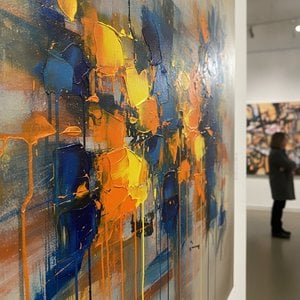
The Alchemy of Material: The Artistic Journey of Marco Gastini
Born in the industrial heart of Turin, Italy, in 1938, Marco Gastini developed an artistic sensibility that was deeply rooted in the tactile reality of physical matter. His early years were defined by a formative apprenticeship within his father’s laboratory, a period that served as more than mere vocational training; it was a profound introduction to the transformative potential of raw materials. This foundational exposure instilled in him a lifelong reverence for the chemical and structural properties of his medium, allowing him to view the canvas not as a passive surface, but as a site of alchemical change. As he emerged into the Italian art scene, Gastini sought to break free from the prevailing artistic stagnation of his era, moving away from traditional representation toward a language of minimal gestures and analytical traces that resonated with the burgeoning minimalist movements of the time.
As his career progressed into the mid-1emb1970s, Gastini’s vision underwent a radical evolution, propelling him toward techniques that challenged the very definition of painting. He began to distance himself from conventional practices, famously embracing unconventional materials such as wood shavings, plaster, and burlap. For Gastini, these elements were never merely supports for pigment; they were active participants in a complex dialogue with the painted surface. By integrating these textures, he created a spatial interplay that expanded the conceptual realm of his work, inviting viewers to move beyond mere visual perception and into a deeper, more contemplative mental space. His art became an exploration of layers, where the physical weight of the material met the ethereal lightness of thought.
A Symphony of Texture and Light
The brilliance of Gastini’s technique lies in his meticulous, almost scientific approach to the behavior of light and color. Influenced by the rigorous minimalism of Robert Ryman and the conceptual depth of Yves Klein, he dedicated himself to studying how pigments interact with textured surfaces under varying conditions. This dedication allowed him to orchestrate subtle shifts in form that could captivate the viewer’s gaze through the interplay of shadow and brilliance. In his most evocative works, such as Sentieri Do Do, one can witness this mastery firsthand:
- The Palette of Shadows: A deliberate use of limited colors—mother of pearl, deep black, and midnight blue—to create a sense of infinite depth.
- Material Contrast: The integration of physical elements like slices of slate or terracotta to ground the composition in reality.
- Graphic Precision: The use of scarce, floating lines and smudges that seem to drift through an expansive, atmospheric space.
- Kinetic Energy: A method of directing the viewer’s eye rapidly from one textured zone to another, simulating an expanding, living composition.
Through this careful orchestration, Gastini achieved a rare feat in contemporary art: he imbued heavy, tactile materials with a sense of profound lightness and poetic grace. His work remains a testament to the idea that painting can transcend the two-dimensional plane, becoming a multidimensional experience that captures both the physical essence of the world and the intangible complexities of human emotion.



 Переглянути в інтер'єрі
 Купити картину ручної роботи
 Надіслати
 Поділитися
 Деталі
 Посібник

 Завантажити
 Схожі предмети колекціонування
 Рентгенівське дослідження
 Слайд-шоу
 Статистика переглядів


 Читати далі






































 Скляний варіант доступний лише для розмірів до 110 см




![Abstract Composition [triptych] — Vaclav Vytlacil, Abstract Expressionism](/media/artworks/images-thumb/08/3c/083c0675045645fd42d4e6c6d63f1ced.jpg)