БЕЗКОШТОВНА КОНСУЛЬТАЦІЯ З МИСТЕЦТВА


x


 Замовити друк Купити цифрове зображення
 Надіслати
 Details
 Додати до улюблених
 Завантажити
 Схожі вироби
 X-Ray
X-Ray
 Слайд-шоу
 Олія на полотніНастінне мистецтвоNaive Art
 1910Раннє Середньовіччя
 62.0 x 51.0 cm
Написана вручну олією на полотні у вашому розмірі та рамі, виготовлена на замовлення нашими художниками.





























Обирайте з наших стандартних розмірів, що відповідають оригінальним пропорціям твору мистецтва.

Ви можете вказати власні розміри, щоб репродукція підійшла до конкретної рами або інтер'єру. Якщо вибраний вами розмір не відповідає пропорціям оригіналу, ми або обріжемо полотно, або доповнимо картину додатковими елементами, промальованими вручну. Цифровий макет буде надіслано вам на затвердження перед початком виробництва.
Зверніть увагу, що попередній перегляд на екрані не відображає фактичне обрізання або розширення зображення. Тільки макет точно покаже остаточну композицію.
Хоча ми можемо виготовити виріб у нестандартному розмірі, для збереження оригінальних пропорцій рекомендуємо обирати варіанти зі встановленого списку.
Доставка по всьому світу () за 3–4 тижні замість стандартних 5 тижнів. (1 Липень). Без жодних компромісів у якості.


The Model
Розмір репродукції
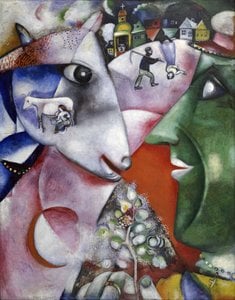
Marc Chagall's "The Model," painted in 1910, isn’t merely a depiction of a woman seated before a piano; it’s an immersion into a world where reality and fantasy intertwine with breathtaking fluidity. This oil on canvas, measuring just 62 x 51 cm, embodies the very essence of Naïve Art – or Primitivism as it was often termed – a style that prioritizes emotional expression over meticulous realism. Chagall, already a rising star in the Parisian art scene, had returned to his roots in Vitebsk, Belarus, bringing with him the vibrant folklore and deeply personal memories of his childhood. “The Model” is a testament to this return, a visual poem steeped in the rhythms of Eastern European life and infused with the artist’s uniquely dreamlike sensibility.
The painting immediately draws the eye to its central figure – a woman radiating an almost ethereal quality. She occupies a simple chair, her posture relaxed yet poised as she appears to play the piano. The scene unfolds against a backdrop of familiar domesticity: several chairs and a couch suggest a comfortable, lived-in space, while two other figures—a man standing behind her and another partially obscured at the right – add layers of narrative without explicitly defining their roles. This deliberate ambiguity is characteristic of Chagall’s work; he rarely offers easy answers, preferring to invite the viewer into a world where meaning emerges from suggestion and feeling.
Chagall's embrace of Naïve Art is evident in every brushstroke. The painting’s style eschews traditional perspective and shading, opting instead for bold colors, simplified forms, and a direct, unmediated approach to representation. This isn’t an attempt to mimic the technical skill of academic painters; rather, it’s a deliberate rejection of convention in favor of conveying raw emotion and immediate experience. The Naïve Art movement, as explored on platforms like WahooArt.com, is defined by artists who lack formal training, relying instead on intuition and an intensely personal vision. Chagall perfectly embodies this spirit, creating images that feel both deeply familiar and utterly otherworldly.
Notice the vibrant hues – the rich blues of the piano’s surface, the warm yellows of the woman's dress, and the deep reds of the surrounding furniture. These colors aren’t blended or muted; they are applied with a directness that mirrors the artist’s emotional state. The composition itself is deliberately unbalanced, creating a sense of dynamism and movement. The figures seem to float within the space, further enhancing the painting's dreamlike quality. It’s as if Chagall has captured a fleeting moment of memory—a cherished scene imbued with nostalgia and longing.
Beyond its immediate visual appeal, “The Model” is rich in symbolic meaning. The piano itself can be interpreted as a symbol of creativity, communication, and perhaps even melancholy – an instrument that invites both expression and introspection. The woman’s posture suggests a quiet contemplation, while the presence of the other figures hints at a complex relationship—one filled with affection, mystery, and possibly unspoken desires. Considering Chagall's upbringing in Vitebsk, a city brimming with cultural diversity and religious traditions, it’s not surprising that his work is populated by recurring motifs drawn from Jewish folklore and Eastern European life.
The painting’s overall effect is profoundly moving. “The Model” isn’t simply a portrait; it's an invitation to step into Chagall’s world—a world where dreams and reality blur, where beauty resides in simplicity, and where the most profound emotions can be expressed with remarkable directness. High-quality reproductions of this captivating artwork, meticulously crafted by WahooArt.com and similar platforms, allow you to experience the full power of Chagall's vision.


1887 - 1985 , Білорусь

Explore the fascinating evolution of light & color in art history! Discover Impressionism, Neo-Impressionism & beyond with expert insights for collectors and enthusiasts. Learn about Seurat's techniques & the psychology of color.

Пориньте у світ імпресіонізму! Відкрийте 10 культових картин Моне, Ренуара та Дега. Історія мистецтва, кольори та техніка – все для натхнення вашого дому. Репродукції музейної якості на WahooArt.com.
Відкрийте для себе 10 легендарних шедеврів олійного живопису від Ван Гога, Моне та інших видатних художників! Історія мистецтва, техніки та натхнення для вашого дому. Купуйте репродукції картин преміум-якості на WahooArt.com

Explore the revolutionary world of Naïve Art & Primitivism! Discover how artists challenged academic traditions with raw emotion & unique styles. Learn about Picasso, Rousseau & more at WahooArt.

Transform cherished photos into timeless oil paintings with skilled artists. Trusted for bespoke portraits & heirloom art. Discover the process, styles & lasting value – a legacy preserved.


Будьте в курсі останніх новин зі світу мистецтва, ексклюзивних пропозицій та ідей для декорування.
Розкажіть нам про свій проєкт, і наші експерти з мистецтва підготують для вас 3 персоналізовані пропозиції щодо творів мистецтва.
Дозвольте нам підібрати 3 варіанти спеціально для вас — безкоштовно!
 Поділитися








 Читати далі
 Скляний варіант доступний лише для розмірів до 110 см