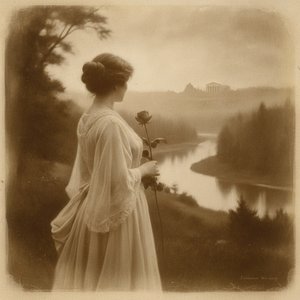
A Life Illuminated by Shadows
Emmanuel Radnitzky, a name forever intertwined with the enigmatic “Man Ray,” was born in Philadelphia in 1890 to Russian Jewish immigrant parents. His early life, steeped in the vibrant energy of New York City, proved formative, exposing him to the burgeoning modernist scene and instilling within him a lifelong fascination with experimentation – a restless spirit determined to forge an identity unbound by convention. The shift from “Manny” Radnitzky to the iconic Man Ray wasn’t merely a pseudonym; it represented a deliberate assertion of artistic independence, a rejection of societal expectations, and a commitment to exploring uncharted creative territories. His family's move to New York City proved pivotal, immersing him in the avant-garde circles that would shape his artistic trajectory. Early influences included the European modernist movements showcased at Alfred Stieglitz’s 291 gallery – a space that served as a crucial incubator for radical ideas and a gateway to a world of artistic innovation. Simultaneously, he absorbed the gritty realism of the Ashcan School, a distinctly American movement capturing the raw energy and social realities of urban life. This potent combination—European sophistication and American grit—would subtly inform his later work, creating a unique visual language characterized by both elegance and unflinching honesty.
Dada, Surrealism, and the Pursuit of the Impossible
Man Ray’s artistic journey took an extraordinary turn with his encounter with Marcel Duchamp in New York around 1915. This meeting ignited a shared rebellion against established artistic norms, leading to explorations of “ready-mades”—ordinary manufactured objects elevated to the status of art – a concept that fundamentally challenged traditional notions of creativity and authorship. This radical spirit propelled Ray into the heart of the Dada movement, an anti-art protest born from the disillusionment following World War I. Dada artists sought to dismantle conventional values, questioning everything from aesthetics to morality. Man Ray embraced this ethos wholeheartedly, participating in numerous Dada gatherings and exhibitions, contributing to a climate of irreverence and iconoclasm. He quickly became associated with the Surrealist movement shortly after, drawn by its exploration of the subconscious mind, dreams, and the irrational. The Surrealists sought to liberate art from the constraints of reason and logic, embracing chance, automatism, and the power of the imagination. Man Ray’s work during this period reflects these influences—a dreamlike quality infused with a sense of mystery and unease. He wasn't interested in simply representing reality; he aimed to capture its essence – its hidden emotions, its unspoken desires, its fragmented nature. His collaborations with other Surrealist artists, such as Salvador Dalí, further solidified his position within the movement, though he always maintained a distinct artistic voice.
Rayographs and the Alchemy of Light
Perhaps Man Ray is most renowned for his invention of the “rayograph,” a groundbreaking technique that fundamentally altered the possibilities of photography. Almost by accident, while experimenting with light and objects, he discovered a method of creating images without using a camera lens. He would place objects – anything from fruit to shoes to portraits – directly onto light-sensitive paper and expose them to light, often utilizing a small electric lamp. The resulting photographs—known as rayographs—were ethereal, ghostly, and utterly unlike traditional photographic representations. The key wasn’t simply the absence of a camera; it was the way in which Ray manipulated light itself. He treated the photograph not as a record of reality but as an artistic medium, capable of evoking mood, emotion, and suggestion. The rayograph wasn't merely an alternative method; it was a philosophical statement about the nature of photography—a rejection of objectivity and an embrace of subjectivity. These images possessed a unique beauty, a sense of mystery that captivated audiences and inspired countless artists. Beyond rayographs, Man Ray’s photographic portraits – particularly those of his contemporaries like Lee Miller – are celebrated for their striking compositions and psychological depth. He experimented relentlessly with solarization—a technique that reverses the tones of a photograph, creating dramatic contrasts and an otherworldly effect—and multiple exposures, pushing the boundaries of what photography could achieve. His innovative approach to portraiture revealed not just physical likenesses but also glimpses into the inner lives of his subjects.
Beyond Stillness: Film and a Lasting Legacy
Man Ray’s artistic curiosity extended beyond still images into the realm of filmmaking. Recognizing the potential for experimentation, he ventured into the world of cinema, producing a series of groundbreaking films that defied conventional narrative structures and embraced surreal imagery. His early experimental films, such as *Le Retour à la Raison* (1923) and *L'Étoile de Mer* (1928), were characterized by their dreamlike sequences, unconventional editing techniques, and a deliberate rejection of traditional storytelling. These weren’t stories told in a linear fashion; they were visual poems— explorations of form, rhythm, and the subconscious. He employed innovative techniques like stop-motion animation and superimposition to create disorienting and mesmerizing effects, challenging viewers' perceptions of reality. While his film work remained relatively small in scale compared to his photography, it was profoundly influential on subsequent generations of avant-garde filmmakers—demonstrating Man Ray’s commitment to pushing the boundaries of artistic expression across multiple mediums. His legacy extends far beyond his own lifetime, continuing to inspire artists and audiences today.
A Continuing Influence
- Photography: Man Ray's techniques, particularly rayography and solarization, continue to be explored by contemporary photographers seeking innovative ways to manipulate light and create evocative images.
- Surrealism: His contributions solidified the movement’s visual language and inspired countless artists across disciplines, influencing everything from painting and sculpture to literature and design.
- Experimental Film: His pioneering work in film laid the groundwork for future generations of avant-garde filmmakers, demonstrating a willingness to challenge conventional cinematic practices.
- Fashion Photography: Ray’s innovative approach to portraiture and composition influenced the development of modern fashion photography, emphasizing mood, atmosphere, and psychological depth.
Man Ray's impact resonates profoundly across various artistic fields, solidifying his position as a pivotal figure in 20th-century art. His unwavering commitment to experimentation, his rejection of convention, and his fearless pursuit of the impossible serve as an enduring inspiration for those who seek to push the boundaries of creative expression—a true pioneer whose work continues to challenge, provoke, and delight.



 Перейти до друку
 Надіслати
 Поділитися
 Деталі
 Посібник

 Завантажити
 Схожі предмети колекціонування
 Слайд-шоу
 Статистика переглядів

 Читати далі






































 Скляний варіант доступний лише для розмірів до 110 см